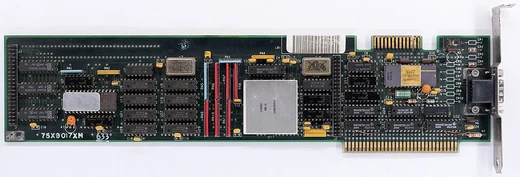
MOS Technology VIC
Video and sound chip for the Commodore VIC-20 home computer.

The MOS Technology VIC (Video Interface Chip), designated 6560 for NTSC and 6561 for PAL, is the integrated circuit responsible for generating video graphics and sound in the Commodore VIC-20 home computer. Originally designed in 1977 for low-cost CRT terminals, biomedical monitors, control system displays, and arcade or home video game consoles, it was later revised with features from other failed MOS video chips before being deployed in the VIC-20.
- Variants
- MOS Technology 6560 (NTSC), 6561 (PAL)
Lore & Background
The VIC was designed by Al Charpentier in 1977, but Commodore could not initially find a market for the chip. In 1979, MOS Technology began work on the 6564 for the TOI computer and the 6562 for a color version of the Commodore PET; both failed due to memory timing constraints requiring fast, expensive SRAM. Before the VIC was used in the VIC-20, chip designer Robert Yannes incorporated features from the 6562 (better sound generator) and 6564 (more colors) into the 6560, resulting in a thoroughly revised chip. The VIC features a 16 kB address space for screen, character, and color memory (only 5 kB points to RAM on the VIC-20 without modification), 16 colors (upper 8 limited to global background and auxiliary colors), two selectable character sizes (8×8 or 8×16 bits), and maximum video resolution depending on television system (176×184 standard for VIC-20 firmware, up to 248×232p/464i NTSC, up to 256×280 PAL). It includes a 4-channel sound system (3 square wave + white noise), on-chip DMA, two 8-bit analog-to-digital converter, and light pen support. Unlike many contemporary video circuits, it lacks dynamic RAM refresh, requiring the VIC-20 to use more expensive SRAM, likely explaining the machine's initial 5 KB RAM configuration. The VIC is programmed via 16 control registers memory-mapped to $9000–$900F. It does not have sprites or an all-points-addressable bitmap mode; programmable characters are the only way to create graphics and animation. A double-height character mode allows an effective bitmap mode of 160×192. The chip does not support scrolling or raster interrupts like the later VIC-II, but scanline counters could be polled for raster effects, rarely used except in titles like Imagic's Demon Attack.
Reader's Guide
The VIC's significance lies in its role as the video and sound heart of the VIC-20, one of Commodore's early home computers. Its design history reflects the challenges of the late 1970s video chip market: initial failure to find a market, followed by salvage and revision using features from other failed chips (6562 and 6564). The chip's lack of DRAM refresh forced the VIC-20 to use costly SRAM, limiting base RAM to 5 KB and shaping the machine's expandability. The VIC preceded the much more advanced VIC-II used in the Commodore 64 and C128. Its 16-color palette, 4-channel sound, and light pen support were notable for the era, though the absence of sprites and bitmap modes constrained graphics to character-based approaches. The chip's on-chip DMA and A/D converters for paddle input added versatility. The VIC's legacy is tied to the VIC-20's place as a popular introductory computer, with its video hardware defining the machine's capabilities and limitations.
Did You Know?
- The VIC was originally designed in 1977 for low-cost CRT terminals and arcade games, not for the VIC-20.
- The VIC lacks dynamic RAM refresh, so the VIC-20 used more expensive static RAM (SRAM).
- The VIC has no sprites or bitmap mode; all graphics are created using programmable characters.
- The VIC's sound system includes three square wave generators and one white noise channel.
More in Graphics Hardware, Part 2 1-24
Spotted an error? Know more?
Reader corrections go straight into our review queue. Suggest an edit · How this site is sourced