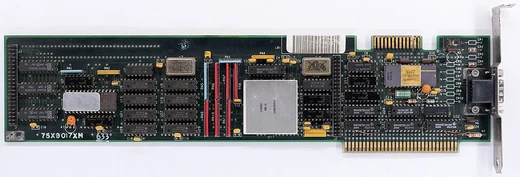
Matrox Mystique
Matrox's first consumer 3D card with strong 2D but limited 3D quality.

The Matrox Mystique is a 2D, 3D, and video accelerator card for personal computers, introduced in 1996. It was Matrox's first attempt to target the consumer gaming PC market, following the limited 3D capabilities of earlier cards like the Impression Plus and Millennium. The Mystique used a 64-bit SGRAM memory interface and an internal 170 MHz RAMDAC, offering strong 2D performance but lacking key 3D features such as bilinear filtering and mipmapping.
- Introduction year
- 1996
- Chip model
- MGA1064SG
- Memory type
- 64-bit SGRAM
- Memory configurations
- 2 MB to 8 MB
- Internal ramdac frequency
- 170 MHz
- Rendering api
- Matrox Simple Interface (MSI)
- Connector
- VGA
Lore & Background
Matrox had been a significant player in high-end 2D graphics acceleration, with the Millennium card released in 1995 being called 'the definitive 2D accelerator' by Next Generation. The company's earlier 3D efforts, the Impression Plus (1994) and Millennium, could only accelerate a very limited feature set and lacked hardware texture mapping. The Mystique was based heavily on the Millennium but with additions and cost-cutting measures, using cheaper SGRAM instead of WRAM. Its 2D performance was excellent, beating peers like the S3 ViRGE and ATI Mach64, especially at resolutions up to XGA 1024×768. However, the Mystique lacked bilinear filtering, fogging, anti-aliasing, and mipmapping, using nearest-neighbor interpolation and stippled textures, resulting in heavy pixelization and texture aliasing. Matrox reasoned that performance was more important than visual quality, and the Mystique did outperform other 2D/3D boards of the time, though its visual quality was lower. Detractors referred to it as the 'Matrox Mystake'.
Reader's Guide
The Mystique was notable as Matrox's most feature-rich 3D accelerator in 1997, yet it still lacked key features that limited its visual quality. Its 2D support rivaled the best cards available, making it a competent board for its era, but its questionable 3D visual quality led many users to pair it with a 3Dfx Voodoo Graphics board for better 3D performance. Driver support was robust at launch, covering MS-DOS, Windows 3.1x, Windows 95, Windows NT, and OS/2. The retail version included three game titles: MechWarrior 2 Mystique edition, Destruction Derby 2, and Scorched Planet. The Mystique 220, released in 1997, upgraded the RAMDAC to 220 MHz, matching the original Millennium for high-resolution support, but was otherwise identical. A business-oriented version, Mystique 220 Business, omitted the games. The memory and internal RAMDAC programming interface lived on in MGA-G100 and later processors until the introduction of Matrox Parhelia.
Did You Know?
- The Mystique used a 64-bit SGRAM memory interface instead of the more expensive WRAM used on the Matrox Millennium.
- Detractors referred to the Mystique as the 'Matrox Mystake'.
- The Mystique 220 Business version had identical hardware but excluded games from its software bundle.
More in Graphics Hardware, Part 2 1-24
Spotted an error? Know more?
Reader corrections go straight into our review queue. Suggest an edit · How this site is sourced