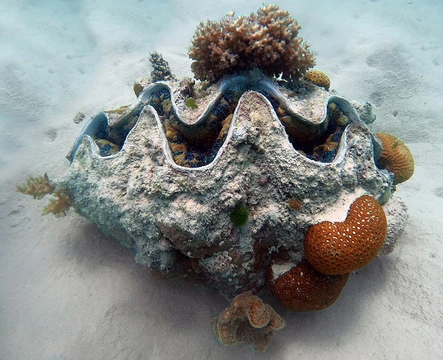
Tridacna squamosina
A giant clam with pronounced tooth-like shell formations and rare Red Sea presence.

Tridacna squamosina is a species of giant clam in the genus Tridacna, belonging to the family Cardiidae. It was originally identified by Sturany in 1899. In 2008, researchers proposed a new species called Tridacna costata, but in 2011, examination of Sturany's specimens revealed that the supposed new species was actually Tridacna squamosina, leading to the formal synonymization of Tridacna costata.
Quick Facts
- Genus
- Tridacna
- Species
- squamosina
Facts from the source article.
Lore & Background
Tridacna squamosina is a bivalve mollusk with an elongated shell bearing 5–7 folds on each valve. The upper shell has somewhat large tooth-like formations projecting from its outer edge. Even when compressed, major spaces remain between the two shell halves, especially near these tooth-like formations. The mollusk has a well-sized byssus on its bottom, similar to Tridacna maxima. Its papillose mantle tissue varies widely in hues and patterns; the papillae are much more pronounced than in Tridacna maxima or Tridacna squamosa, though those species may bear relatively few papillae. The siphon is ringed with tentacles, as in other giant clams.
The species is distributed across tropical areas of the Indo-Pacific, though originally thought to exist only in the Red Sea, where it is actually rare. It inhabits shallow reef areas and seagrass beds, usually 0–5 m below the surface. Tridacna squamosina is most concentrated around Oceania and Southeast Asia, especially the Philippines and the Malay Archipelago. It is also found in areas of the Red Sea. In 2005, a student found a giant clam in the Gulf of Aqaba; 19th-century expeditions had also collected specimens there and off the coast of modern-day Yemen, but those were taxonomically identified as Tridacna elongata with the variation squamosina. The species is reported to be abundant near the Bazaruto Archipelago off southern Mozambique. A survey showed T. squamosina makes up only 1% of all tridacnas in the Red Sea, making it a rarity there, yet it comprises 80% of all tridacnid fossils in the area, leading scientists to believe the species was heavily hunted nearly 100,000 years ago, when humans had only begun occupying the area.
Reader's Guide
Tridacna squamosina is notable for its taxonomic history: in 2008, Roa-Quiaoit, Kochzius, Jantzen, Zibdah & Richter identified what they believed was a new species called Tridacna costata. However, in 2011, Markus Huber and Anita Eschner examined a collection of Rudolf Sturany's specimens held in the Natural History Museum, Vienna, that had remained improperly identified for over 100 years. They discovered the specimens were actually Tridacna squamosina, leading to the formal acceptance of Tridacna squamosina and the synonymization of Tridacna costata. The species is physically distinguished by its elongated shell with 5–7 folds, large tooth-like projections, and pronounced papillae on the mantle. Ecologically, it is rare in the Red Sea (only 1% of local tridacnas) but dominates the fossil record there (80% of tridacnid fossils), suggesting heavy human hunting nearly 100,000 years ago. Its distribution spans the Indo-Pacific, with highest concentrations in Oceania, Southeast Asia, the Philippines, and the Malay Archipelago, and it is also abundant near the Bazaruto Archipelago off Mozambique. The species inhabits shallow reefs and seagrass beds at depths of 0–5 meters.
Did You Know?
- Tridacna squamosina was originally described by Sturany in 1899.
- In 2011, Markus Huber and Anita Eschner identified seven syntypes of Tridacna squamosina in the Natural History Museum, Vienna, leading to the synonymization of Tridacna costata.
- The species makes up only 1% of all tridacnas in the Red Sea but 80% of local tridacnid fossils.
- Tridacna squamosina has 5–7 folds on each shell and pronounced tooth-like formations on the upper shell.
More in Giant Clams and Marine Bivalves 1-24
Spotted an error? Know more?
Reader corrections go straight into our review queue. Suggest an edit · How this site is sourced