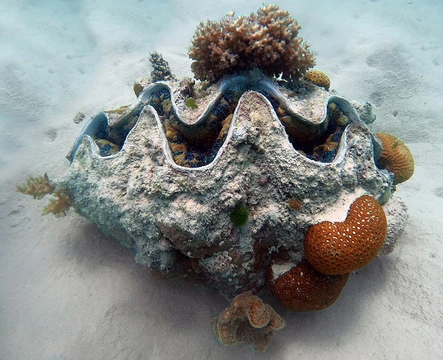
Tridacninae
Subfamily of very large saltwater clams in the family Cardiidae.

Tridacninae, called giant clams, are a subgroup of very large saltwater clams. These marine bivalve mollusks belong to the family Cardiidae, which also includes cockles. Among them is the largest living bivalve, *Tridacna gigas*. Their shells are heavy and have four to six folds. The mantle is often vividly colored. They live on coral reefs in warm Indo-Pacific seas. Most species have a symbiotic relationship with photosynthetic dinoflagellates, or zooxanthellae, a form of photosymbiosis.
Sometimes giant clams are still placed in their own family, Tridacnidae, but modern genetic studies put them within Cardiidae as a subfamily. There are two living genera: *Hippopus* (two species) and *Tridacna* (ten species). Genetic evidence shows these two groups are monophyletic sister taxa.
Humans farm smaller giant clams in places like the Philippines for the marine aquarium trade and for food markets in East Asia. All Tridacninae species are listed under CITES Appendix II, meaning international trade requires permits.
The group first appeared in Western Europe during the Eocene, spread east to Arabia by the Oligocene, and reached its current Indo-Pacific range during the Pliocene and Pleistocene.
Quick Facts
- Taxon
- Tridacninae
Facts from the source article.
Lore & Background
Tridacninae originated in Western Europe during the Eocene, expanding eastwards towards Arabia by the Oligocene, and becoming established in its modern distribution in the Indo-Pacific during the Pliocene-Pleistocene. They have heavy shells, fluted with 4–6 folds, and the mantle is usually brightly colored. These clams inhabit coral reefs in warm seas in the Indo-Pacific region, and most live in symbiosis with photosynthetic dinoflagellates (zooxanthellae), a type of photosymbiosis.
Reader's Guide
Sometimes the giant clams are still treated as a separate family Tridacnidae, but modern phylogenetic analyses included them in the family Cardiidae as a subfamily. Recent genetic evidence has shown the two recent genera, Hippopus and Tridacna, to be monophyletic sister taxa. In some areas, such as the Philippines, smaller members of the subfamily are farmed to supply the marine aquarium trade and food trade towards east Asia. All species in the Tridacninae family are protected under CITES Appendix II, meaning international trade requires CITES permits to be granted.
Did You Know?
- Tridacninae contains the largest living bivalve species, Tridacna gigas.
- Most giant clams live in symbiosis with photosynthetic dinoflagellates (zooxanthellae).
- All species in the subfamily are protected under CITES Appendix II.
The Living Solar Reactor
Giant clams have evolved what amounts to a biological photovoltaic system embedded in their own flesh. The mantle tissue of an adult Tridacna gigas hosts hundreds of thousands of symbiotic dinoflagellate algae called zooxanthellae, which supply roughly 65 to 70 percent of the clam's total nutritional requirements. In exchange, the clam provides carbon dioxide, phosphates, and nitrates while maintaining a specialized circulatory network that keeps a remarkably high density of symbionts per unit of tissue volume. During daylight hours the clam flings its shell open and spreads its colorful mantle toward the sun, allowing the algae to photosynthesize. Recent modelling by Sweeney and colleagues (2024) revealed that the algae are arranged in vertical columns and that iridescent iridocyte cells channel incoming light, producing a quantum photon-to-electron conversion efficiency approaching 67 percent. That figure places the giant clam among the most efficient natural solar-energy harvesting systems ever documented, and researchers are now studying the arrangement as a blueprint for highly efficient artificial bioreactors.
A Thousand Tiny Eyes
One of the most striking anatomical features of the adult giant clam is the dense carpet of pinhole eyespots lining the border of its mantle. Each individual eyespot measures roughly half a millimeter across and contains a small cavity with a pupil-like aperture backed by a base of one hundred or more photoreceptor cells. What makes this array extraordinary is that the receptors respond to three distinct ranges of light, including ultraviolet wavelengths—a sensitivity that may be unique among all molluscs. Rather than a single lensed eye, the clam forms images through a sequential, local dimming process in which pigment shifts to shade individual apertures, effectively building up a picture one pixel at a time. These eyes allow the clam to partially close its shell when light dims, when the direction of illumination changes, or when an object moves across its field. Adult T. gigas are also the only giant clam species unable to seal their shells fully, leaving a strip of brownish-yellow mantle perpetually exposed. The shell itself bears four or five vertical folds, a key feature distinguishing it from the similar T. derasa, which carries six or seven.
Synchronized Spawning in a Stationary World
Because adult giant clams are sessile and cannot chase a mate, they have evolved an elegant chemical signaling system for reproduction. Tridacna gigas are simultaneous hermaphrodites, producing both eggs and sperm within a single animal, yet self-fertilization is impossible. This arrangement means any two clams of the species can pair, effectively doubling potential offspring while removing the need to locate a specifically compatible partner. When the time comes, a clam releases a transmitter molecule called spawning induced substance (SIS) through its syphonal outlet. Neighboring clams detect SIS almost instantly via chemoreceptors positioned near the incurrent syphon, which relay the signal directly to the cerebral ganglia—their simple brain. The response is a coordinated sequence: the mantle swells in the central region, the adductor muscle contracts, water chambers fill, and the incurrent syphon closes. Vigorous shell contractions then force the contents of the excurrent chamber out through the excurrent syphon. After a few water-only pulses, eggs and sperm appear in the excurrent stream, completing the broadcast-spawn release into the surrounding water.
From Pigafetta's Journal to the Museum Shelf
Long before Western science catalogued them, indigenous communities across East Asia had known giant clams for thousands of years. The first European written record appears in the journal of Venetian scholar Antonio Pigafetta, who documented the creatures as early as 1521 during his travels. Since then, the species has been recorded across the Indo-Pacific, from the shallow coral reefs of the South Pacific and Indian Oceans to the waters off the Philippines, the South China Sea, and Malaysian reefs. Two specimens stand out in the historical record. The largest by length, measuring 137 centimeters and estimated at 250 kilograms alive, was found around 1817 on the northwestern coast of Sumatra; its shells now sit in a museum in Northern Ireland. In 1956, a heavier individual was recovered off the Japanese island of Ishigaki, weighing 333 kilograms dead and estimated at 340 kilograms alive, though its shell spanned only 115 centimeters. Today, however, populations are diminishing rapidly, and the giant clam has vanished from many areas where it was once abundant, a stark reminder that even a creature that lives over a century can be lost to pressure faster than it can recover.
Frequently Asked Questions
What is Tridacninae?
Tridacninae is a subfamily of very large saltwater clams that sits within the family Cardiidae, the same family that includes cockles. It comprises two genera—Hippopus and Tridacna—and is best known for producing some of the biggest bivalve mollusks on the planet.
What is the largest living bivalve?
Tridacna gigas, a member of the Tridacninae subfamily, holds the title of the largest living bivalve. Its heavy shell bears four to six prominent folds, and its mantle often displays vivid, eye-catching colors.
How do giant clams get their energy?
Most Tridacninae species host photosynthetic dinoflagellates called zooxanthellae inside their tissues, forming a photosymbiotic partnership. These single-celled algae convert sunlight into nutrients that supply much of the clam's metabolic needs.
Where do giant clams live in the wild?
Giant clams inhabit warm coral reefs throughout the Indo-Pacific region. They are strictly saltwater organisms that favor shallow, sunlit waters where their symbiotic algae can photosynthesize effectively.
Why do some sources list giant clams under a different family name?
Older taxonomic treatments sometimes placed Tridacninae in their own family, Tridacnidae, but modern genetic analyses have reclassified them as a subfamily within Cardiidae. This update better reflects their true evolutionary relationships to other bivalves such as cockles.
More in Giant Clams and Marine Bivalves 1-24
Spotted an error? Know more?
Reader corrections go straight into our review queue. Suggest an edit · How this site is sourced