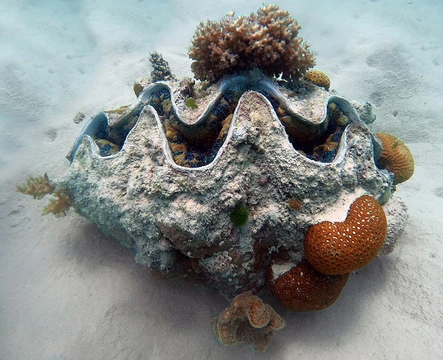
Scallop
Free-living marine bivalves with swimming ability and numerous eyes.

Scallop is a common name for various species of marine bivalve molluscs in the taxonomic family Pectinidae, though it is also sometimes applied to species in closely related families within the superfamily Pectinoidea, which includes thorny oysters. Scallops are a cosmopolitan family found in all of the world's oceans, never in fresh water, and are notable as one of very few bivalve groups to be primarily free-living, with many species capable of swimming short distances and migrating across the ocean floor.
Quick Facts
- Taxon
- Pectinidae
Facts from the source article.
Lore & Background
The family name Pectinidae comes from the Latin pecten meaning comb, in reference to a comb-like structure of the shell next to the byssal notch. Scallop shells consist of two valves, a left and a right, divided by a plane of symmetry; most species rest on their right valve, which is often deeper and more rounded. A unique feature of the family is the ctenolium, a comb-like structure on the anterior edge of the right valve, present at some point in every scallop's life and absent in all other bivalves. Many scallops lose this feature as free-swimming adults. The shells of most scallops are streamlined for swimming, and ridged valves provide architectural strength at the cost of weight.
Reader's Guide
Scallops are highly prized as a food source, with the adductor muscle sold as seafood, and some species are farmed as aquaculture. Their brightly colored, symmetrical, fan-shaped shells are valued by collectors and have been used since ancient times as motifs in art, architecture, and design. Owing to their widespread distribution, scallop shells are a common sight on beaches and popular among beachcombers. The shells also hold a significant place in popular culture. Scallops possess a well-developed nervous system with three paired ganglia, and unlike most bivalves, all scallops have a ring of numerous simple eyes around the edge of their mantles, using a concave mirror of guanine crystals to focus light. Their adductor muscle is larger and more developed than that of oysters, enabling active swimming and, in some species, mass movement from one area to another.
Did You Know?
- All scallops have a ctenolium at some point during their lives, a feature unique to the family.
- Scallops have up to 200 small eyes arranged along the edge of their mantles.
- The word 'scallop' also refers to the adductor muscle sold as seafood.
Physical Form and Lifespan
Clams are bivalve molluscs defined by their paired calcareous valves, typically of equal size, joined at a hinge by a flexible ligament that may sit either inside or outside the shell. This ligament generates the tension needed to pull the valves apart, while one or two adductor muscles work in opposition to snap them shut. Beneath the shell, a clam possesses a full complement of organs—kidneys, a heart, a mouth, a stomach, and a nervous system—and many species extend a siphon for drawing in water. All clams are filter feeders, and their powerful burrowing foot allows them to live as infauna, spending most of their existence partially embedded in sandy or muddy substrates on sea floors and riverbeds. They inhabit both freshwater and marine settings, with the richest diversity found in North America. Remarkably, their lifespans span an extraordinary range: some complete an entire life cycle in a single year, while at least one species has been documented surviving beyond five hundred years.
Place in the Food Web
Clams occupy a dual ecological role: they filter-feed to keep water bodies clean, and they serve as a critical food source for a remarkably wide array of predators. Among mammals, both Pacific and Atlantic walrus species, every known subspecies of harbour seal across both oceans, most sea lion species including the California sea lion, bearded seals, and even certain river otters in Asia and North America that target freshwater clams all rely on them. In the bird world, clams are prey for an astonishing variety of species in the littoral zone—roseate spoonbills across the Americas, the Eurasian oystercatcher, whooping and common cranes, American flamingos in Florida and the Caribbean, and the common sandpiper are just a few examples. Perhaps most strikingly, the vast majority of octopus species, from small coastal varieties up to the colossal Giant Pacific octopus, count clams as a dietary staple. Together, these relationships make clams a keystone node in the marine and freshwater food webs that keep coastal ecosystems functioning.
North American Harvest and Kitchen
Along the eastern seaboard of the United States and the Canadian Maritimes, the term "clam" most commonly denotes the hard clam, though soft-shell clams, ocean quahogs, and surf clams are also commercially important. The bamboo clam, which burrows just beneath the beach, is prized for making clam strips but resists mechanical harvesting and must be handled carefully due to its razor-sharp shell edges. On the West Coast, archaeological middens testify to thousands of years of consumption by Indigenous peoples including the Chumash, Nisqually, and Tsawwassen. Today, butter clams, Pacific razor clams, gaper clams, geoducks, and Pismo clams are all regarded as delicacies. Preparation methods are diverse: clams may be eaten raw, steamed, boiled, baked, or fried; transformed into chowder, casino, cakes, or stuffies; cooked over hot rocks with seaweed in a New England clam bake; or folded into West Coast cioppino and local ceviche variants. Cockles, though less commonly harvested than in Europe, appear in soups, steamed preparations, or pickled forms along the Outer Banks and barrier islands of North Carolina.
Asian Culinary Traditions
In India, clams feature prominently in coastal cuisines across the Konkan, Kerala, Bengal, Karnataka, and Tamil Nadu regions. In Kerala, they are simmered into curries or fried with coconut; the Malabar region calls them "elambakka" while middle Kerala uses "kakka," and Thalassery is particularly known for its coconut-based clam curry. Along the Konkan coast of Maharashtra, a dish called Tisaryachi Ekshipi presents clams still in one shell, and in the Mangalore area, Beary Muslim families prepare a main course known as Kowldo Pinde. The Tulu-speaking communities of Udupi and Mangalore refer to clams as "marvai" and build an entire repertoire around them—marvai sukka, marvai gassi, and marvai pundi among them. In Japan, clams are a regular component of mixed seafood platters, hot pots, miso soups, and tsukudani. The three most frequently used varieties are Shijimi, Asari, and Hamaguri, each bringing a distinct texture and flavor to the table.
Frequently Asked Questions
What is a scallop?
A scallop is a common name for marine bivalve molluscs in the family Pectinidae, though the term is sometimes broadened to include species in closely related families under the superfamily Pectinoidea. They inhabit every ocean on Earth but are never found in freshwater.
How do scallops swim?
Scallops rapidly clap their two shells together and expel a jet of water, propelling themselves short distances across the seafloor. This makes them one of the very few bivalve groups that are primarily free-living rather than permanently anchored to a substrate.
How many eyes do scallops have?
A single scallop can bear up to 200 tiny blue eyes lined up along the mantle edge between its shells. These simple photoreceptors are sensitive enough to detect shifts in light and shadow, alerting the animal to an approaching predator.
What is a ctenolium and why does it matter?
The ctenolium is a comb-like row of fine internal teeth on the shell that is unique to the Pectinidae family. It serves as a key diagnostic feature for distinguishing true scallops from other bivalves that may look superficially similar.
What makes scallops different from oysters and mussels?
While oysters and mussels typically cement themselves to rocks or pilings for their entire lives, scallops remain mobile and can migrate across the ocean floor. They also use a dual-muscle system—fast striated fibers for a quick snap and slow smooth fibers for sustained grip—giving them both speed and endurance.
More in Giant Clams and Marine Bivalves 1-24
Spotted an error? Know more?
Reader corrections go straight into our review queue. Suggest an edit · How this site is sourced