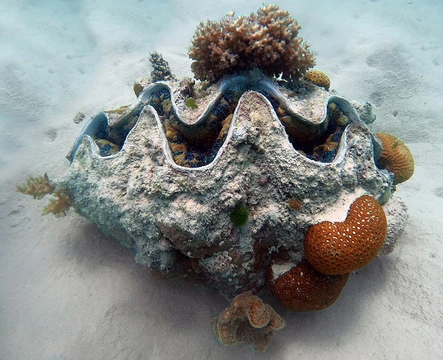
Adamussium colbecki
A large, slow-growing Antarctic scallop with paper-thin, purplish-red valves.

The Antarctic scallop (*Adamussium colbecki*) is a bivalve mollusk from the scallop family, Pectinidae. For a long time, it was considered the sole living member of its genus, but a fossil species from the Pliocene epoch was identified in 2016. Its evolutionary ties to other scallops remain uncertain. This species inhabits the frigid waters around Antarctica and can be found at considerable depths. It is a sizable, slow-developing scallop that dwells on the ocean floor and plays a key role in the local ecosystem; its top shell often serves as a surface for algae, sponges, and other creatures to grow on.
Quick Facts
- Genus
- Adamussium
- Species
- colbecki
Facts from the source article.
Lore & Background
The Antarctic scallop was first described by the British zoologist Edgar Albert Smith in 1902 as Pecten colbecki. Smith worked at the British Museum and examined shells from collections deposited there. In 1934, the German malacologist Johannes Thiele determined that its characteristics warranted inclusion in a separate genus, Adamussium. The specific name most likely honours William Colbeck, the cartographer and magnetic observer on the British Southern Cross Antarctic Expedition (1898–1900). More recent examinations of chromosome structure and mitochondrial DNA have been undertaken, but the exact phylogenetic relationship with other pectinids remains unclear.
The shell grows to about 7 cm long and 7 cm wide, with a nearly circular outline. The two purplish-red valves are paper thin and only slightly convex, attached by a long, slightly sinuous hinge. Near the hinge is an umbo on each valve, with irregular winged processes called auricles on either side. Smaller specimens have about 12 shallow ribs, with further low ridges appearing as the shell grows. The interior of the valves is pink. A fringe of small tentacles projects from the mantle, and there are simple eyes in a row around the rim. The Antarctic scallop could be confused with other scallops, other bivalves, or lamp shells.
The species is endemic to waters surrounding Antarctica, including the Ross Sea, Weddell Sea, Davis Sea, McMurdo Sound, and the Southern Ocean. It is commonly found at depths of less than 100 m, but remotely operated vehicles have recorded it at depths up to 4,840 m. It lives on various substrates including sand, gravel, and silt. In shallow waters it is usually attached by byssus threads; at greater depths it is usually free living. Its distribution is circum-polar but very disjunct, and overall it is not common. In some places densities reach up to 90 per square metre, and in Terra Nova Bay some beds were so crowded that adults lay on top of others.
Reader's Guide
The Antarctic scallop is an important member of the Antarctic seabed community. Its upper valve often acts as a substrate for seaweeds, sponges, and other organisms, and juveniles bind themselves by threads to the upper valve of older shells, using these as a base for several years as they grow. The adult scallops have been used in research to study the accumulation of heavy metals in marine organisms.
The species is monitored in connection with the Vulnerable Marine Ecosystems (VME) classification set up by the Convention on the Conservation of Antarctic Marine Living Resources (CCAMLR). Vessels that land the scallop as by-catch are required to notify authorities. It is often found living in association with the Antarctic sea urchin Sterechinus neumayeri and the sea star Odontaster validus. Predatory invertebrates in its vicinity include the gastropod Neobuccinum eatoni and the ribbon worm Parborlasia corrugatus. The emerald rockcod (Trematomus bernacchii) is one of the main predators of medium-sized Antarctic scallops. Large individuals are adept at jumping and swimming to escape attackers. The scallops are intolerant of low salinity levels, and mortality sometimes occurs from fresh water pools that form under melting sea ice in summer.
Epifaunal organisms living on the shells may represent 90% of the hard substrate available in some regions. The species' paper-thin shell is characteristic of bivalves living in stable, deep water areas with little water movement. Its presence in shallower locations is limited to protected bays or areas with extensive sea ice coverage, which provide stable environments unaffected by storm waves and iceberg scouring.
Did You Know?
- The Antarctic scallop was first described in 1902 by British zoologist Edgar Albert Smith as Pecten colbecki.
- It has been recorded at depths up to 4,840 m using remotely operated underwater vehicles.
- Juveniles attach themselves by byssus threads to the upper valves of older scallops for 3 to 5 years.
Frequently Asked Questions
What is Adamussium colbecki?
It is a large, slow-growing scallop native to Antarctic waters, classified in the family Pectinidae. Its most striking visual trait is a pair of paper-thin valves with a purplish-red hue.
How big does Adamussium colbecki get?
Adults measure roughly 7 cm in both length and width, which is substantial for an Antarctic bivalve. Despite that size, it develops very gradually over its lifetime.
Where does Adamussium colbecki live?
This scallop settles on the seafloor in the cold, deep waters encircling Antarctica. It was first described by Edgar Albert Smith in 1902, and its own genus was later formalized by Johannes Thiele in 1934.
What role does Adamussium colbecki play in its ecosystem?
It functions as a keystone habitat builder because its upper valve offers a hard, stable surface for algae, sponges, and other small organisms to colonize. That structural contribution makes it a critical anchor for Antarctic benthic communities.
Is Adamussium colbecki the only species in its genus?
For most of its taxonomic history it was, but a Pliocene fossil species was recognized in 2016, giving the genus a second member. Its precise evolutionary links to other scallops are still uncertain.
More in Giant Clams and Marine Bivalves 1-24
Spotted an error? Know more?
Reader corrections go straight into our review queue. Suggest an edit · How this site is sourced