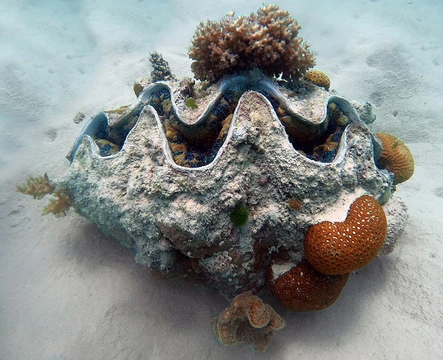
Pectinidae
Free-living marine bivalves with eyes and swimming ability.

Pectinidae is the taxonomic family of marine bivalve molluscs commonly known as scallops. They are notable for being one of very few groups of bivalves that are primarily free-living, with many species capable of swimming rapidly and migrating across the ocean floor. Scallops have a well-developed nervous system and, unlike most other bivalves, possess a ring of numerous simple eyes around the edge of their mantles.
Quick Facts
- Taxon
- Pectinidae
Facts from the source article.
Lore & Background
The family name Pectinidae comes from the Latin pecten, meaning comb, in reference to a comb-like shell structure near the byssal notch. Scallops are found in all of the world's oceans but never in fresh water. Most species live recumbent on sandy substrates, though some attach to objects via a byssal thread or live cemented to rocks. When sensing a predator such as a starfish, they may escape by swimming swiftly and erratically using jet propulsion from clapping their shells. The shell consists of two valves with a straight hinge line and flat ears (auricles) on either side; the anterior ear is never smaller than the posterior. A unique feature is the ctenolium, a comb-like structure on the right valve's anterior edge, present in all scallops at some life stage and absent in other bivalves. The adductor muscle is large and developed for swimming, with fast striated and slow smooth parts. Scallops are filter feeders that lack siphons, and their nervous system is controlled by three paired ganglia, with the visceral ganglia being the largest and most intricate of any modern bivalve.
Reader's Guide
Scallops are highly prized as a food source, with the adductor muscle sold as seafood, and some species are farmed in aquaculture. Their shells, often brightly colored, symmetrical, and fan-shaped with fluted ornamentation, are valued by collectors and have been used since ancient times as motifs in art, architecture, and design. Owing to their widespread distribution, scallop shells are a common sight on beaches and popular among beachcombers. The shells also hold a significant place in popular culture. The family's unique anatomy, including the ctenolium and the ring of eyes, distinguishes scallops from other bivalves and contributes to their ecological role as active swimmers. The word 'scallop' also refers to the meat itself.
Did You Know?
- Scallops have up to 200 small eyes arranged along the edge of their mantles, which use a concave mirror of guanine crystals to focus light.
- All scallops possess a ctenolium at some point in their lives, a comb-like shell feature not found in any other bivalve.
- Scallops lack siphons and are filter feeders that trap food particles in mucus.
- The adductor muscle of scallops has both fast striated and slow smooth parts, enabling both rapid swimming and prolonged shell closure.
Taxonomic Placement Within Mollusca
Pectinidae, commonly known as scallops, occupy a position within the class Bivalvia of the phylum Mollusca. Mollusca is a phylum of protostomic invertebrate animals that currently encompasses roughly 86,600 recognized extant species, making it the second-largest animal phylum behind only Arthropoda. As the largest marine phylum, molluscs account for approximately 23 percent of all named marine organisms. The phylum is typically divided into seven or eight taxonomic classes, two of which are now entirely extinct. While gastropods dominate the phylum with about 80 percent of all classified molluscan species, bivalves represent a substantial and ecologically significant portion of marine life. Pectinidae, as a family within Bivalvia, shares this broad molluscan heritage, contributing to a group whose members display extraordinary diversity in size, anatomical structure, behavior, and habitat across both marine and, in some cases, freshwater and terrestrial environments.
The Two Documented South African Scallop Species
The South African marine mollusc inventory records exactly two species under the family Pectinidae. The first is Chlamys tincta, commonly referred to as the dwarf fan shell, whose documented range stretches from Cape Columbine along the coast to Mozambique. The second is Pecten sulcicostatus, simply called the scallop, found from Cape Point to the Eastern Cape. Both species are saltwater organisms, as the South African list deliberately excludes land and freshwater molluscs. Their geographic distributions overlap considerably along the eastern and southern coasts, yet each occupies a slightly different stretch of shoreline. Chlamys tincta extends further north into Mozambican waters, while Pecten sulcicostatus is confined to the southern and southeastern sectors. Together, these two representatives illustrate the modest but distinct presence of scallops within the broader bivalve fauna of the region.
Pectinidae Within the South African Bivalve Assemblage
Scallops are one of many bivalve families documented in South African saltwater habitats. The regional inventory lists numerous other families alongside Pectinidae, including Mytilidae (mussels), Ostreidae (true oysters), Pteriidae (pearl oysters), Arcidae (ark clams), Pinnidae (pen shells), Tridacnidae (giant clams), Cardiidae (cockles), Donacidae (wedge shells), Veneridae (venus shells), and many more. Each family contains multiple species with their own distinct coastal ranges, from Namibia in the west to Mozambique in the north. Within this rich assemblage, Pectinidae stands out for having only two recorded species, a notably small representation compared to families like Mytilidae or Veneridae, which each list a dozen or more. This contrast highlights how the South African bivalve fauna is dominated by other groups, with scallops forming a smaller but recognizable component of the overall marine molluscan community.
Knowledge Gaps and the Fossil Heritage
Despite the extensive cataloguing of South African marine molluscs, significant gaps remain in our understanding of the phylum as a whole. The proportion of undescribed extant molluscan species is described as very high, and many taxa remain poorly studied. Beyond living species, the fossil record adds another layer of complexity: an estimated 60,000 to 100,000 additional fossil molluscan species are known, vastly expanding the historical picture of this phylum. Two of the seven or eight recognized taxonomic classes are now entirely extinct, underscoring how much of molluscan evolutionary history is preserved only in stone. For Pectinidae specifically, the South African list provides just two species names, but whether this reflects a genuinely small regional presence or simply incomplete survey work is difficult to determine given the acknowledged gaps in molluscan taxonomy. The dwarf fan shell and the scallop thus represent a small, well-defined slice of a much larger and still incompletely known marine world.
Frequently Asked Questions
Who is Pectinidae?
Pectinidae is the taxonomic family of marine bivalve molluscs that fans know simply as scallops, sitting under the superfamily Pectinoidea. Unlike most of their bivalve relatives, these creatures live a largely free-living existence on the ocean floor rather than cementing themselves permanently to rock.
What are Pectinidae's signature abilities?
Scallops can jet-propel themselves across the seabed by rapidly clapping their shells shut, making them one of the few bivalve groups that truly swims and migrates. They also boast a surprisingly well-developed nervous system for a mollusc, which coordinates that quick burst of movement.
How many eyes does Pectinidae have, and what are they like?
A ring of up to 200 tiny simple eyes lines the edge of a scallop's mantle, each one roughly a millimeter across. These pinhole-like photoreceptors let the animal detect shadows and movement without the complex optics found in vertebrate eyes.
How does Pectinidae swim, exactly?
The family relies on a single central adductor muscle that is split into a fast, striated portion and a slower, smooth portion. By snapping the striated fibers shut in a rapid contraction, the scallop ejects a jet of water that propels it forward between the two shell valves.
Why is Pectinidae considered special among bivalves?
Most bivalve families are sedentary filter-feeders that anchor early and stay put, but Pectinidae broke that mold by evolving mobility, a ring of eyes, and a more complex nervous system. That combination of free-living behavior and sensory capability makes them a standout lineage in the class Bivalvia.
More in Giant Clams and Marine Bivalves 1-24
Spotted an error? Know more?
Reader corrections go straight into our review queue. Suggest an edit · How this site is sourced