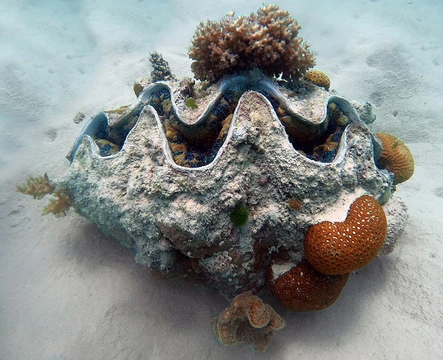
Hippopus hippopus
A giant clam with horse-foot name and strawberry blotches.

Hippopus hippopus, called the Horse Hoof clam or Strawberry clam, is a giant clam species belonging to the subfamily Tridacninae and the genus Hippopus. Its scientific name comes from the Ancient Greek words for "horse" and "foot." In many Southeast Asian countries, it is prized as a food source because of its high-quality meat.
This clam lives in the tropical waters of the Indian and Pacific Oceans, with common populations along the coasts of Indonesia and Palau. Its range stretches from India in the Indian Ocean to Kiribati in the Pacific. It prefers shallow waters in fringing reefs, barrier reefs, and seagrass beds. Because it stays in shallow areas, its symbiotic partners can use sunlight for photosynthesis. Unlike some relatives, it does not attach to rocks; instead, it settles on sandy patches away from reef rocks.
For nutrition, H. hippopus depends heavily on photosynthetic dinoflagellates called zooxanthellae, which supply about 65 to 70 percent of its food. These dinoflagellates live in the siphonal mantle and inside a complex tubular system. This system begins at the stomach, where a primary zooxanthellae tube moves away and splits into two tubes at the digestive system. These two tubes travel to the root of the siphonal mantle, where they branch into many smaller tertiary tubes. This network allows the zooxanthellae to communicate with the stomach through a small opening. The clam’s relationship with the dinoflagellates is unusual because the zooxanthellae connect directly to the digestive system.
The clam also gets nutrients by filter feeding. It uses its inhalant siphon to take in marine microorganisms like phytoplankton and zooplankton, catching them on ciliated tracts on its gill plates. The amount of carbon obtained this way depends on the clam’s size: smaller clams get about 60 percent of their carbon from filter feeding, while larger ones get about 34 percent.
The shell of H. hippopus has strawberry-colored blotches arranged in bands on the outside. Its mantle is green-yellow with tightly interlocking ridges. The shell is sub-rhomboidal in shape, with deep ridges running vertically across its surface. Among giant clams, it is average in size, typically reaching 22 cm (8.7 in) and up to 45 cm (18 in) at maximum. Unlike other bivalves, its hinge sits next to the substrate, while the inhalant siphon and mantle tissues face upward.
Quick Facts
- Genus
- Hippopus
Facts from the source article.
Lore & Background
The scientific name hippopus comes from Ancient Greek for 'horse foot' (ἵππος, hippos, 'horse', and πούς, pous, 'foot'). The species is found in tropical waters of the Indian and Pacific Oceans, commonly on the coast of Indonesia and Palau, with a range extending to India and Kiribati. It inhabits shallow waters of fringing and barrier reefs and seagrass beds, settling on sandy patches rather than attaching to rocks.
H. hippopus relies heavily on zooxanthellae housed in a vast tubular system that starts at the stomach and branches into the siphonal mantle, allowing direct communication with the digestive system. It also filter-feeds on phytoplankton and zooplankton via its inhalant siphon. The shell is sub-rhomboidal with deep vertical ridges and strawberry blotches; the mantle is green-yellow with interlocking ridges. Unlike other bivalves, its hinge is adjacent to the substrate, orienting the mantle toward sunlight.
The species is a protandrous hermaphrodite, releasing sperm then eggs into the water column, with spawning triggered by other clams. Larvae are planktonic for 6 to 14 days before settling on sandy substrate and becoming sessile. Juveniles acquire zooxanthellae after about 25 days, causing a sharp growth increase.
Reader's Guide
Hippopus hippopus is significant both as a food source and as a species under threat. The article notes that its meat is considered a delicacy in many Southeast Asian countries, and its shell is also harvested. However, its extremely slow growth and reproduction make such harvesting unsustainable; stocks can take several decades to recover after a single harvest. Consequently, the species is considered overfished in many countries and may even be extinct in several of them. Conservation efforts include aquaculture operations at the National Aquaculture Center in Kosrae, Micronesia, run by the private company MMME, which provides seed stocks for local community farms. The species is listed on the IUCN Red List of Threatened Species, and its international trade is regulated by CITES. In the reef aquarium hobby, it is less common than Tridacna species but growing in popularity, though it requires very high levels of artificial light. The species' reliance on shallow-water habitats and its symbiotic relationship with zooxanthellae underscore its ecological role, while its vulnerability highlights the need for sustainable management.
Did You Know?
- The scientific name hippopus means 'horse foot' in Ancient Greek.
- About 65 to 70 percent of a giant clam's nutrition comes from zooxanthellae.
- H. hippopus settles on sandy substrate, unlike Tridacna species that attach to rocks.
- Egg cells remain viable for only 4 to 6 hours after release.
Frequently Asked Questions
What is Hippopus hippopus?
Hippopus hippopus is a species of giant clam in the subfamily Tridacninae, widely known as the Horse Hoof clam or Strawberry clam. Its binomial name pulls from Ancient Greek terms for "horse" and "foot," referencing the shape of its shell.
What does Hippopus hippopus look like?
This bivalve is recognizable by its distinctive strawberry-patterned blotches across the shell surface. Most specimens measure around 22 cm, though the largest individuals can reach roughly 45 cm.
Where does Hippopus hippopus live?
The species ranges across tropical shallow waters from India in the Indian Ocean to Kiribati in the Pacific. It is most frequently encountered on fringing reefs along the coasts of Indonesia and Palau.
How does Hippopus hippopus obtain its food?
Between 65 and 70 percent of its nutritional intake comes from symbiotic zooxanthellae living within its tissues. The rest of its carbon needs are met through filter-feeding, with the split shifting depending on whether the clam is small or large.
Why is Hippopus hippopus important to people and reefs?
Across much of Southeast Asia, this clam is harvested as a food source because its meat is considered high quality. Ecologically, it contributes to reef health by filtering particles from shallow tropical waters.
More in Giant Clams and Marine Bivalves 1-24
Spotted an error? Know more?
Reader corrections go straight into our review queue. Suggest an edit · How this site is sourced