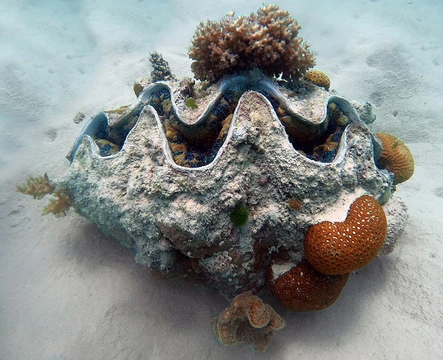
Annachlamys flabellata
A scallop with partial protandric sex reversal and pink, orange or mauve ribs.

Annachlamys flabellata is a scallop, a type of marine bivalve mollusk belonging to the family Pectinidae. It lives on sandy seafloors in the neritic zone, at depths up to 127 meters, along the coasts of Western Australia, Northern Territory, Queensland, New South Wales, New Guinea, and Indonesia.
This scallop reaches a length of 6 to 10 centimeters. Its shell is moderately compressed and inequivalve—the right valve is more inflated and less convex than the left. The shell is roughly circular, with two broad auricles extending from either side of the umbones, and a straight hinge line aligned with them. It has 18 to 20 broad radial ribs; these are more prominent on the right valve, with wider gaps between them. Concentric growth rings also mark the shell. On the left valve, some or all ribs are pink, orange, or mauve, while the right valve is entirely white. The gaps between ribs are narrower than in the similar species *Annachlamys reevei*. Inside the valve, there is often a red tinge or a ring of red dots.
The animal lies on sandy seabeds, covered by a thin layer of substrate. It is a filter feeder, drawing water into its gill chambers through a gap at the back of the shell. Oxygen is absorbed by the gills, while food particles—mostly microscopic algae—are sieved out and carried to the mouth; the water is then expelled.
Individuals become mature at about 4.5 centimeters in length. They show partial protandric sex reversal: smaller individuals are mostly male, but females dominate among larger ones, though some small females and large males exist. In New Caledonian lagoons with stable temperatures, spawning occurs at intervals all year, with a peak from November to March. Spawning shows no link to sea temperature changes, salinity shifts, or moon phases. Mature male gonads are cream-colored; female gonads are bright red. When ripe, they enlarge and obscure the digestive tract in live animals. Eggs are fertilized externally, and the trochophore larvae develop into veliger larvae that drift as zooplankton. After several weeks, they settle, undergo metamorphosis, and become juveniles.
Quick Facts
- Genus
- Annachlamys
- Species
- flabellata
Facts from the source article.
Lore & Background
Annachlamys flabellata has a shell that is inequivalve and moderately compressed, with the right valve more inflated and less convex than the left. The shell is circular with two broad auricles extending on either side of the umbones, and a straight hinge line exactly in line with the umbones. There are 18 to 20 broad radial ribs, more prominent on the right valve, with concentric growth rings. Some or all ribs on the left valve are pink, orange or mauve, while the right valve is entirely white. The inside of the valve often has a red tinge or a concentric ring of red dots.
This species is found on sandy seabeds in the neritic zone off the coasts of Western Australia, Northern Territory, Queensland, New South Wales, New Guinea, and Indonesia. It lies covered with a thin layer of substrate and is a filter feeder, drawing water into its gill chambers through a gap between the valves at the back of the shell. Food particles, mostly microscopic algae, are sieved out and transported to the mouth.
Individuals become mature at about 4.5 centimetres in length. They exhibit partial protandric sex reversal: smaller individuals are mostly males, but females predominate among larger individuals, though some small females and large males exist. In lagoons in New Caledonia with little thermal variation, spawning occurs at intervals throughout the year, with a maximum from November to March. Spawning shows no correlation to sea temperature, salinity changes, or moon phases. Male gonads are cream coloured, female gonads bright red; when ripe they are enlarged and visible in the live animal. Eggs are fertilised externally, and larvae develop into veliger larvae that disperse with currents before settling and metamorphosing into juveniles.
Reader's Guide
Annachlamys flabellata is notable for its distinctive shell coloration and partial protandric sex reversal, where smaller individuals are mostly male and larger ones mostly female. This species is found across a broad geographic range north of Australia, from Western Australia to New South Wales, as well as in New Guinea and Indonesia, inhabiting sandy seabeds in the sublittoral zone down to 127 metres. Its filter-feeding biology, drawing water through a gap between the valves to capture microscopic algae, is typical of scallops. The species exhibits a spawning period from November to March in New Caledonian lagoons, with no correlation to temperature, salinity, or lunar phases. The shell's inequivalve structure, with 18 to 20 radial ribs and pink, orange, or mauve coloring on the left valve, distinguishes it from the closely related Annachlamys reevei, which has narrower interstices between ribs. The presence of red tinges or concentric rings of red dots inside the valve adds to its identification features. Its life cycle includes external fertilization and a planktonic larval stage, contributing to its dispersal across the region.
Did You Know?
- Spawning in New Caledonian lagoons occurs year-round, with a maximum from November to March, and shows no correlation to temperature, salinity, or moon phases.
- The shell has 18 to 20 broad radial ribs, with the space between ribs narrower than in the closely related Annachlamys reevei.
Frequently Asked Questions
Who is Annachlamys flabellata?
Annachlamys flabellata is a medium-sized scallop (family Pectinidae) that inhabits sandy seafloors in the neritic zone along the coasts of western and northern Australia, New Guinea, and Indonesia. It is a benthic marine bivalve mollusk found at depths reaching up to 127 metres.
What are Annachlamys flabellata's signature traits?
The species grows to 6–10 cm in length and displays a roughly circular, moderately compressed shell with 18 to 20 broad radial ribs in pink, orange, or mauve tones. Its shell is inequivalve, meaning the right valve is noticeably more inflated and less convex than the left, giving it a subtly asymmetrical silhouette.
How does Annachlamys flabellata's reproductive story unfold?
It reaches sexual maturity at around 4.5 cm and spawns during the austral summer, roughly November through March. Notably, it exhibits partial protandric sex reversal, so some individuals shift from male to female during their lives rather than remaining a single sex.
Why is Annachlamys flabellata important to its ecosystem?
As a benthic filter-feeder on sandy substrates, it helps process suspended particles and contributes to nutrient cycling across a broad Indo-Australian range. Its protandric capacity also adds reproductive resilience to local scallop populations.
Where exactly can fans spot Annachlamys flabellata in the wild?
Look for it on sandy bottoms in the neritic zone off Western Australia, the Northern Territory, Queensland, New South Wales, New Guinea, and Indonesian waters. It is typically encountered at depths up to about 127 metres (417 ft).
More in Giant Clams and Marine Bivalves 1-24
Spotted an error? Know more?
Reader corrections go straight into our review queue. Suggest an edit · How this site is sourced