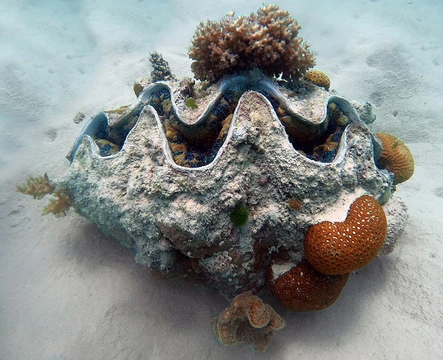
Tridacna squamosa
A large clam with fluted shell scutes and symbiotic algae.

Meet the fluted giant clam, also called the scaly clam—scientific name *Tridacna squamosa*. This bivalve belongs to the family Cardiidae and lives on shallow coral reefs across the South Pacific and Indian Oceans. Its shell stands out thanks to large, leaf-like fluted edges known as scutes, and its byssal opening is noticeably smaller than those of other clams in the subfamily Tridacninae. The mantle typically shows colors ranging from browns and purples to greens and yellows, arranged in elongated lines or spots. Adults can reach up to 40 centimeters (16 inches) across.
Once settled, the clam stays put for life. Its mantle tissue provides a home for single-celled dinoflagellate algae called zooxanthellae, which live symbiotically inside the clam. These algae supply a major portion of the clam’s nutrition through photosynthesis. During the day, the clam spreads its mantle wide to give the algae the sunlight they need.
**Distribution** The native range of *Tridacna squamosa* stretches from South Africa and the Red Sea all the way to the Marshall Islands.
**In captivity** This species sometimes appears in home aquariums, where it requires moderate care and is considered a relatively hardy member of the Tridacnidae family. Because it relies partly on zooxanthellae for food, it needs a moderate amount of light—though it depends less on photosynthesis than other tridacnids like *Tridacna crocea* or *T. maxima*. It also eats phytoplankton to round out its diet. Peaceful by nature, it doesn’t harm other organisms in the wild or in tanks. Even though it can close its shell completely, predators such as anemones, triggerfish, and puffers may pose a threat in a domestic setup. It’s best not to keep it with anemones, as they might move close and sting or eat the clam. Before adding a clam to an aquarium, inspect it for Pyramidellidae snails and quarantine it if possible. In the tank, place it lower in the display. Some specimens prefer lying in the substrate, but they may occasionally attach their byssal threads to rocks above it. All clams need good to excellent water quality, but they can help reduce nitrate levels by consuming free nitrates to some degree.
**Conservation status** The International Union for the Conservation of Nature lists this clam as least concern.
Quick Facts
- Taxon
- Tridacna squamosa
Facts from the source article.
Lore & Background
Tridacna squamosa is sessile in adulthood, and its mantle tissues act as a habitat for symbiotic single-celled dinoflagellate algae (zooxanthellae), from which it gets a major portion of its nutrition. By day, the clam spreads out its mantle tissue so that the algae receive the sunlight they need to photosynthesize. Normal coloration of the mantle ranges from browns and purples to greens and yellows arranged in elongated linear or spot-like patterns.
In captivity, this species is a relatively hardy member of the Tridacnidae and requires moderate care. It is not nearly as dependent on photosynthesis as other tridacnids such as Tridacna crocea or T. maxima, and it also consumes phytoplankton to complete its diet. It is a peaceful resident and does not harm other organisms, though anemones, triggerfish, and puffers may be predators in a domestic environment. It should be kept lower in the display, and some specimens prefer lying in the substrate while others attach their byssal threads to rocks above the substrate.
Reader's Guide
Tridacna squamosa is notable for its distinctive fluted shell scutes and its reliance on symbiotic zooxanthellae for nutrition, though it is less dependent on photosynthesis than some other tridacnids. The species is listed as Least Concern by the International Union for the Conservation of Nature, but its international trade is regulated under Appendix II of CITES. In aquaria, it requires moderate light and good to excellent water quality, and it may help reduce nitrate levels in a system. It should be inspected for Pyramidellidae snails and quarantined before being added to aquaria. The species is a peaceful resident that does not harm other organisms, but it can be preyed upon by anemones, triggerfish, and puffers. Its native range spans from South Africa to the Red Sea and to the Marshall Islands, and it grows to 40 centimetres across. The article notes that the clam's mantle coloration includes browns, purples, greens, and yellows in linear or spot-like patterns.
Did You Know?
- Tridacna squamosa is distinguished by large, leaf-like fluted edges on its shell called 'scutes'.
- It grows to 40 centimetres (16 in) across.
- It is listed in Appendix II of CITES, meaning international trade is regulated.
- In aquaria, it should be kept lower in the display and may attach its byssal threads to rocks above the substrate.
More in Giant Clams and Marine Bivalves 1-24
Spotted an error? Know more?
Reader corrections go straight into our review queue. Suggest an edit · How this site is sourced