Tridacna noae
A giant clam long confused with Tridacna maxima.

Tridacna noae, called Noah’s giant clam or the teardrop giant clam, belongs to the giant clam subfamily Tridacninae. Röding first described and named it in 1798, basing the description on figures from Chemnitz (1784). For a long time, people confused it with the smaller giant clam Tridacna maxima, but scientists now recognize it as a separate species. It lives across a wide area of the Indo-Pacific.
Like all giant clams, T. noae populations are shrinking because people harvest them for food, their shells, and the aquarium trade. The species, along with all members of Tridacninae, has been listed as endangered since 1985.
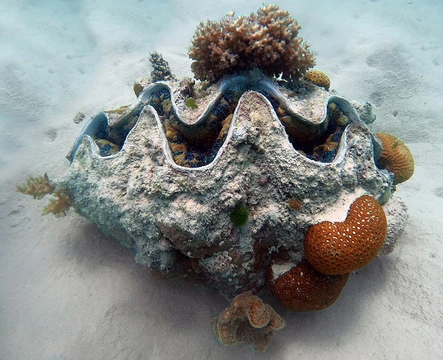
In appearance, T. noae looks like most bivalves, especially other giant clams. Its shell usually measures between 6 and 20 centimeters long and has five to seven radial ribs. The mantle can be brown, yellow, blue, or green. Black hyaline organs—essentially eyes—line the mantle’s edge, along with a thin white margin and ocellate spots.
Researchers first identified T. noae as a cryptic species separate from T. maxima in Taiwan (Tang, 2005) and Japan (Kubo and Iwai, 2007). DNA sequencing confirmed they are distinct. Ribosomal RNA evidence shows T. noae is actually more closely related to other giant clams than T. maxima is. Although the two look very similar, key differences exist in shell shape, mantle pattern, and color. T. noae has ocellate spots with a thin white border and a unique arrangement of hyaline organs. Its shell usually has five to seven radial ribs, while T. maxima has four to six—though this trait is not reliable for identification. Past confusion has led to overestimates of T. maxima populations and possibly misleading research results.
T. noae ranges broadly across the Indo-West Pacific, overlapping with T. maxima. It lives in shallow water up to 20 meters deep, typically on coral reef edges and crests, where it attaches with byssal threads. First recognized in Taiwan and Japan, it has been observed as far west as Christmas Island. Mitochondrial DNA markers split its distribution into three groups: the eastern Indo-Malay archipelago to Western Australia, Melanesia to Micronesia, and Central Polynesia.
All giant clams, including T. noae, have been on Appendix II of CITES since 1985 and on the IUCN Red List since 1986. Human exploitation—for meat, shells, and the pet trade—has driven their decline.
Quick Facts
- Genus
- Tridacna
- Species
- noae
Facts from the source article.
Lore & Background
Tridacna noae was first recognized as a cryptic species distinct from Tridacna maxima in Taiwan and Japan by Tang (2005) and Kubo and Iwai (2007), respectively. DNA sequencing characterizes the two as distinct species, and rRNA evidence shows T. noae is even closer related to other members of Tridacninae than T. maxima is. Although very similar in appearance, key differences include shell morphology, mantle pattern, and mantle coloration. The mantles of T. noae have ocellate spots with a thin, white border around the edge, along with hyaline organs (eyes) arranged distinctively. While proven to be an unreliable distinguishing factor, T. noae usually have a higher number of radial ribs (5–7) compared with T. maxima (4–6). Confusion between the two species has led to overestimated population densities of T. maxima and potentially misleading conclusions in studies of T. maxima populations.
T. noae have a broad distribution, mainly Indo-West Pacific, overlapping with that of T. maxima. They live in shallow waters up to 20 meters in depth, typically on the edges and crests of coral reefs, attached by byssal threads. Populations were first recognized in Taiwan and Japan, but have been observed as far west as Christmas Island. Mitochondrial DNA markers break up the distribution into three groups: east Indo-Malay archipelago to Western Australia, Melanesia to Micronesia, and Central Polynesia.
Reader's Guide
Tridacna noae is notable primarily for its long-standing confusion with Tridacna maxima, which obscured its true identity as a separate species until the early 2000s. This confusion has had practical consequences: it led to overestimated population densities of T. maxima and potentially misleading conclusions in studies of that species. The recognition of T. noae as a distinct species, confirmed by DNA sequencing and rRNA evidence, clarifies the taxonomy of giant clams and highlights the importance of molecular methods in distinguishing cryptic species. As with all giant clams, populations of T. noae are declining due to human exploitation for flesh, shells, and as aquarium pets. It has been listed in Appendix II of CITES since 1985 and on the IUCN Red List since 1986. Conservation efforts include breeding in captivity to replenish wild populations, with the additional goal of culture for commercial markets. The species' broad Indo-West Pacific distribution and its specific habitat on coral reef edges and crests make it an important component of reef ecosystems, though its exact population status remains understudied due to past taxonomic confusion.
Did You Know?
- T. noae was originally described and named by Röding in 1798 based on figures in Chemnitz (1784).
- T. noae typically has 5–7 radial ribs on its shell, compared with 4–6 in T. maxima, though this is an unreliable distinguishing factor.
More in Giant Clams and Marine Bivalves 1-24
Spotted an error? Know more?
Reader corrections go straight into our review queue. Suggest an edit · How this site is sourced