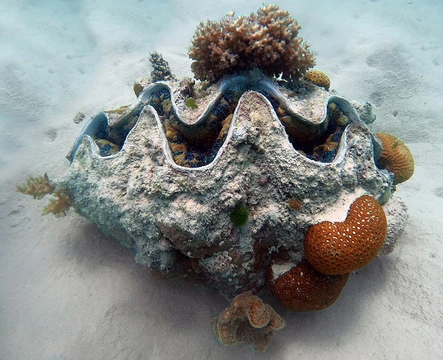
Tridacna derasa
A large, smooth-shelled giant clam with photosymbiotic algae.

Tridacna derasa, called the southern giant clam or smooth giant clam, is a very large marine bivalve in the family Cardiidae. It can grow up to 60 cm long, making it one of the biggest giant clams. Its shell is thick and relatively smooth, with six to seven vertical folds, which sets it apart from the larger Tridacna gigas, which has four to five folds and a rougher surface. Unlike most other Tridacna species, it usually lacks scutes—scale-like shell projections—though aquaculture specimens have occasionally developed them in abnormal cases. The mantle displays wavy stripes or spots in mixtures of orange, yellow, black, and white, often with bright blue or green lines. The white color in its mantle comes from multi-colored crystalline pigment cells, whereas T. maxima clusters red, blue, and green cells.
This clam is native to waters around Australia, the Cocos Islands, Fiji, Indonesia, New Caledonia, Palau, Papua New Guinea, the Philippines, the Solomon Islands, Tonga, and Vietnam. It has been introduced to American Samoa, the Cook Islands, the Marshall Islands, and Samoa, and reintroduced after local extinction in Guam, the Federated States of Micronesia, and the Northern Mariana Islands. It lives on the outer edges of reefs at depths of 4 to 10 meters.
Like other Tridacna clams, it has muscles to open and close its shell and a foot to attach to the reef. It breathes through gills and feeds through a mouth. Most clams get nutrients by filter feeding and absorbing dissolved organic compounds, but Tridacna clams also rely on photosymbiotic algae called zooxanthellae living in their tissues. Through photosynthesis, these algae convert carbon dioxide and dissolved nitrogen (such as ammonium) into carbohydrates and other nutrients for the clam. When first reaching sexual maturity, the clam is male, but about a year later it becomes hermaphroditic, with both male and female organs. Sperm and eggs are released separately to prevent self-fertilization, though self-fertilization can still happen. Breeding usually occurs in spring and summer, but spawning can be induced year-round.
The southern giant clam is listed as Vulnerable on the IUCN Red List and on Appendix II of CITES. It is a popular food and aquarium species, leading to heavy hunting in its natural range.
Quick Facts
- Genus
- Tridacna
- Species
- derasa
Facts from the source article.
Lore & Background
The southern giant clam is distinguished from its larger relative Tridacna gigas by its six to seven vertical folds and smoother shell, lacking the scutes present in most other Tridacna species, though an abnormal aquaculture specimen has developed scutes. Its mantle displays wavy stripes or spots in mixtures of orange, yellow, black, and white, often with brilliant blue or green lines; it produces white using multi-colored crystalline pigment cells, unlike T. maxima which clusters red, blue, and green cells.
Native to waters around Australia, Cocos Islands, Fiji, Indonesia, New Caledonia, Palau, Papua New Guinea, Philippines, Solomon Islands, Tonga, and Vietnam, it has also been introduced to American Samoa, Cook Islands, Marshall Islands, and Samoa, and reintroduced after extinction in Guam, the Federated States of Micronesia, and Northern Mariana Islands. It inhabits outer reef edges at depths of 4 to 10 meters.
Tridacna clams respire through gills and feed through a mouth, but T. derasa also relies on photosymbiotic zooxanthellae algae in its tissues to provide carbohydrates and nutrients. Upon reaching sexual maturity, individuals are first male, then become hermaphrodites about a year later, releasing sperm and eggs separately to prevent self-fertilisation, though self-fertilisation can occur. Breeding usually occurs in spring and summer but can be induced year-round.
Reader's Guide
The southern giant clam is classified as Vulnerable on the IUCN Red List and listed on CITES Appendix II. It has been hunted extensively throughout its natural habitat as a popular food item and aquarium species. However, specimens traded today tend to come from aquaculture farms rather than wild-caught individuals, because Tridacna derasa was one of the first clams to be bred commercially. This pioneering large-scale development occurred at the MMDC Giant Clam Hatchery in Palau, which focused on this species. The species' ability to be bred in captivity has helped reduce pressure on wild populations, though its vulnerable status remains. Its smooth shell and distinctive mantle coloration make it a notable species both ecologically and commercially.
Did You Know?
- The southern giant clam can reach up to 60 cm in length.
- It has six to seven vertical folds on its shell, distinguishing it from Tridacna gigas which has four to five.
- The species produces white in its mantle using multi-colored crystalline pigment cells.
More in Giant Clams and Marine Bivalves 1-24
Spotted an error? Know more?
Reader corrections go straight into our review queue. Suggest an edit · How this site is sourced