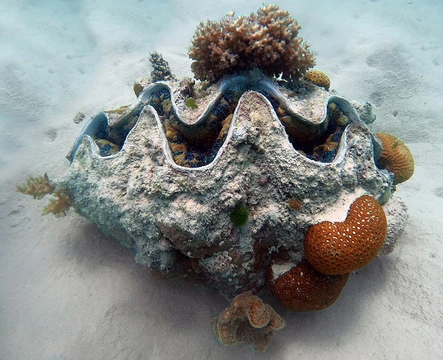
Tridacna crocea
The smallest clam in the subfamily Tridacninae, native to the Indo-Pacific.

Tridacna crocea, commonly known as the boring clam, crocus clam, crocea clam or saffron-coloured clam, is a species of bivalve in the family Cardiidae. It is native to the Indo-Pacific region and is occasionally found in the aquarium trade, where it is often simply referred to as crocea. It is notable as the smallest clam in the subfamily Tridacninae.
Quick Facts
- Taxon
- Tridacna crocea
Facts from the source article.
Lore & Background
The boring clam grows to a maximum shell size of 15 cm (6 in). It has two thick valves joined by a hinge that is typically between a third and less than a half of the width of the shell. Shells are slightly to moderately elongate, and the animal is strongly inflated, especially near the hinge. The upper valve has six to ten flattish folds that interlock at the margin with similar folds on the lower valve, allowing the shell to close tightly. The lower valve has slits through which byssal threads emerge to secure the animal to the seabed. This clam burrows into the substrate, a process that tends to wear away and smooth the outer surface of the valves; they may also become distorted by burrowing into substrates of uneven hardness.
The colour of the valves is generally greyish-white, sometimes with a hint of pink-orange, yellow or orange, which can form a band near the top margin, especially on the interior surface. The mantle, the soft body wall covering the internal organs, projects from between the valves when open and is brightly coloured in various shades of blue, green, purple, gold, orange or brown, often patterned with spots, stripes or squiggles. It has many small protrusions on the exposed surface and a line of simple eyes near the margin. The inhalent siphon is surrounded by many small tentacles, and the exhalent siphon is often long and tubular.
Its typical habitat is embedded in massive corals. Its range extends from Malaysia, Vietnam and Japan to Indonesia, the Philippines, Palau, New Guinea, Australia, the Solomon Islands and Vanuatu. At one time it was known from Guam and the Northern Mariana Islands, but it may now be locally extinct in those locations.
Reader's Guide
Tridacna crocea is significant as the smallest member of the subfamily Tridacninae, reaching a maximum shell size of 15 cm. Its ability to burrow into substrate, including massive corals, distinguishes it from many other giant clams. The species is occasionally found in the aquarium trade, where it is simply called crocea, indicating its popularity among hobbyists. Its shell morphology—with thick valves, interlocking folds, and a hinge width between a third and less than half the shell width—allows tight closure. The byssal threads emerging through slits in the lower valve anchor it to the seabed. The mantle's bright coloration, often patterned with spots, stripes, or squiggles, and the presence of simple eyes near the margin, are characteristic features. The species' distribution across the Indo-Pacific, from Japan to Australia, and its possible local extinction in Guam and the Northern Mariana Islands, highlight both its wide range and vulnerability in certain areas. Its typical habitat embedded in massive corals underscores its ecological role in reef environments.
More in Giant Clams and Marine Bivalves 1-24
Spotted an error? Know more?
Reader corrections go straight into our review queue. Suggest an edit · How this site is sourced