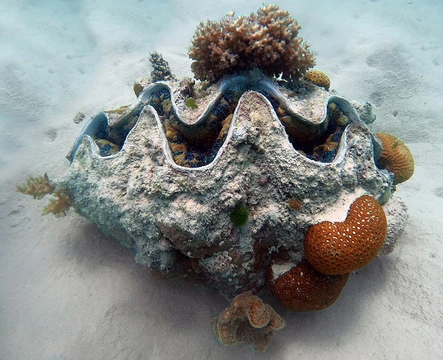
Pedini
A monotypic scallop tribe that bores into live coral.

Pedini is a tribe of bivalves within the family Pectinidae, the scallops. It is a monotypic group, containing only the genus Pedum and its sole species, Pedum spondyloideum, sometimes called the iridescent scallop. This tribe is notable for its unique lifestyle among scallops: its members bore into live coral, creating a narrow burrow or niche that they inhabit throughout their life.
Quick Facts
- Genus
- Pedum (bivalve)
- Grandparent Authority
- Bronn, 1862
- Species
- spondyloideum
Facts from the source article.
Lore & Background
Pedini is represented solely by Pedum spondyloideum, a scallop that exhibits a nestling life habit by boring into living stony corals. Phylogenetics suggests this behavior evolved from ancestors that used byssus to attach to a substrate. The scallop's two shell valves are fan-shaped and asymmetrical: the right valve is larger, wider, smoother, and has a deep byssal notch, while the left valve is flattened with radial lines and spines. The mantle folds and tentacles are visible; two tentacle types have been observed: wholly white and brown-striped. Like other scallops, Pedum possesses eyes.
Reader's Guide
Pedini's significance lies in its unique ecological role among scallops. By boring into live coral, Pedum spondyloideum creates a crevice it inhabits for life, secreting a chemical that erodes coral skeleton and tissues—a behavior compared to distantly related Lithophaga mussels. Juveniles settle on coral surfaces and slowly embed themselves, with shell width increasing faster than shell height initially. The scallop's growth keeps pace with its coral host, and its pallial tissues and tentacles attack surrounding coral tissues to maintain an opening, leaving a band with chemical etch marks. Notably, these scallops may benefit their hosts by repelling crown-of-thorns starfish (Acanthaster spp.) with jets of water, leaving a remnant region of live coral around the scallops. Pedum does not tolerate marine lakes, where mytilid bivalves and polychaete tube worms occupy its filter-feeding niche. Examination of coral growth rings suggests a lifespan of at least six years.
Did You Know?
- Pedini is a monotypic tribe containing only the genus Pedum and species Pedum spondyloideum.
- Pedum bores into live coral, a unique lifestyle among scallops.
- The scallop secretes a chemical that erodes coral skeleton and tissues, similar to Lithophaga mussels.
- Pedum-inhabited corals were left uneaten by crown-of-thorns starfish, which are repelled by jets of water from the scallops.
More in Giant Clams and Marine Bivalves 1-24
Spotted an error? Know more?
Reader corrections go straight into our review queue. Suggest an edit · How this site is sourced