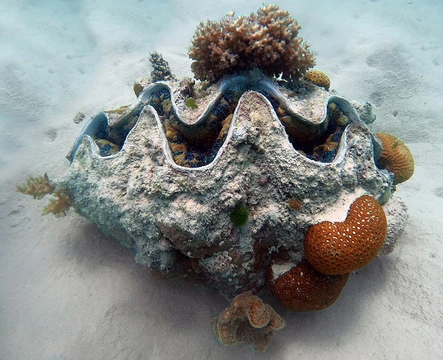
Pecten maximus
Northeast Atlantic scallop, type species of genus Pecten.

Pecten maximus, called the great scallop, king scallop, St James shell, or escallop, is a marine bivalve mollusc from the family Pectinidae found in the northeast Atlantic. It is the type species of its genus and might be the same species as Pecten jacobaeus (the pilgrim's scallop), though that form has a much smaller range.
The shell is sturdy, with equal-sized "ears" on each side of the apex. The right (lower) valve is convex and slightly overlaps the flat left (upper) valve. Large specimens are nearly circular and can reach 21 cm across. The ears are prominent, at least half the shell's width, and the byssal notch on the right front ear is shallow and smooth. The valves have 12 to 17 wide radiating ribs and many concentric lines that record growth; the ears have a few thin ribs radiating from the beaks. The ribs extend to the shell edges, creating a scalloped outline. The left valve is usually reddish-brown, while the right valve ranges from white to cream to pale brown, sometimes with pink, red, or pale yellow hints. Either valve may show zigzag patterns, bands, or spots of red, pink, or bright yellow. The body is pink or red, and the mantle is marbled brown and white. Young scallops attach to the substrate with a byssus, but adults can swim by rapidly opening and closing their valves. The adductor muscle is large and strong. The foot is a finger-like organ that spins byssal threads, which pass through the byssal notch. The mantle edge has two layers: an inner finely fringed layer and an outer layer lined with long tentacles and 30–36 dark blue or green simple eyes (ocelli) in two rows at their base.
This species lives in the eastern Atlantic along Europe from northern Norway to the Iberian Peninsula, and has been reported off West Africa and the Macaronesian Islands. Around Great Britain and Ireland it occurs all along the coast but is uncommon and localised on the eastern North Sea coast. It prefers offshore waters down to 100 metres deep.
Pecten maximus often creates a shallow hollow in the substrate by opening and closing its shells to eject water from the mantle cavity, raising the shell at an angle so that jets of water dig a recess. Once settled, sand, mud, gravel, or living organisms cover the upper valve, leaving only the shell margin with tentacles and eyes visible.
Quick Facts
- Genus
- Pecten
- Species
- maximus
Facts from the source article.
Lore & Background
The shell of Pecten maximus is robust, with equal-sized 'ears' on either side of the apex. The right valve is convex and slightly overlaps the flat left valve; larger specimens are nearly circular and may reach 21 cm. The sculpture consists of 12 to 17 wide radiating ribs and numerous concentric lines showing growth history. The left valve is normally reddish-brown, while the right valve varies from white through cream to shades of pale brown, often with zigzag patterns, bands, or spots of red, pink, or bright yellow. The body is pink or red with the mantle marbled brown and white. Young scallops attach by a byssus, but mature animals can swim by rapidly opening and closing the valves. The adductor muscle is very large and powerful. The mantle margin has two layers: an inner finely fringed layer and an outer lined with long tentacles and two series totalling 30–36 dark blue or green simple eyes at their base.
Pecten maximus occurs in the eastern Atlantic from northern Norway south to the Iberian Peninsula, also reported off West Africa and the Macaronesian Islands. It prefers offshore waters down to 100 metres. It frequently creates a slight hollow in the substrate by ejecting water from the mantle cavity. It is a filter feeder, extracting particles via cilia across the gills. Swimming is generally limited to escape reactions, triggered by predators such as the starfish Asterias rubens and Astropecten irregularis. The scallop jumps forward by rapidly clapping its valves. Scallops in sheltered habitats grow faster than those in exposed areas. Abundance and growth rates are negatively correlated with the amount of mud in the substrate. The reproductive cycle is extremely variable; they are hermaphroditic with tongue-shaped gonads (red/orange for female, white for male). A three-year-old scallop may release 15–21 million oocytes per emission. Fertilization is external. The larval stage lasts up to a month, allowing high dispersal potential.
Reader's Guide
Pecten maximus is notable as the type species of the genus Pecten and as a commercially important marine bivalve. The article reports that in 1999 the total catch reported by the United Nations Food and Agriculture Organisation was 35,411 tonnes, with the United Kingdom and France landing 19,108 tonnes and 12,745 tonnes respectively. Great scallops are fished using Newhaven scallop dredges, with less than 5% gathered by hand by divers. The fisheries for P. maximus and the queen scallop Aequipecten opercularis are among the top five fisheries by value in United Kingdom waters, though the use of towed gear causes damage to the wider ecosystem. Aquaculture of this species is reasonably advanced in France and Norway. The article notes that some natural stocks show indications of overexploitation, leading to strict enforcement of fisheries legislation and development of stock enhancement practices. A draft genome was presented by Kenny et al. 2020, with an assembly of 918 Mb and an estimated genome size of 1,150 Mb, coding 67,741 genes. Recent improvements in read length have helped resolve questions of copy number variation. The species is also of cultural note as the St James shell or escallop, and may be conspecific with the pilgrim's scallop.
Did You Know?
- Pecten maximus may be conspecific with Pecten jacobaeus, the pilgrim's scallop.
- A three-year-old scallop can release 15–21 million oocytes per emission.
- The adductor muscle used to close and open the valves is very large and powerful.
- The genome of Pecten maximus is estimated at 1,150 Mb with 67,741 genes.
More in Giant Clams and Marine Bivalves 1-24
Spotted an error? Know more?
Reader corrections go straight into our review queue. Suggest an edit · How this site is sourced