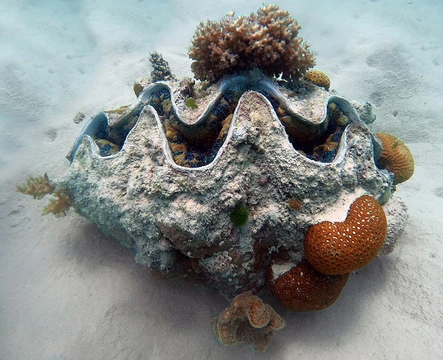
Nodipecten nodosus
The largest scallop of the Western-Atlantic Ocean.

Nodipecten nodosus, commonly known as the lion's paw scallop, is a species of bivalve mollusc in the family Pectinidae. It is notable as the largest scallop of the Western-Atlantic Ocean, found along the Atlantic coast of North America from Cape Hatteras to the West Indies, including Brazil and Bermuda. Its shell is known for its large size, vibrant colors, and distinct knobs on the ridges, which give it a visual similarity to a lion's paw.
Quick Facts
- Genus
- Nodipecten
- Species
- nodosus
Facts from the source article.
Lore & Background
The lion's paw scallop is an epibenthic bivalve that usually lives on rocks inside caves or in shaded areas, in deep tropical waters with rough sediment and rubble. It attaches to hard substrate and is a filter feeder, consuming microalgae from the water column. The species is hermaphroditic, with both male and female gonads, and reproduces through external fertilization, releasing eggs and sperm into the water. Spawning occurs twice a year; along the coast of Brazil, it spawns once in winter and once in summer. Fertilized eggs develop into 'D-shaped' veligers 22–24 hours after fertilization.
The shell ranges from 6.4 to 15.2 cm in length, is nearly circular, and has a moderately thick shell with flattened anterior wings near the hinge. Its colors vary from red to orange, with some appearing purple or yellow. The shell's common name derives from its color and knobs, which give it visual similarities to a lion's paw. The lion's paw scallop rarely produces pearls, and when it does, the pearl is composed mainly of calcite and is non-nacreous.
Reader's Guide
The lion's paw scallop has been commercially fished for human consumption for decades, and its recent decline in abalone fisheries, along with an increase in the shell's value, has led to aquaculture specific to the species. Its high growth rate makes it popular for farming, though not much is known about the requirements to improve farming. Due to its popularity in commercial fishing, lion's paw scallops native to Brazil face the risk of extinction. The species is also valuable to collectors because of its size, vibrant colors, and extremely distinctive features. Because of its large size and its occurrence in deeper, rocky waters, it is very rare to find an intact shell on sandy beaches. Lion's paw scallops usually occur in low densities and cannot be farmed from a fishery, but they are a commonly used species for aquaculture in the Caribbean Colombian due to their quick growth rate.
Did You Know?
- The lion's paw scallop is the largest scallop of the Western-Atlantic Ocean.
- It is hermaphroditic, releasing both eggs and sperm during external fertilization.
- Its shell ranges in color from red to orange, and also purple and yellow.
- Lion's paw scallops rarely produce pearls, and when they do, the pearls are non-nacreous and composed mainly of calcite.
More in Giant Clams and Marine Bivalves 1-24
Spotted an error? Know more?
Reader corrections go straight into our review queue. Suggest an edit · How this site is sourced