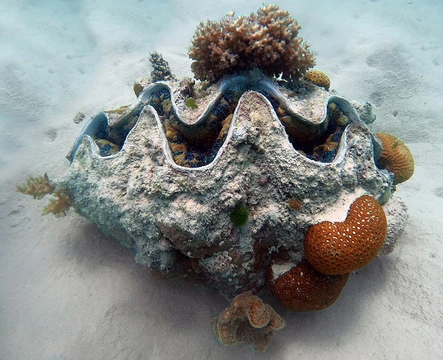
Hinnites
Genus of rock scallops that cement to substrates as adults.

Hinnites is a genus of rock scallops, a group of marine bivalve mollusks within the family Pectinidae. These animals have thick, oyster-like shells. A distinctive trait of this genus is its life cycle: juveniles are free-swimming, but as adults they permanently cement themselves to a hard surface, a behavior also seen in the living species *Crassadoma gigantea*. Fossil remains of *Hinnites* have been found in sediments dating from the Triassic period through the Quaternary, spanning roughly 235 million to 126,000 years ago. These fossils have been recovered from Algeria, Angola, Tanzania, Ethiopia, South Africa, Oman, Saudi Arabia, the United States, Australia, and several European countries. Species within the genus include *Hinnites corallinus*, *Hinnites crispus* (extinct), *Hinnites denticostatus* (extinct), *Hinnites distortus*, *Hinnites ercolanianus* (extinct), *Hinnites granulosus* (extinct), and *Hinnites obliquus* (extinct). Some former species, such as *Hinnites cortesyi*, are now considered synonyms of *Hinnites crispus*, while *Hinnites giganteus* and *Hinnites multirugosus* are recognized as synonyms of *Crassadoma gigantea*.
Quick Facts
- Taxon
- Hinnites
Facts from the source article.
Lore & Background
Hinnites is a genus of rock scallops, marine bivalve mollusks in the family Pectinidae. These mollusks have been recorded as fossils from the Triassic to the Quaternary (from 235.0 to 0.126 Ma). Fossils have been found in the sediments of Algeria, Angola, Tanzania, Ethiopia, South Africa, Oman, Saudi Arabia, United States, Australia and of various European countries.
The genus includes scallops with thick shells resembling that of an oyster. Hinnites is unusual in that, like the extant taxon Crassadoma gigantea, it was free-swimming as a juvenile, but subsequently cemented itself to a hard substrate.
Species within the genus include Hinnites corallinus, Hinnites crispus †, Hinnites denticostatus †, Hinnites distortus, Hinnites ercolanianus †, Hinnites granulosus †, and Hinnites obliquus †. Some species have been brought into synonymy: Hinnites cortesyi is a synonym of Hinnites crispus †; Hinnites giganteus and Hinnites multirugosus are synonyms of Crassadoma gigantea.
Reader's Guide
The significance of Hinnites lies in its unusual life history, as described in the source article: it was free-swimming as a juvenile but subsequently cemented itself to a hard substrate, a trait shared with the extant taxon Crassadoma gigantea. This adaptation distinguishes it from many other scallops in the family Pectinidae. The genus has a long fossil record, from the Triassic to the Quaternary (235.0 to 0.126 Ma), with fossils found across a wide geographic range including Africa, the Middle East, the United States, Australia, and Europe. The thick shells of Hinnites resemble those of an oyster, further setting it apart within its family. The article lists several species, both extant and extinct, and notes synonymies that clarify taxonomic relationships, such as the transfer of Hinnites giganteus and Hinnites multirugosus to the genus Crassadoma. This entry relies solely on the provided source and does not introduce any external information.
Did You Know?
- Hinnites is a genus of rock scallops in the family Pectinidae.
- Hinnites was free-swimming as a juvenile but later cemented itself to a hard substrate.
More in Giant Clams and Marine Bivalves 1-24
Spotted an error? Know more?
Reader corrections go straight into our review queue. Suggest an edit · How this site is sourced