Crassadoma
Monotypic genus of sessile rock scallops in the eastern Pacific.

Crassadoma is a genus of rock scallops, a type of marine bivalve mollusk within the family Pectinidae. This genus contains only one species: Crassadoma gigantea, commonly called the rock scallop, giant rock scallop, or purple-hinge rock scallop. Young scallops can swim freely, but they quickly become fixed in place, cementing themselves to a surface. These animals are found in the eastern Pacific Ocean.
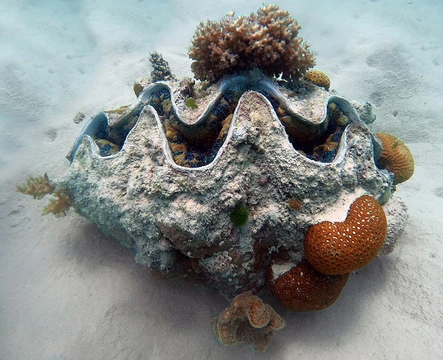
The adult rock scallop attaches its right valve to a base, often a vertical rock face, and this valve frequently deforms to match the rock’s shape. The left valve is roughly circular but irregular, thick and heavy, with deep radial ribs. Every third or fourth rib carries blunt spines that overlap one another, though these spines often wear down and become smooth as the scallop ages. On either side of the straight hinge are flaps of shell called auricles. The shell is generally brown, with a glossy white interior marked by a purple patch near the hinge and a large, central scar from the adductor muscle. In the intertidal zone, this scallop grows to about 15 centimeters (5.9 inches) in diameter, and in subtidal areas it can reach 25 centimeters (9.8 inches). Between the valves, the orange mantle edge is visible, lined with tiny blue eyes and a sparse fringe of short tentacles.
Crassadoma gigantea lives along the Pacific Coast of North America, from British Columbia south to Baja California and Mexico. Adults do not move; they stay on the seafloor, favoring crevices, spaces under boulders, or surfaces cemented to rock, coral, or man-made structures like harbor pilings. They are found at depths down to roughly 80 meters (260 feet).
Like other scallops, this species is a filter feeder, straining phytoplankton from water passing over its gills. Cilia move particles along grooves to the mouth, where edible material is separated from sediment. Waste is formed into mucous balls and expelled from the mantle cavity by a clapping motion of the valves.
The rock scallop is cryptic and hard to spot because its shell often hosts sponges, sea anemones, hydroids, barnacles, bryozoans, worms, and algae. The parasitic boring sponge *Cliona celata* damages the shell by creating hollows, though the mantle lays down extra shell material to compensate.
Quick Facts
- Genus
- Crassadoma
- Species
- gigantea
Facts from the source article.
Lore & Background
Adults of Crassadoma gigantea have one valve (the right valve) fixed to a base, often a vertical rock face. This valve often becomes deformed to fit the contours of the rock. The left valve is roughly circular but irregular in outline, thick and heavy, with deep radial ribs. Every third or fourth rib is clad with blunt spines that overhang each other, which often get abraded and worn smooth as the scallop ages. There are flaps of shell known as auricles on either side of the straight hinge. The general colour is brown with the inside of the shell being glossy white with a purple patch at the hinge and a large, central adductor muscle scar. Between the valves, the margin of the orange mantle can be seen, with a row of tiny blue eyes and a sparse fringe of short tentacles.
Crassadoma gigantea is found on the Pacific Coast of North America, from British Columbia south to Baja California and Mexico. It does not move around as an adult but lives on the sea floor. Its favoured habitats include inside crevices and under boulders, or cemented to rock surfaces, corals or man-made structures such as harbour pilings. It is found at depths down to about 80 metres (260 ft). The scallop is cryptic and difficult to detect because of the sponges, sea anemones, hydroids, barnacles, bryozoans, worms and algae which tend to grow on the shell. The parasitic boring sponge Cliona celata damages the shell by making hollows in it, and additional shell material is laid down by the mantle tissue to compensate. Other sponges, such as the yellow boring sponge (Cliona californiana) that grow on the shell may be considered mutualistic, granting some protection against predators such as the sunflower starfish (Pycnopodia helianthoides) and purple sea star (Pisaster ochraceus).
Reader's Guide
Crassadoma is notable as a monotypic genus of rock scallops that undergo a dramatic shift from free-swimming juveniles to permanently cemented adults. Its single species, Crassadoma gigantea, is distinguished by its purple-hinge and heavy, irregular shell that conforms to the substrate. The species is ecologically significant as a filter feeder in eastern Pacific waters, and its cryptic nature—camouflaged by fouling organisms—provides a unique example of mutualism and parasitism. The parasitic boring sponge Cliona celata damages the shell, while the yellow boring sponge Cliona californiana may offer protection against predators like the sunflower starfish and purple sea star. Experimental evidence suggests that rock scallops grow faster in deeper water, possibly due to reduced fouling. The species spawns in summer, with veliger larvae spending about 40 days in the zooplankton before settling. Juveniles are free-living and can swim, but by the time they reach 4.5 cm in diameter they typically cement themselves permanently. Rock scallops can live at least 20 years, shifting energy from growth to gamete production around mid-life. This life history and its interactions with fouling organisms make Crassadoma a subject of interest in marine biology and ecology.
Did You Know?
- Crassadoma gigantea is the only species in the genus Crassadoma.
- Juveniles are free-swimming but become permanently cemented to the substrate by about 4.5 cm in diameter.
- The shell often has sponges, sea anemones, hydroids, barnacles, bryozoans, worms and algae growing on it, making the scallop cryptic.
- The parasitic boring sponge Cliona celata damages the shell, but the yellow boring sponge Cliona californiana may protect against predators.
Frequently Asked Questions
What is Crassadoma?
Crassadoma is a single-species genus of rock scallops in the family Pectinidae, containing only Crassadoma gigantea. You'll most often hear it called the rock scallop, giant rock scallop, or purple-hinge rock scallop.
How big does a rock scallop get?
Intertidal individuals top out at roughly 15 cm (5.9 in) in shell diameter, while those living below the tide line can reach about 25 cm (9.8 in). They occur at depths extending down to approximately 80 m (260 ft).
How does a rock scallop cement itself to rock?
After a planktonic larval phase lasting around 40 days, the young scallop reaches about 4.5 cm (1.8 in) in diameter and begins to permanently attach to a surface. The adult then fixes its right valve—often to a vertical rock face—and that valve gradually deforms to mirror the contours of the rock.
Where in the ocean can you find Crassadoma?
The genus is restricted to the eastern Pacific Ocean. They typically settle on vertical rock faces in both intertidal and subtidal habitats.
Can rock scallops actually swim?
Only as larvae; they drift freely in the plankton for roughly 40 days before settling. Once they cement to a substrate at around 4.5 cm in diameter, they remain sessile for the rest of their lives and can no longer move under their own power.
More in Giant Clams and Marine Bivalves 1-24
Spotted an error? Know more?
Reader corrections go straight into our review queue. Suggest an edit · How this site is sourced