Chlamys hastata
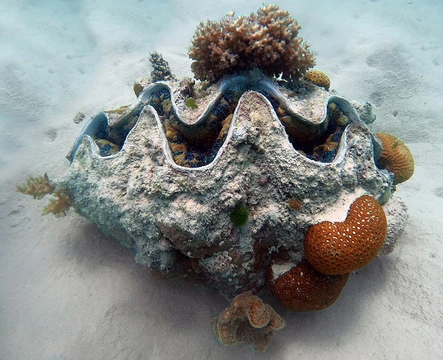
A spiny scallop with a symbiotic sponge on its shell.

**Chlamys hastata**—also called the spear scallop, spiny scallop, or swimming scallop—is a bivalve mollusk in the family Pectinidae. Its range runs along the west coast of North America, from the Gulf of Alaska down to San Diego, California. Off the coast of Canada, a small number are harvested by divers or with narrow trawls.
The name *Chlamys* comes from the Latin word for a Greek soldier’s short woolen cloak or cape; *hastata* means “spear-like,” from *hasta*, a spear or javelin.
The shell is somewhat fan-shaped and can grow to about 9 cm (3.5 in) tall, though adults more commonly reach 6 cm (2.4 in). It has two convex valves, each with a few broad ribs covered in blunt spines. These ribs radiate from the umbone—the rounded bump near the hinge—and fine etched striations run between them. The background color is white with pale purple radial bands; the right valve, usually underneath, is paler than the left. Annual growth rings are visible, often as concentric bands of a different hue. Near the hinge are two irregular shell flaps (auricles), with the front one usually much larger. This larger flap anchors the single strong adductor muscle that closes the shell. Along the long hinge are small ridges and grooves called teeth, which keep the valves from sliding sideways. Unlike some bivalves, the spiny scallop has no large “cardinal” teeth below the umbone; instead, it has five or six lateral teeth on each side of the hinge. The mantle—a membrane lining the inside of the valves and covering the gut and other organs—appears as a thick layer around the valve margins. It is fringed with many short tentacles, and a row of tiny simple eyes sits close to each valve. The animal usually rests on its right valve, and its exposed left valve often hosts a colonial sponge.
The spiny scallop differs from its close relative, the Pacific pink scallop (*Chlamys rubida*), by having less rounded valves and small curved spines on the ribs that make it rough to the touch (the Pacific pink feels smooth). The inside of the spiny scallop’s shell is glossy white, often with a purplish blotch near the umbone—a mark the Pacific pink lacks.
It lives on the seabed in the sublittoral zone, from the low tide mark down to about 150 m (490 ft), on soft sediment or rock, especially in areas with strong currents.
Quick Facts
- Genus
- Chlamys
- Species
- hastata
Facts from the source article.
Lore & Background
The spiny scallop lives on the seabed in the sublittoral zone, on soft sediment or rock, particularly in areas with strong currents. It is a filter feeder, sieving microscopic algae from water passing through its gills. Its shell is fan-shaped, with broad ribs covered in blunt spines, and the right valve is paler than the left. The animal usually lies on its right valve, and the exposed left valve often hosts a colonial sponge. The spiny scallop can be distinguished from the Pacific pink scallop (Chlamys rubida) by its less rounded valves and small curved spines that give it a rough texture, as well as a purplish blotch near the umbone on the interior. It anchors itself to the substrate with byssus threads, though their purpose is unclear; they may help orient the scallop for feeding or angle it for a quick getaway. The scallop can detect predators by smell and sight and can swim away by opening and closing its valves. It is preyed upon by starfish, octopuses, and sea otters.
Reader's Guide
The spiny scallop is significant for its symbiotic relationship with encrusting sponges, most often the orange Myxilla incrustans or the purple or brown Mycale adhaerens. The sponge provides camouflage and may deter predators by producing a repulsive odour or making it harder for starfish to grip the shell. The sponge benefits by being kept free of sediment. In areas of high turbidity, both scallops and their sponges grow larger, and laboratory studies showed that sponges on living scallops survived stirred-up sediment while those on empty shells died. However, scallops heavily encrusted by sponges had significantly lower growth rates than unencumbered ones. Other epibionts such as tube worms, barnacles, and bryozoans also grow on the shell, and the boring sponge Cliona celata parasitically makes holes in the valve. A limited number of these scallops are harvested by divers or narrow trawls off the west coast of Canada.
Did You Know?
- The spiny scallop can process about 4 litres of water per hour per gram of its weight.
- Its eyes contain a lens, two retinas, and a concave spherical mirror, detecting light and darkness.
- The larvae drift with plankton for about 40 days before metamorphosing into benthic juveniles.
- The scallop's scientific name comes from Latin: chlamys meaning a Greek cloak, and hastata meaning 'spear-like'.
More in Giant Clams and Marine Bivalves 1-24
Spotted an error? Know more?
Reader corrections go straight into our review queue. Suggest an edit · How this site is sourced