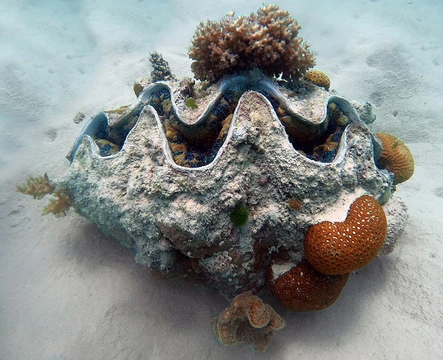
Argopecten irradians
Edible saltwater bivalve native to the northwest Atlantic.

Argopecten irradians, formerly classified as Aequipecten irradians, is a species of scallop in the family Pectinidae. Common names include Atlantic bay scallop, bay scallop, and blue-eyed scallop. It is an edible saltwater bivalve native to the northwest Atlantic from Cape Cod to the Gulf of Mexico.
Quick Facts
- Genus
- Argopecten
- Species
- irradians
Facts from the source article.
Lore & Background
At the northern extreme of its range in Massachusetts, germ and gonial cells complete and begin development in winter and early spring. At the southern extreme in Tarpon Springs, Florida, cytoplasmic growth stages occur in July when water temperatures are highest. Several immune-related proteins have been identified in this species: AiPGRP, a peptidoglycan recognition protein, was the first bivalve PGRP cloned (Ni et al. 2007). AiGal1 is a galectin discovered by Song et al. 2010. CfToll-1, a toll-like receptor shared with other bivalves, was first found in this scallop by Song et al. 2006, who also found an inhibitor of κB. AiBD is the first big defensin cloned from this scallop; its recombinant form is antimicrobial against Gram-positive bacteria, Gram-negative bacteria, and fungi. Manganese superoxide dismutase mRNA expression increases in the gill and mantle in response to Vibrio anguillarum.
Reader's Guide
The bay scallop once supported a large wild fishery on the East Coast of the United States, but since the 1950s it has decreased greatly, apparently due to reduced sea grasses from coastal development and nutrient runoff. In contrast, the Atlantic sea scallop (Placopecten magellanicus) is at historically high levels because the Magnuson-Stevens Fishery Conservation and Management Reauthorization Act of 2006 limited catch numbers and allowed recovery from overfishing. Scallop farming is a million-dollar industry in Canada, with British Columbia producing 85% of the country's farmed scallops. Aquaculture is also practiced in Florida, and the species was introduced into China in the 1980s, where it supports a vibrant aquaculture industry. The species has five subspecies, including one fossil subspecies (A. i. sablensis).
Did You Know?
- AiPGRP was the first bivalve peptidoglycan recognition protein to be cloned.
- The species was introduced into China in the 1980s and supports a vibrant aquaculture industry there.
- British Columbia produces 85% of Canada's farmed scallops.
More in Giant Clams and Marine Bivalves 1-24
Spotted an error? Know more?
Reader corrections go straight into our review queue. Suggest an edit · How this site is sourced