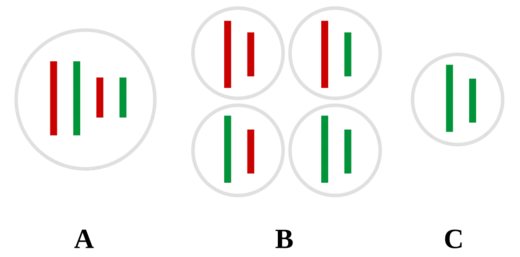
Operon
A cluster of genes transcribed into a single mRNA molecule.

An operon is a DNA unit where a cluster of genes is controlled by a single promoter. These genes get transcribed together into one mRNA molecule. That mRNA may then be translated as a single piece in the cytoplasm, or it might be spliced into separate monocistronic mRNAs, each coding for one protein. The key result is that all the genes in the operon are either turned on or off as a group. For an operon to exist, several genes must be co-transcribed.
Operons were originally believed to occur only in prokaryotes—including bacteria-derived organelles like plastids. However, they were found in eukaryotes in the early 1990s, though they remain rare there. In prokaryotes, operons usually produce polycistronic mRNAs, while eukaryotic operons typically yield monocistronic mRNAs. Viruses, such as bacteriophages, also have operons. For instance, T7 phages contain two operons: the first codes for several products, including a T7 RNA polymerase that binds to and transcribes the second operon, which includes a lysis gene that makes the host cell burst.
The term "operon" was first proposed in a short 1960 paper in the Proceedings of the French Academy of Sciences. That paper introduced the general theory of the operon, which held that genes within an operon are always negatively controlled by a repressor acting at a single operator located before the first gene. Later research showed that genes could be positively regulated and also controlled after transcription initiation. Because different operons use different mechanisms, there is no single general regulatory mechanism. Today, an operon is simply defined as a cluster of genes transcribed into a single mRNA molecule. Still, the concept’s development is considered a landmark in molecular biology. The first operon described was the *lac* operon in *E. coli*, and the 1965 Nobel Prize in Physiology or Medicine was awarded to François Jacob, André Michel Lwoff, and Jacques Monod for their discoveries concerning genetic control of enzyme and virus synthesis.
Operons are found mainly in prokaryotes, but also rarely in some eukaryotes, such as nematodes like *C. elegans* and the fruit fly *Drosophila melanogaster*. rRNA genes often exist in operons, which have been found in a range of eukaryotes, including chordates. An operon consists of several structural genes arranged under a common promoter and regulated by a common o
- first described
- 1960
- first operon discovered
- lac operon in E. coli
- term coined by
- François Jacob, André Michel Lwoff, Jacques Monod
- Nobel Prize
- 1965 Nobel Prize in Physiology and Medicine
- primary occurrence
- prokaryotes
- rare occurrence
- eukaryotes (e.g., C. elegans, Drosophila melanogaster)
Lore & Background
The term 'operon' was first proposed in a short paper in the Proceedings of the French Academy of Sciences in 1960. From this paper, the general theory of the operon was developed, suggesting that genes within an operon are negatively controlled by a repressor acting at a single operator. Later discoveries showed that genes could be positively regulated and regulated at steps after transcription initiation, so no general regulatory mechanism exists for all operons. The first operon described was the lac operon in E. coli. The 1965 Nobel Prize in Physiology and Medicine was awarded to François Jacob, André Michel Lwoff and Jacques Monod for their discoveries concerning genetic control of enzyme and virus synthesis.
Reader's Guide
The operon concept is a landmark in molecular biology, providing the first clear model of coordinated gene regulation. Operons occur primarily in prokaryotes but also rarely in some eukaryotes, including nematodes such as C. elegans and the fruit fly Drosophila melanogaster. An operon consists of structural genes under a common promoter and regulated by a common operator. Regulation can be negative or positive, by induction or repression. The lac operon in E. coli is the classic example, negatively controlled and inducible by allolactose. The trp operon is a negatively controlled repressible operon. Operons are related to regulons, stimulons, and modulons. The term 'operon' is derived from the verb 'to operate'. The discovery that operons exist in eukaryotes, though rare, expanded the concept beyond prokaryotes.
Did You Know?
- The term 'operon' was first proposed in a short paper in the Proceedings of the French Academy of Sciences in 1960.
- The first operon to be described was the lac operon in E. coli.
- Operons are also found in viruses such as bacteriophages; for example, T7 phages have two operons.
- The 1965 Nobel Prize in Physiology and Medicine was awarded to François Jacob, André Michel Lwoff and Jacques Monod for their discoveries concerning the operon and virus synthesis.
More in Genetics Fundamentals 1-24
Spotted an error? Know more?
This is a living reference — every entry is fact-audited, and reader corrections feed straight into our audit queue. Suggest an edit · See this site's audit record