Genetic recombination
Exchange of genetic material producing novel trait combinations.

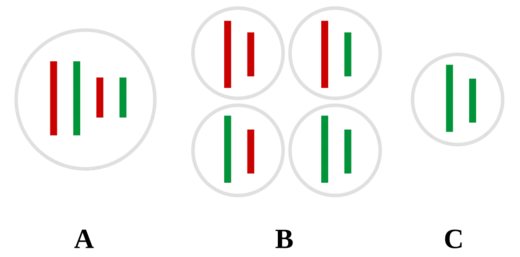
Genetic recombination, or genetic reshuffling, is the process where genetic material is swapped between organisms, creating offspring with trait combinations not seen in either parent. In eukaryotes, it happens naturally during meiosis, producing a novel set of genetic information passed to offspring. Most recombination occurs naturally and falls into two types: interchromosomal recombination, which happens through independent assortment of alleles on different homologous chromosomes (random orientation of chromosome pairs in meiosis I), and intrachromosomal recombination, which occurs via crossing over.
During eukaryotic meiosis, homologous chromosomes pair up, and information may transfer between them. This transfer can happen without physical exchange—where a section of genetic material is copied from one chromosome to another without altering the donor (as in the SDSA pathway)—or through breaking and rejoining DNA strands to form new molecules (as in the DHJ pathway). Recombination also occurs during mitosis in eukaryotes, typically between sister chromatids after replication, but this doesn’t produce new allele combinations since sister chromatids are usually identical. In both meiosis and mitosis, recombination happens between similar DNA sequences (homologous sequences). In meiosis, non-sister homologous chromosomes pair, so recombination typically occurs between them. In both meiotic and mitotic cells, homologous recombination is a common DNA repair mechanism. Gene conversion, where homologous sequences become identical, also falls under genetic recombination.
Bacteria and archaea, which reproduce asexually, also undergo genetic recombination and recombinational DNA repair. Recombination can be artificially induced in the lab to create recombinant DNA, used for purposes like vaccine development. V(D)J recombination in organisms with adaptive immune systems is a type of site-specific genetic recombination that helps immune cells rapidly diversify to recognize new pathogens.
The mechanism is driven by enzymes called recombinases, which catalyze the strand transfer step. In *E. coli*, the main recombinase is RecA, responsible for repairing double-strand breaks. In yeast and other eukaryotes, two recombinases handle double-strand break repair: RAD51 for mitotic and meiotic recombination, and DMC1 specifically for meiotic recombination. In archaea, the
- field
- Genetics, Molecular Biology
- known_for
- Exchange of genetic material between organisms, producing novel trait combinations; key mechanisms include crossing over, gene conversion, and V(D)J recombination
Lore & Background
Genetic recombination occurs through two main types: interchromosomal recombination, via independent assortment of alleles on different homologous chromosomes, and intrachromosomal recombination, via crossing over. During meiosis, homologous chromosomes pair and may exchange information either without physical exchange (synthesis dependent strand annealing, SDSA) or by breaking and rejoining DNA strands (double-Holliday junction pathway, DHJ). Recombination also occurs during mitosis between sister chromatids, though this usually does not produce new allele combinations. In bacteria, recombination occurs through transformation, transduction, and conjugation.
Reader's Guide
Genetic recombination is a fundamental biological process that generates genetic variation, which is essential for evolution and adaptation. In sexually reproducing organisms, meiotic recombination shuffles genes between homologous chromosomes, increasing diversity and helping avoid the accumulation of deleterious mutations (Muller's ratchet). Recombination also plays a critical role in DNA repair, using homologous sequences to fix double-strand breaks and other damage. The frequency of recombination between two loci depends on their distance apart, allowing geneticists to construct genetic maps and infer gene linkage. In organisms with adaptive immune systems, V(D)J recombination enables rapid diversification of immune cells to recognize new pathogens. The process is catalyzed by recombinases such as RecA in bacteria, RAD51 and DMC1 in eukaryotes, and RadA in archaea. Understanding recombination has practical applications, including the production of recombinant DNA for vaccines and other biotechnology.
Did You Know?
- Genetic recombination can occur without physical exchange, via synthesis dependent strand annealing (SDSA), where a section of genetic material is copied from one chromosome to another without the donating chromosome bei
- In bacteria, recombination occurs through three main ways: transformation (uptake of exogenous DNA), transduction (virus-mediated transfer), and conjugation (cell-to-cell contact).
- V(D)J recombination in organisms with an adaptive immune system is a type of site-specific genetic recombination that helps immune cells rapidly diversify to recognize new pathogens.
- Achiasmy is the phenomenon where autosomal recombination is completely absent in one sex of a species, such as in male Drosophila melanogaster.
Origins and Mechanisms of Genetic Variation
Genetic variation—the differences in DNA sequences among individuals or between populations of the same species—arises from several distinct mechanisms. While random mutations stand as the ultimate source of new genetic material, they are typically rare events, and most are either neutral or harmful to the organism. In certain cases, however, a newly created allele may be favored by natural selection, giving it a foothold in the population. Beyond mutation, genetic recombination through crossing over and random segregation during meiosis shuffles existing alleles into novel combinations. Random fertilization adds another layer of mixing. Transposable genetic elements, endogenous retroviruses, LINEs, and SINEs further facilitate variation and recombination. For multicellular organisms, this variation can be acquired in somatic cells or passed down through the germline. Additionally, persistent viruses and their defective counterparts can introduce genetic novelty into host genomes, supplementing the recombination driven by transposable elements.
Scales and Forms of Genetic Change
Genetic variation manifests across a wide spectrum of genomic scales. At the smallest level, changes under one kilobase in length include simple base-pair substitutions and insertions or deletions, commonly called indels. Moving to larger structural changes exceeding one kilobase, organisms can experience copy number variation—gaining or losing copies of genomic segments—or chromosomal rearrangements such as translocations, inversions, and segmental acquired uniparental disomy. At the numerical level, whole-chromosome or whole-genome changes take the form of polyploidy, where an organism carries three or more complete sets of chromosomes, or aneuploidy, involving gains or losses of individual chromosomes. These different forms of variation interact with recombination processes. Transposable elements and endogenous retroviruses drive recombination at certain scales, while persistent viruses and their defective variants add another source of genetic novelty. The interplay between these small, large, and numerical changes shapes the full landscape of genetic diversity within and between species.
Recombination as a Driver of RNA Virus Evolution
In the world of RNA viruses, genetic recombination plays a pivotal role alongside the high mutation rates that result from the absence of proofreading mechanisms. When at least two viral genomes coexist within a single host cell, numerous RNA viruses are capable of recombining their genetic material. Among the Picornaviridae family of positive-sense single-stranded RNA viruses, such as poliovirus, recombination appears to be a major force shaping genome architecture and directing the trajectory of viral evolution. In Retroviridae, exemplified by HIV, a specific form of recombination called strand switching occurs during reverse transcription, helping the virus avoid damage to its RNA genome. Coronaviruses, including SARS, also undergo recombination. Overall, recombination in RNA viruses seems to function as an adaptive strategy for dealing with genome damage. Notably, recombination can occur infrequently between divergent lineages of the same viral species, and the resulting recombinant viruses have occasionally triggered outbreaks of human infection.
Maintenance, Measurement, and Population-Level Effects
Genetic variation within populations is preserved through several mechanisms. In diploid organisms, potentially harmful recessive alleles can remain hidden from natural selection because they are masked in heterozygous individuals; these alleles are only expressed in the less common homozygous state. Balanced polymorphisms represent another maintenance strategy, occurring when heterozygotes enjoy a selective advantage or when selection operates in a frequency-dependent manner. At the population level, geographic separation produces geographic variation, driven by the combined effects of natural selection, genetic drift, and gene flow. Scientists commonly quantify within-population variation by measuring the percentage of polymorphic gene loci or the proportion of loci found in heterozygous individuals. These measurements prove valuable for understanding how individuals adapt to their environments. Polymorphic genes—those carrying more than one allele at a given locus—are found in roughly half of enzyme-coding genes in insects and plants, though they are less prevalent among vertebrates.
Frequently Asked Questions
Who is Genetic recombination?
Genetic recombination is the biological process by which DNA segments are exchanged between chromosomes or organisms, yielding offspring that carry trait combinations absent in either parent. It sits at the heart of genetics and molecular biology as a core mechanism for generating diversity.
What are Genetic recombination's powers/role?
Its central job is to shuffle genetic material so that new allele combinations arise in the next generation. The key tools it wields include crossing over during meiosis, gene conversion events, and V(D)J recombination in developing immune cells.
How does Genetic recombination's story end?
The narrative resolves with the formation of gametes or offspring bearing a freshly mixed genome, guaranteeing that no two individuals (barring identical twins) share an identical set of alleles. That reshuffled package is then inherited by the next generation, perpetuating the cycle.
Why is Genetic recombination important?
It is the principal engine of biological diversity, supplying the raw variation on which natural selection can act. Without this constant reshuffling, populations would lack the adaptive flexibility needed to survive shifting environments.
Where and how does Genetic recombination operate?
In eukaryotes it unfolds naturally during meiosis, most visibly in prophase I when homologous chromosomes align and exchange segments. The process splits into two broad modes: interchromosomal recombination driven by independent assortment of whole chromosome pairs, and intrachromosomal recombination produced by crossing over within a single chromosome.
More in Genetics Fundamentals 1-24
Spotted an error? Know more?
This is a living reference — every entry is fact-audited, and reader corrections feed straight into our audit queue. Suggest an edit · See this site's audit record