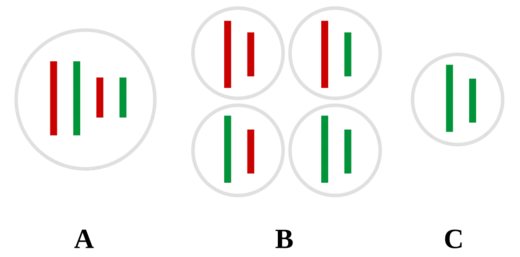
Horizontal gene transfer
Movement of genetic material between organisms beyond parent-to-offspring inheritance.

Horizontal gene transfer (HGT), also called lateral gene transfer (LGT), refers to the movement of genetic material between organisms that is not the result of parent-to-offspring DNA transmission during reproduction. This process is a key factor in the evolution of many life forms, reshaping scientific views on higher-order evolution and, even more significantly, transforming how bacterial evolution is understood. HGT is now seen as a widespread evolutionary mechanism that moves genes across distantly related prokaryotic groups and can also involve eukaryotes.
The main way antibiotic resistance spreads in bacteria is through horizontal gene transfer. HGT also plays a major role in the evolution of bacteria that can break down novel compounds, such as human-made pesticides, and in the development, maintenance, and transmission of virulence. This transfer often relies on temperate bacteriophages and plasmids. Genes that provide antibiotic resistance in one bacterial species can move to another species via HGT mechanisms like transformation, transduction, and conjugation, giving the recipient bacteria resistance to antibiotics. The rapid spread of resistance genes this way is creating a growing challenge for medicine. Ecological factors may also influence the horizontal transfer of these resistance genes.
HGT events are thought to happen less often in eukaryotes than in prokaryotes, but increasing evidence shows that HGT is fairly common among many eukaryotic species and can affect their ability to adapt to new environments. Studying this in eukaryotes is difficult, however, because their genomes are complex and contain many repeat-rich regions, which makes it hard to accurately identify and characterize transferred genes. It is proposed that HGT helps maintain a universal biochemistry of life and, as a result, the universality of the genetic code.
**History** The first experiment suggesting bacteria could transfer genetic information—through a process called transformation—was Griffith's experiment, reported in 1928 by Frederick Griffith. This was followed by research in the late 1930s and early 1940s that identified DNA as the material carrying this genetic information. In 1951, horizontal genetic transfer was described in Seattle in a paper showing that transferring a viral gene into *Corynebacterium diphtheriae* turned a non-virulent strain into a virul
- field
- Molecular biology, genetics, evolutionary biology
- known_for
- Primary mechanism for spread of antibiotic resistance in bacteria; influences bacterial evolution and adaptation; involves transformation, transduction, conjugation, and gene transfer agents
- first_experiment
- Griffith's experiment (1928) suggesting bacteria can transfer genetic information via transformation
- first_inter_bacterial_transfer_demonstra
- Japan, 1959 publication showing antibiotic resistance transfer between different bacterial species
- key_mechanisms
- Transformation, transduction, bacterial conjugation, gene transfer agents, horizontal transposon transfer
Lore & Background
Horizontal gene transfer was first suggested by Frederick Griffith's experiment in 1928, which indicated bacteria could transfer genetic information through transformation. This was followed by research in the late 1930s and early 1940s that isolated DNA as the material communicating this information. In 1951, a paper from Seattle demonstrated that transfer of a viral gene into Corynebacterium diphtheriae created a virulent strain from a non-virulent one, revealing the mechanism of diphtheria and providing the first example of the lysogenic cycle's relevance. Inter-bacterial gene transfer was first described in Japan in a 1959 publication showing antibiotic resistance transfer between different bacterial species. In the mid-1980s, Syvanen postulated that biologically significant lateral gene transfer has existed since the beginning of life and has shaped all of evolutionary history.
Reader's Guide
Horizontal gene transfer is a fundamental evolutionary process that challenges traditional views of vertical inheritance. It is the primary mechanism for the spread of antibiotic resistance in bacteria, playing a crucial role in the evolution of bacteria that can degrade novel compounds such as human-created pesticides and in the evolution, maintenance, and transmission of virulence. HGT often involves temperate bacteriophages and plasmids, and its rapid spread of antibiotic resistance genes is becoming a challenge to manage in medicine. While HGT events are thought to occur less frequently in eukaryotes than in prokaryotes, growing evidence indicates it is relatively common among many eukaryotic species and can impact adaptation to novel environments. Its study is hindered by the complexity of eukaryotic genomes and repeat-rich regions. HGT is postulated to promote the maintenance of a universal life biochemistry and the universality of the genetic code. Molecular biologists such as Peter Gogarten have described horizontal gene transfer as 'A New Paradigm for Biology.'
Did You Know?
- Griffith's experiment in 1928 was the first to suggest bacteria can transfer genetic information through transformation.
- Horizontal gene transfer is the primary mechanism for the spread of antibiotic resistance in bacteria.
- HGT can involve temperate bacteriophages and plasmids, and mechanisms include transformation, transduction, and conjugation.
- Horizontal transposon transfer (HTT) is a common and widespread phenomenon in eukaryote evolution as well as prokaryotes.
The Machinery of Transfer
The primary vehicle for moving whole mitochondria between cells is an actin-rich membrane protrusion called a tunneling nanotube, or TNT. The process begins when a donor cell extends a filopodium-like protrusion toward a neighboring cell; upon reaching the recipient, the protrusion retracts, leaving behind an ultrafine bridge suspended above the substrate through which mitochondria and their genomes travel. This structural dependency on actin dynamics means that chemical inhibitors or mechanical disruption can block TNT formation and substantially reduce mitochondrial exchange. Interestingly, certain stressors such as doxorubicin or ethidium bromide actually stimulate TNT formation, suggesting cells may upregulate this pathway under duress. Beyond TNTs, researchers have also proposed alternative routes for organelle sharing, including membrane microvesicles, direct cell fusion, dendritic extensions, and active mitochondrial extrusion, though TNTs remain the best-characterized and most widely supported mechanism.
Evidence Across Laboratory and Living Systems
The first documented case of functional mitochondrial transfer in culture involved human mesenchymal stem cells delivering healthy mitochondria to lung carcinoma cells whose own organelles had lost function, effectively restoring their bioenergetic capacity. Since then, transfer has been observed from stem cells and endothelial cells to breast, ovarian, and osteosarcoma lines, and even between cancer cell types such as mesothelioma and laryngeal carcinoma. Non-tumor donors including renal epithelial cells, retinal pigment epithelial cells, and monocyte-derived macrophages have also been shown to contribute mitochondria to neighbors. In living organisms, a striking example comes from transmissible canine venereal tumor, a clonal cancer spread during mating in feral dogs; phylogenetic analysis of mitochondrial sequences revealed that tumor cells periodically harvest mitochondria from their host, counteracting the high mutation rate that would otherwise accumulate deleterious changes and threaten long-term survival.
Cancer, Immune Manipulation, and Therapeutic Resistance
Within the tumor microenvironment, mitochondrial transfer operates as a bidirectional resource exchange that can profoundly alter cancer cell behavior. Highly glycolytic cancer-associated fibroblasts, for instance, donate their surplus mitochondria to neighboring prostate cancer cells, boosting the tumor's respiratory capacity. This same process has been linked to chemotherapy resistance, as cancer cells replenish damaged organelles from healthy neighbors, restoring mitochondrial transcription, translation, and oxidative phosphorylation. A 2026 study in mice added a chilling dimension: tumor cells were able to compel immune cells to release their mitochondria, which the tumor then absorbed. This not only fortified the cancer cells—activating genes in the type 1 interferon pathway that help them evade immune detection—but simultaneously weakened the immune cells that had surrendered their organelles. Together, these findings position mitochondrial transfer as a central node in tumor survival, immune subversion, and treatment failure.
Tissue Repair, Development, and Broader Physiological Roles
Beyond oncology, mitochondrial transfer appears to be a fundamental physiological process with wide-ranging consequences. In acute lung injury models, bone marrow-derived stem cells injected into mice transfer intact mitochondria to alveolar cells, shielding them from damage and supporting tissue repair. Overexpression of Miro1, a protein that tethers mitochondria to cytoskeletal motor proteins, enhances this transfer from mesenchymal stem cells into stressed epithelial cells via TNTs, underscoring the role of cytoskeletal coupling in the process. In the brain, injured neurons that cannot be rapidly replaced after ischemia benefit from functional mitochondria donated by astrocytes or stem cells, promoting neurological recovery. More broadly, because stem cells, immortalized cells, and primary cells can all serve as mitochondrial donors within their niches, this exchange is implicated in cell differentiation, proliferation, tissue homeostasis, development, and the aging process, suggesting that mitochondrial sharing is a pervasive mechanism of cellular cooperation.
Frequently Asked Questions
Who is Horizontal gene transfer?
Horizontal gene transfer is the process by which genetic material moves directly between organisms outside of normal parent-to-offspring reproduction. It also goes by the name lateral gene transfer and operates across prokaryotes and, in some cases, eukaryotes.
What are Horizontal gene transfer's powers and abilities?
HGT moves genes through several distinct mechanisms: transformation (uptake of free environmental DNA), transduction (virus-mediated shuttling), and conjugation (direct cell-to-cell transfer via a physical bridge). It can also involve dedicated gene transfer agents that package and deliver DNA between bacterial cells.
What is Horizontal gene transfer's origin story?
The idea first took shape with Frederick Griffith's 1928 experiment, which showed that a harmless pneumococcus strain could acquire lethal traits by absorbing material from a dead virulent strain. The first clear demonstration of resistance genes jumping between living bacteria came from a 1959 publication out of Japan.
Why is Horizontal gene transfer so important to the story?
HGT is the primary engine behind the rapid spread of antibiotic resistance among bacterial populations, making it a central concern in modern medicine. It also fundamentally reshaped how scientists view evolution, showing that the tree of life is more of a tangled web than a simple branching structure.
How does Horizontal gene transfer's story end?
It doesn't really end—HGT is a continuous, ongoing force that keeps reshaping microbial genomes and driving adaptation in real time. Its lasting legacy is a fundamentally revised picture of evolution, one in which genes can leap across species boundaries rather than passing only downward through generations.
More in Genetics Fundamentals 1-24
Spotted an error? Know more?
This is a living reference — every entry is fact-audited, and reader corrections feed straight into our audit queue. Suggest an edit · See this site's audit record