Genetic linkage
Tendency of nearby DNA sequences to be inherited together.

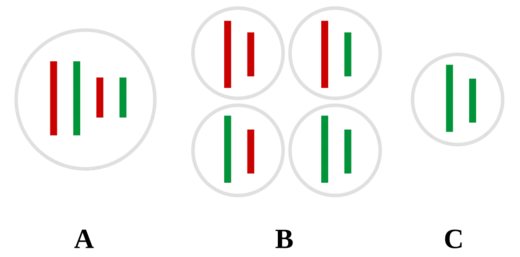
Genetic linkage describes how DNA sequences positioned near each other on a chromosome tend to be passed down together during meiosis. The closer two genes are, the less likely a crossover event will separate them, making their inheritance more predictable. Markers on different chromosomes are completely unlinked, though the expression of harmful alleles can be influenced by other alleles elsewhere in the genome. This phenomenon is the main exception to Mendel’s law of independent assortment.
An early hint of linkage came in 1905 from British geneticists William Bateson, Edith Rebecca Saunders, and Reginald Punnett. Working with sweet peas, they crossed pure lines for flower color (purple vs. red) and pollen shape (long vs. round), then self-crossed the offspring. Mendel’s 9:3:3:1 ratio predicted equal combinations, but the researchers saw far more purple-long and red-round plants than expected, and fewer purple-round and red-long ones. They called this puzzling pattern 'coupling' and 'repulsion' but did not understand its chromosomal basis. The concept of linkage as physical proximity on a chromosome was established later by Thomas Hunt Morgan and his group around 1910–1911, working with Drosophila. Morgan noticed that the rate of crossing over between linked genes varied, suggesting that crossover frequency could measure the distance separating genes on a chromosome. The centimorgan (cM), the standard unit of genetic linkage, honors him. One centimorgan means two markers separate into different chromosomes once per 100 meiotic products—or once per 50 meioses.
A linkage map, or genetic map, charts the positions of genes or markers relative to one another using recombination frequencies, not physical distances. Alfred Sturtevant, a student of Morgan, created the first such maps. The logic is simple: the more often two markers recombine, the farther apart they lie; the less they recombine, the closer they are. Early maps relied on visible traits like eye color or enzyme production, but modern maps use noncoding DNA markers such as microsatellites or RFLPs. Linkage maps help researchers find new genes by testing for linkage with known markers. As data accumulates, markers group into linkage sets that eventually cover entire chromosomes. In well-studied organisms, these groups correspond one-to-one with actual chromosomes. A linkage map is n
- field
- Genetics
- known_for
- Exception to Mendel's Law of Independent Assortment; basis of linkage maps and linkage analysis
- unit
- Centimorgan (cM)
- first_experiment
- 1905 by Bateson, Saunders, and Punnett in sweet pea (observed coupling/repulsion, not interpreted as chromosomal linkage)
- key_researcher
- Thomas Hunt Morgan (established linkage as physical proximity on chromosomes, 1910–1911)
- linkage_map_developer
- Alfred Sturtevant
Lore & Background
An early hint of what would become known as genetic linkage came in 1905 from British geneticists William Bateson, Edith Rebecca Saunders, and Reginald Punnett. They cross-bred pea plants studying flower colour and pollen shape genes, expecting a 9:3:3:1 ratio per Mendelian genetics. Instead, they observed increased frequency of parental combinations (purple-long and red-round) and decreased frequency of the other combinations (purple-round and red-long). They called this phenomenon 'coupling' and 'repulsion' but did not attribute it to physical proximity on a chromosome. The concept of linkage as physical proximity on a chromosome was established later by Thomas Hunt Morgan and his group around 1910–1911, working with Drosophila. Morgan observed that the amount of crossing over between linked genes varied, leading to the understanding that crossover frequency could measure the distance separating genes on a chromosome.
Reader's Guide
Genetic linkage is a foundational concept in genetics, providing the first major exception to Mendel's Law of Independent Assortment. Its discovery in 1905 by Bateson, Saunders, and Punnett demonstrated that genes physically close on a chromosome tend to be inherited together, a principle later quantified by Thomas Hunt Morgan and Alfred Sturtevant through recombination frequencies. The centimorgan unit and linkage maps derived from this work allow researchers to locate genes relative to markers, aiding in the mapping of disease-associated genes. Linkage analysis, particularly parametric analysis using LOD scores, remains a key tool for identifying chromosomal segments that cosegregate with traits in families. The concept also underpins modern genetic mapping, where markers such as microsatellites or RFLPs are used to assemble linkage groups that correspond to entire chromosomes. While linkage maps are not physical maps, they provide essential positional information that guides further genetic research, including the identification of genes for both binary and quantitative traits. The understanding that recombination frequency reflects physical distance has enabled the construction of genetic maps for many organisms, facilitating studies of inheritance, evolution, and disease.
Did You Know?
- A distance of 1 centimorgan (cM) between two markers means they are separated to different chromosomes on average once per 100 meiotic products, thus once per 50 meioses.
- The first experiment to demonstrate linkage was carried out in 1905 by William Bateson, Edith Rebecca Saunders, and Reginald Punnett using sweet pea plants.
- The LOD score, developed by Newton Morton, compares the likelihood of obtaining test data if two loci are linked versus the likelihood of observing the same data by chance.
- Alfred Sturtevant, a student of Thomas Hunt Morgan, developed the first linkage maps based on recombination frequencies.
Roots in Ancient Language
The very name of the field carries a linguistic heritage stretching back to Ancient Greek. The term 'genetics' is built from genetikos, which translates as 'genite,' and that word in turn descends from genesis, meaning 'origin.' This etymological chain reveals that the discipline was named with a deliberate nod to the question of beginnings. Even before modern laboratories or molecular tools existed, the Greek language had already framed the idea that living things have origins and that understanding those origins is a meaningful intellectual pursuit. The choice of a Greek root rather than a Latin or vernacular one signals that the field's identity was consciously tied to classical philosophical inquiry into what gives rise to living forms. For anyone studying genetics, the word itself is a small reminder that the science of heredity is not a modern invention but the latest chapter in a long human conversation about where traits, forms, and life itself come from.
A Discipline Defined Within Biology
Genetics occupies a specific and well-defined position within the broader landscape of biological science. It is classified as a discipline of biology, meaning it is one branch among many that collectively seek to understand the living world. Its particular subject matter is the science of heredity and variation in living organisms. This dual focus is essential: heredity captures the continuity passed from one generation to the next, while variation accounts for the differences that make each individual distinct. Together, these two forces describe the full picture of how traits are maintained and reshaped across populations. Importantly, the definition applies to living organisms broadly, not to a single species or taxonomic group. This universality places genetics at the intersection of every branch of biology, from microbiology to ecology, and makes it a foundational framework rather than a narrow specialty.
An Alphabet of Interconnected Topics
One striking feature of how genetics is organized in reference literature is the sheer breadth of related material that surrounds it. A standard genetics article includes an alphabetical index of associated topics running from A all the way through Z. This twenty-six-letter span is not merely a formatting convention; it signals that genetics touches an enormous web of concepts, sub-disciplines, and cross-cutting ideas. Whether one looks at entries under early letters or late letters, the field radiates outward into numerous adjacent areas of inquiry. The alphabetical arrangement also suggests a community of knowledge that has grown large enough to require systematic cataloguing. For a student or researcher entering the field, this index serves as a map of the intellectual territory, showing that genetics is not an isolated subject but a hub connected to a vast and diverse network of biological and scientific topics.
The People and Institutions Behind the Science
Behind the abstract concepts of heredity and variation sits a concrete human and institutional infrastructure. Reference materials on genetics point readers toward lists of genetics research organizations, indicating that the field is sustained by dedicated institutions that fund, coordinate, and carry out experimental and theoretical work. Alongside these organizations, there exist curated lists of geneticists and biochemists, the two professional groups most directly engaged in the day-to-day practice of the discipline. The pairing of geneticists with biochemists is telling: it acknowledges that understanding heredity and variation requires both the conceptual framework of genetics and the molecular and chemical tools of biochemistry. Together, these people and their institutions form the living engine of the field, transforming the ancient Greek question of origin into a modern, collaborative, and continuously evolving body of knowledge.
Frequently Asked Questions
What is Genetic linkage?
Genetic linkage is the tendency of DNA sequences sitting close together on the same chromosome to get inherited as a correlated package during meiosis. The tighter the physical spacing between two loci, the lower the probability that a crossover event will split them apart into different gametes.
Who first identified Genetic linkage?
British geneticists William Bateson, Edith Rebecca Saunders, and Reginald Punnett stumbled onto the pattern in 1905 using sweet-pea crosses, though they framed it as coupling and repulsion rather than chromosomal proximity. Thomas Hunt Morgan is credited with establishing the correct interpretation in 1910–1911: that linkage reflects actual physical closeness on a chromosome.
What is Genetic linkage's core mechanism or 'power'?
Its mechanism is that recombination crossovers are statistically less likely to land between two loci that are physically adjacent, so their alleles travel to gametes as a correlated set. Markers residing on entirely different chromosomes show no such correlation and are therefore considered fully unlinked.
How does Genetic linkage break Mendel's rules?
It stands as the principal exception to Mendel's law of independent assortment, which assumes every gene pair segregates without regard to every other pair. When two genes are linked, their inheritance ratios deviate from the classic 9:3:3:1 expectation because the alleles are physically tethered on the same chromosomal strand.
Why is Genetic linkage important in modern genetics?
It underpins the construction of linkage maps and the practice of linkage analysis used to locate disease-causing genes. The mapping unit, the centimorgan (cM), was formalized by Alfred Sturtevant and quantifies recombination frequency between markers, turning a simple inheritance observation into a practical tool for genome navigation.
More in Genetics Fundamentals 1-24
Spotted an error? Know more?
This is a living reference — every entry is fact-audited, and reader corrections feed straight into our audit queue. Suggest an edit · See this site's audit record