Genotype
Genotype is the genetic makeup of an organism.

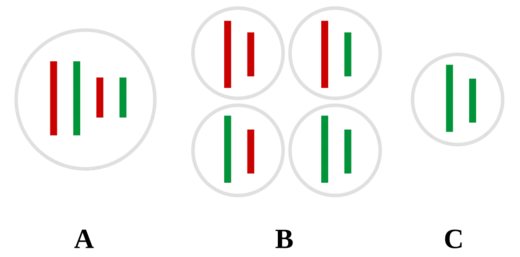
The complete set of genetic material in an organism is called its genotype. This term also describes the specific alleles or genetic variants a person carries at a single gene or location. How many alleles an individual can have for a given gene depends on the species' ploidy—the number of chromosome copies per cell. In diploid species, such as humans, each person carries two alleles for every gene. When both alleles match, the genotype is homozygous; when they differ, it is heterozygous. Genotype influences phenotype, which refers to an organism's observable traits and characteristics. The extent of that influence varies by trait. For instance, petal color in pea plants is set entirely by genotype, resulting in either purple or white petals depending on the alleles present. Other traits, called complex traits, are only partly shaped by genotype and are also affected by environmental and epigenetic factors. Because of this, individuals with the same genotype may not look or behave identically, and organisms that appear alike may not share the same genotype. The term "genotype" was introduced by Danish botanist Wilhelm Johannsen in 1903.
- term_coined_by
- Wilhelm Johannsen
- year_coined
- 1903
- field
- Genetics
- related_concepts
- Phenotype, Allele, Ploidy, Homozygous, Heterozygous
- example_organism
- Pea plant (Pisum sativum)
Lore & Background
The term genotype was coined by the Danish botanist Wilhelm Johannsen in 1903. It describes the complete set of genetic material in an organism, or more specifically, the alleles an individual carries at a particular genetic location. In diploid species such as humans, each individual possesses two alleles per gene, one from each parent. When both alleles are identical, the genotype is homozygous; when they differ, it is heterozygous.
Reader's Guide
Genotype is a foundational concept in genetics, distinct from phenotype, which refers to observable traits. The relationship between genotype and phenotype is not always direct: some traits are determined solely by genotype, as in pea plant petal color, while others are influenced by environmental and epigenetic factors. This distinction is critical for understanding inheritance patterns. Mendelian traits follow simple dominant-recessive patterns, but many traits exhibit incomplete dominance, codominance, or epistasis. Genotype also underlies the study of hereditary diseases, where patterns such as autosomal dominant, autosomal recessive, and X-linked inheritance are observed. Factors like incomplete penetrance and variable expressivity further complicate the link between genotype and phenotype. The concept remains central to modern genetics, from single-nucleotide polymorphisms to complex trait analysis.
Did You Know?
- The term genotype was coined by Danish botanist Wilhelm Johannsen in 1903.
- In diploid species like humans, each individual has two alleles for any given gene.
- If both alleles are the same, the genotype is called homozygous; if different, it is heterozygous.
- Not all individuals with the same genotype look or act the same way due to environmental and growing conditions.
Origins and the Core Distinction
The conceptual split between an organism's inherited genetic code and the traits it actually displays was formalized in 1911 by Wilhelm Johannsen, who introduced the terms "genotype" and "phenotype" into scientific vocabulary. While the precise meanings and the weight of the distinction have shifted over more than a century, the core idea remains a pillar of genetics. The genotype encompasses the complete hereditary information carried by an organism, whereas the phenotype refers to the observable characteristics—morphology, developmental patterns, behavior—that an individual actually exhibits. This separation is not merely terminological; it is the logical foundation upon which the study of trait inheritance and evolutionary change rests. Because natural selection acts on the physical properties an organism presents to its environment, yet those properties are ultimately rooted in inherited genetic material, any coherent account of evolution must navigate the relationship between the two. The mapping from a collection of genotypes to a collection of phenotypes is sometimes called the genotype–phenotype map, and understanding its structure is central to the field.
Beyond the Blueprint: Phenotypic Plasticity
A common misconception is that the genotype serves as a fixed blueprint from which a single, predictable phenotype emerges. In reality, the genotype is only one contributor to an organism's observable traits, and its influence varies depending on the relative dominance, penetrance, and expressivity of the alleles involved. The phenomenon of phenotypic plasticity captures the degree to which environmental conditions can reshape the phenotype that ultimately develops. A striking illustration comes from larval newts: when these young amphibians detect chemical cues from predators like dragonflies, they grow disproportionately large heads and tails and develop darker coloration, trading off slower growth for improved survival odds. Even in the most genetically identical cases—monozygous twins, whose genomes are indistinguishable—the phenotypes never match perfectly. Close family members can distinguish the twins by subtle differences that strangers miss, and their fingerprints, though similar, are never identical. These examples underscore that the same genetic information can yield a range of observable outcomes.
Canalization and the One-Way Street of the Map
If phenotypic plasticity describes how much the environment can alter the output of a given genotype, genetic canalization addresses the reverse question: how reliably can one infer the underlying genotype from an observed phenotype? A trait is considered canalized when a wide variety of different genomic configurations all produce the same or very similar physical outcome. In such cases, mutations in the genome leave the organism's morphology essentially unchanged, and the genotype–phenotype map becomes non-invertible—many different genotypes funnel into one phenotype, making it impossible to work backward from the observable trait to a unique genetic cause. When canalization is absent, by contrast, even minor changes in the genome produce immediate and noticeable shifts in the phenotype. This asymmetry means the relationship between genes and traits is not a simple one-to-one correspondence but rather a many-to-one mapping in canalized cases, a fact that profoundly complicates efforts to predict genetic architecture from phenotypic observation alone.
The Two-Space Challenge in Evolutionary Theory
Richard Lewontin framed the central theoretical problem of population genetics as a process unfolding across two distinct spaces: a genotypic space and a phenotypic space. A complete evolutionary theory, in his view, must supply a coherent chain of transformations. First, the laws of development and functional biology (labeled T1) must map a population of genotypes into a population of phenotypes—this is the genotype–phenotype map in action. Second, natural selection (T2) acts upon those phenotypes, reshaping the population. Third, epigenetic relations (T3) must map the selected phenotypes back into genotype space, and finally Mendelian inheritance (T4) predicts the next generation's genotypes, closing the cycle. Lewontin emphasized that even if one sets aside the complexities of non-Mendelian molecular genetics, articulating this full sequence of transformations remains an enormous intellectual undertaking. The schematic cycle—genotypes to phenotypes, selection, back to genotypes, and onward—encapsulates why the genotype–phenotype distinction is not a footnote but the structural backbone of evolutionary theory.
Frequently Asked Questions
What is Genotype?
Genotype refers to the full complement of genetic material an organism carries, or more narrowly, the particular alleles it holds at a specific gene locus. It is essentially the organism's underlying genetic blueprint, distinct from the traits that actually show up.
Who coined the term Genotype and when?
The Danish botanist Wilhelm Johannsen introduced the word in 1903 to draw a clear line between an organism's internal genetic constitution and its outward, observable characteristics. His pea-plant (Pisum sativum) experiments were the backdrop for that distinction.
How does Genotype connect to Phenotype?
Genotype sets the genetic instructions that shape phenotype, the visible traits and measurable characteristics you can actually observe. In practice, the phenotype emerges from the genotype acting together with environmental influences.
What's the difference between a homozygous and a heterozygous genotype?
A homozygous genotype means both copies of a gene carry the same allele, while a heterozygous genotype means the two copies are different. In diploid species like humans, every gene exists in two-allele pairs, so one of these two states always applies.
How many alleles does a human genotype carry for a given gene?
Because humans are diploid—carrying two full sets of chromosomes per cell—each individual holds exactly two alleles at any single gene location. This two-allele structure is what makes the homozygous-versus-heterozygous distinction meaningful in human genetics.
More in Genetics Fundamentals 1-24
Spotted an error? Know more?
This is a living reference — every entry is fact-audited, and reader corrections feed straight into our audit queue. Suggest an edit · See this site's audit record