Microevolution
Change in allele frequencies within a population over time.

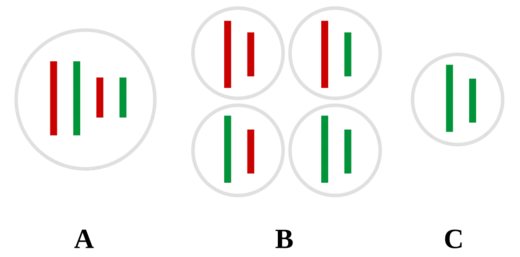
Microevolution describes shifts in how often different versions of a gene appear within a single population over time. These shifts are driven by four mechanisms: mutation, selection (both natural and artificial), gene flow, and genetic drift. Compared to the larger-scale changes of macroevolution, microevolution operates over a relatively brief period. It supplies the fundamental changes upon which macroevolution builds.
The mathematical framework for studying microevolution comes from population genetics, while ecological genetics examines these changes in natural settings. Most observable instances of evolution—such as bacteria developing resistance to antibiotics—are examples of microevolution.
**Difference from macroevolution** Macroevolution sorts variation between species ("species selection"), rather than within a species as microevolution does. Species selection can take two forms: effect-macroevolution, where traits of individual organisms (like body size) influence how fast species form or go extinct; and strict-sense species selection, where traits belonging to the species itself (such as its geographic range) affect those rates. Macroevolution does not create new evolutionary features, but it determines how widely those features spread within the groups where they first appeared, and it adds species-level traits as non-organismic factors in the sorting process.
**Four processes**
**Mutation** Mutations are changes to a cell's DNA sequence. They can be caused by radiation, viruses, transposons, mutagenic chemicals, or errors during meiosis and DNA replication. Replication errors are especially common when the second DNA strand is being built. Some mutations are deliberately induced by the organism itself through processes like hypermutation. If a mutation occurs in a gene's protein-coding region, it can alter the organism's appearance or function. Error rates are typically very low—about one mistake per 10 to 100 million bases—thanks to proofreading by DNA polymerases. Without proofreading, error rates rise a thousandfold; many viruses, which rely on polymerases lacking this ability, show much higher mutation rates. Mutagenic chemicals promote errors by interfering with base-pairing, while UV radiation damages DNA structure. Cells also suffer natural chemical damage and use repair mechanisms to fix mismatches and breaks, though repairs someti
- field
- Evolutionary biology
- known_for
- Change in allele frequencies within a population over time via mutation, selection, gene flow, and genetic drift
Lore & Background
Microevolution is studied through population genetics, which provides the mathematical structure for the process, and ecological genetics, which observes microevolution in the wild. Observable instances of evolution, such as bacterial strains with antibiotic resistance, are typically examples of microevolution. The four processes driving microevolution are mutation, selection (natural and artificial), gene flow, and genetic drift. Mutation involves changes in DNA sequence caused by radiation, viruses, transposons, mutagenic chemicals, and errors during meiosis or DNA replication. Selection is the process by which heritable traits that increase survival and reproductive success become more common. Genetic drift is the change in allele frequency due to random sampling, with larger effects in small populations.
Reader's Guide
Microevolution is significant because it provides the raw material for macroevolution, the larger-scale changes that lead to new species and higher taxonomic groups. While macroevolution is guided by sorting of interspecific variation (species selection), microevolution operates through sorting of intraspecific variation. The distinction between microevolution and macroevolution is important in evolutionary biology, with microevolutionary processes such as mutation and selection generating the genetic variation upon which macroevolutionary forces act. The relative importance of genetic drift versus natural selection in microevolution remains debated among scientists, as noted in the source article. Understanding microevolution is essential for fields such as medicine (e.g., antibiotic resistance in bacteria) and agriculture (e.g., artificial selection).
Did You Know?
- Microevolution is driven by four processes: mutation, selection (natural and artificial), gene flow, and genetic drift.
- Observable instances of evolution, such as bacterial strains with antibiotic resistance, are typically examples of microevolution.
- Genetic drift has a larger effect in small populations and a smaller effect in large populations.
- Mutations can involve large sections of DNA becoming duplicated, which is a major source of raw material for evolving new genes.
More in Genetics Fundamentals 1-24
Spotted an error? Know more?
This is a living reference — every entry is fact-audited, and reader corrections feed straight into our audit queue. Suggest an edit · See this site's audit record