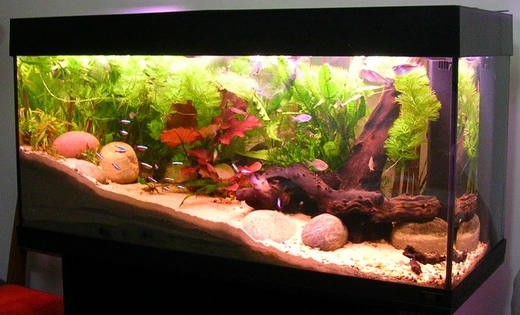
Deep sand bed
A filtration method using sand to remove nitrates.

A deep sand bed is a type of aquarium filter used in both saltwater and freshwater setups. Its purpose is to grow anaerobic bacteria deep within the sand, where they convert harmful nitrates into harmless nitrogen gas—a process similar to the Berlin Method.
To function properly, the sand bed must be at least four to six inches deep. This depth ensures that the bottom layer receives very little water circulation. Over time, the bed becomes home to bacteria, algae, and small marine animals like worms, crabs, snails, and starfish. These creatures dig through the top two to three inches of sand while feeding, which helps pull water deeper into the bed than would happen naturally.
The sand itself is usually fine or "superfine," with grains between 1 mm and 0.05 mm. Coarser sand allows more water flow, so a deeper bed is needed to create oxygen-free zones. Larger grains also make it harder for small animals to burrow, reducing water movement into the bed. Grains of 2 mm or larger tend to trap debris, requiring regular siphoning to clean.
- Minimum depth
- 4 to 6 inches
- Grain size range
- 1 mm to 0.05 mm
- Burrowing depth
- top 2 to 3 inches
- Particle size threshold for cleaning
- 2 mm or larger
Lore & Background
A deep sand bed is commonly defined as a bed of fine sand with a minimum depth of four to six inches, ensuring that a portion of the sand at the bottom will not be exposed to significant circulation of water. An established deep sand bed consists of sand populated with bacteria, algae and other marine organisms such as worms, crabs, snails and stars. These creatures burrow and overturn the top two to three inches of sand in search of food, which causes water to circulate deeper in the sand than it would if the creatures were not present.
Deep sand beds may be made of a variety of materials, but typically fine or 'superfine' sand is used, with a grain size between 1 mm and 0.05 mm. A larger particle size increases circulation, which in turn requires greater depth to establish anaerobic areas. Larger particles can also inhibit the burrowing of small animals, which would limit circulation into the bed. Additionally, larger particles (2 mm or larger) are prone to detritus accumulation, which necessitates periodic siphon cleaning.
Reader's Guide
The deep sand bed is significant as a filtration method that relies on biological processes to remove toxic nitrates from aquarium water. Its operation depends on maintaining a sufficient depth of fine sand to create anaerobic zones where bacteria convert nitrate to nitrogen gas. The presence of burrowing organisms such as worms, crabs, snails and stars is essential for circulating water into the deeper layers, enhancing the bed's effectiveness. The choice of sand grain size is critical: fine sand between 1 mm and 0.05 mm is typical, as larger particles require greater depth to establish anaerobic areas and can hinder burrowing, while particles 2 mm or larger accumulate detritus and need regular siphon cleaning. The method is used in both saltwater and freshwater aquariums, and is noted as similar to the Berlin Method. Its legacy lies in providing a natural, low-maintenance approach to nitrate reduction, though it demands careful setup and maintenance to avoid issues like detritus buildup.
Did You Know?
- A deep sand bed requires a minimum depth of four to six inches to create anaerobic zones.
- The sand grain size used is typically between 1 mm and 0.05 mm.
- Burrowing organisms like worms, crabs, snails and stars help circulate water into the deeper sand layers.
- Larger particles of 2 mm or more are prone to detritus accumulation and need periodic siphon cleaning.
Frequently Asked Questions
What is a deep sand bed in aquarium keeping?
A deep sand bed is a natural filtration setup in which a thick layer of sand at the tank bottom hosts anaerobic bacteria that break down nitrates into nitrogen gas. It works in both freshwater and saltwater systems and operates on a principle similar to the Berlin Method.
How deep does the sand need to be for a deep sand bed to work?
The sand bed must be at least four to six inches deep so that the lower layers receive very little water circulation. That stagnant zone is where the anaerobic, nitrate-removing bacteria can establish themselves.
What grain size should I use for a deep sand bed?
You want a fine-grain sand with particles ranging from roughly 0.05 mm up to 1 mm. Anything 2 mm or larger is too coarse and will not support the dense bacterial colonies the method depends on.
What animals end up living in a deep sand bed over time?
The bed gradually becomes a small ecosystem hosting worms, tiny crabs, snails, and even starfish. These invertebrates typically burrow and forage within the top two to three inches of the sand.
How exactly does a deep sand bed remove nitrates from the water?
Anaerobic bacteria colonize the oxygen-poor bottom layers of the sand and convert accumulated nitrates into inert nitrogen gas. That gas then escapes from the sand into the water column, effectively stripping the nutrient out of the system.
More in Fishkeeping, Part 2 1-24
Spotted an error? Know more?
Reader corrections go straight into our review queue. Suggest an edit · How this site is sourced