Croaking gourami
A small labyrinth fish that croaks using its pectoral fins.

The croaking gourami (*Trichopsis vittata*) is a freshwater fish from the gourami family, known for living in calm, still waters across Southeast Asia. Its name comes from the grunting or chirping sound it makes, which is produced by special adaptations in its pectoral fins. Both males and females use these sounds during breeding displays, and males also use them when competing for dominance. In a typical male showdown, the fish circle each other, flare their fins, and make darting movements (usually without making contact) while croaking—sometimes for hours if they are evenly matched.
This species typically reaches about 5 cm in length, though some individuals grow to 6 or 7 cm. Its coloration varies widely, from pale brown and green to dark purple, with black or red spots on the fins. Two to four brown or black stripes or rows of spots run along the sides. The edges of the median fins have a thin, iridescent blue, and the iris is bright blue or purple. Females are generally paler than males, with a slightly rounded dorsal fin (males have a pointed one) and a shorter anal fin.
Native to still-water habitats like ponds, canals, and paddy fields, the croaking gourami is found in Java, Borneo, Sumatra, Malaya, Thailand, Laos, Cambodia, and Vietnam. Through the aquarium trade, it has spread to other parts of Southeast Asia, such as East Malaysia, and to other regions worldwide. A breeding population exists in a series of drainage ditches in Florida, almost certainly introduced via the aquarium trade.
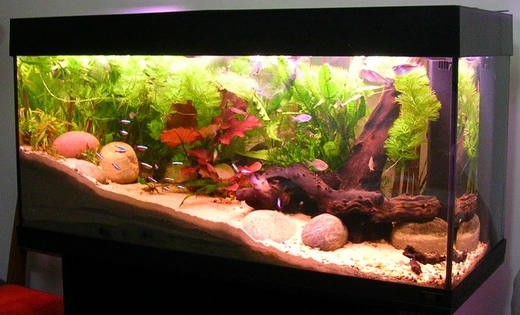
In an aquarium, the croaking gourami is a shy, peaceful fish that does well in most community tanks, though males can become territorial with each other during breeding. A tank of at least 40 liters (11 U.S. gallons) is recommended, preferably larger. They explore all areas of the aquarium but prefer lurking among reeds and under large leaves near the water surface. At night, they may rest on the bottom or hover motionless at the surface. Like all labyrinth fish, they can breathe atmospheric oxygen using a specialized organ, so the water surface should be exposed to fresh air—either through an open-top tank or a ventilated hood, though good air pumps can also help.
The tank should be heavily planted, with at least part of the surface shaded by broad leaves or floating plants, as bare tanks cause stress.
- Average size
- about 5 cm (2.0 in)
- Maximum size
- 6 or 7 cm (2.4 or 2.8 in)
- Native range
- still waters in Southeast Asia: Thailand, Borneo, parts of Java island, Sumatra, Malaya, Laos, Cambodia, Vietnam
- Introduced range
- East Malaysia; a breeding population exists in drainage ditches in Florida
- Optimal temperature
- 26 °C (79 °F)
- Optimal ph
- 6.8
- Minimum tank size
- 40 L (11 U.S. gal)
Lore & Background
The croaking gourami reaches an average size of about 5 cm, though some individuals can grow to 6 or 7 cm. Coloration is highly variable, ranging from pale brown and green to dark purple with black or red spots on the fins, and 2 to 4 brown or black stripes or rows of spots on the flanks. The median fins have a thin iridescent blue edge, and the iris is bright blue or purple. Females are paler than males, with a slightly rounded dorsal fin and a shorter anal fin.
Native to stillwater habitats such as ponds, canals, and paddy fields across Southeast Asia, the species has spread through the aquarium trade to other parts of Southeast Asia and to other parts of the world, including a breeding population in drainage ditches in Florida. Both sexes produce croaking noises during breeding displays and during the establishment of dominance hierarchies among males. A typical male showdown involves circling, flaring fins, aggressive darting (rarely making contact), and croaking, which may continue for several hours.
Like all members of the suborder Anabantoidei, the croaking gourami can breathe atmospheric oxygen using a specialized labyrinth organ, so the water surface must be exposed to fresh air. It is a fairly shy, peaceful fish that does well in community aquaria, though males can be territorial toward each other during breeding. The aquarium should be heavily planted with hiding places and a darker substrate; the species is very sensitive to noise and requires a quiet location.
Reader's Guide
The croaking gourami is significant in fishkeeping as a small, peaceful labyrinth fish that adds both visual interest and acoustic novelty to a community aquarium. Its ability to produce audible croaking noises—used in breeding and dominance displays—makes it a distinctive species among gouramis. The article notes that it is susceptible to diseases and infections, particularly if cold air reaches the water surface, so careful temperature maintenance and regular water changes are essential. It tolerates high temperatures up to 29 °C but does best near 26 °C, with a pH of about 6.8 and peat filtration recommended. The species should not be kept with large, aggressive fish or male bettas, which target it. In the wild it is mostly insectivorous, and in aquaria a varied diet of flake foods, freeze-dried bloodworms, tubifex worms, brine shrimp, and algae-based flakes is recommended. Breeding involves the male building a bubblenest under a leaf; after spawning the female must be removed to prevent egg eating, and the male is removed when the fry are 2 to 3 days old. The croaking gourami's legacy in the hobby is as a hardy, vocal, and visually variable species that thrives in well-planted, quiet tanks.
Did You Know?
- The croaking gourami produces an audible croaking noise using specialized adaptations of its pectoral fins.
- A breeding population exists in drainage ditches in Florida, introduced through the aquarium trade.
- Males may engage in circling, flaring, and croaking displays for several hours without making physical contact.
- The species is very sensitive to noise and should be kept in a quiet area.
Physical Appearance and Sexual Dimorphism
The croaking gourami is a compact freshwater fish that typically measures around five centimetres in length, though a few individuals push toward six or seven. Its coloration is remarkably diverse, shifting from muted browns and greens to deep purples, with black or red spotting scattered across the fins. Along the flanks, two to four distinct stripes or rows of dark spots provide a consistent visual signature regardless of the base hue. The median fins carry a delicate iridescent blue edging, and the eyes stand out with a vivid blue or purple iris. Sexual differences are subtle but noticeable: females display a paler overall tone, a gently rounded dorsal fin, and a noticeably shorter anal fin, whereas males sport a more pointed dorsal profile. These visual cues, combined with the species' small size and variable patterning, make the croaking gourami a visually engaging yet understated member of the Osphronemidae family.
Vocal Communication and Territorial Displays
Perhaps the most remarkable trait of Trichopsis vittata is its ability to produce an audible grunting or chirping sound, a feat accomplished through specialized structural adaptations of its pectoral fins. Both males and females generate these croaking noises, though they serve different social purposes. During breeding season, the vocalizations form part of courtship displays, while among males they play a central role in establishing and maintaining dominance hierarchies. A typical confrontation between two males unfolds as a prolonged, choreographed standoff: the fish circle one another, flare their fins wide, and execute sharp aggressive darts without actually making physical contact, all while emitting their characteristic croak. Remarkably, when two well-matched individuals face off, this ritualized display can drag on for several continuous hours. The combination of visual posturing and vocal output makes these encounters a striking example of acoustic communication in a small freshwater fish.
Aquarium Husbandry and Environmental Sensitivities
In captivity, the croaking gourami proves to be a shy yet peaceful addition to community tanks, rarely causing trouble with compatible tankmates. A minimum volume of forty litres is recommended, with larger enclosures preferred, especially when housing multiple males who may display territorial aggression during breeding periods. The fish naturally prows every zone of the aquarium, favouring dense reed beds and the shelter beneath broad floating leaves near the surface; at night it may rest directly on the substrate or hover motionless at the waterline. Because it possesses a labyrinth organ for extracting atmospheric oxygen, the water surface must remain exposed to fresh air, best achieved with an open-top setup or a ventilated hood. Heavily planted tanks with a darker substrate and partial surface shading are essential, as bare environments cause severe stress. The species is also highly sensitive to ambient noise and to cold air above the water, which can trigger labyrinth-organ infections. Optimal conditions hover around 26 °C at a pH near 6.8, with peat filtration advised. Male bettas and large aggressive species should be avoided as tankmates.
Breeding Ritual and Parental Care
Reproduction in the croaking gourami follows the classic bubble-nest strategy seen across many Osphronemidae. The male constructs a small nest of air bubbles and mucus beneath a leaf, and the aquarist should lower the water level to roughly twenty centimetres, minimize circulation, and hold the temperature near 28 °C to encourage spawning. Courtship involves a dance in which the female rolls over, prompting the characteristic gourami embrace. Eggs are released in quick bursts of five to ten, which the male carefully collects and deposits into the nest, often reinforcing it with additional bubbles. This sequence repeats a dozen or more times, yielding approximately one hundred eggs, though larger females may produce over two hundred. Immediately after spawning, the female must be removed to prevent egg predation. The male then assumes full parental duty, tending the nest and guarding the developing fry. Once the young are two to three days old, the male too should be relocated, as he may turn on them. Newly hatched fry are initially fed infusoria, later transitioning to baby brine shrimp, fine ground flakes, and eventually freeze-dried tablets.
Frequently Asked Questions
What is a croaking gourami?
The croaking gourami (Trichopsis vittata) is a tiny labyrinth fish in the gourami family that usually tops out around 5 cm, with a few individuals reaching 6–7 cm. It's a gentle, small freshwater species that appeals to hobbyists looking for a low-maintenance community tankmate.
How does a croaking gourami produce its croaking sound?
Both sexes generate the grunting, chirping noise through specialized structures in their pectoral fins rather than through any mouth or throat mechanism. Males croak during dominance disputes and courtship, while females also use the sound as part of their breeding displays.
What water conditions does a croaking gourami need?
This species does best in calm, still water at roughly 26 °C (79 °F) with a slightly acidic pH near 6.8. A planted, low-flow community tank mirrors the slow-moving or stagnant habitats it evolved in across Southeast Asia.
How do male croaking gouramis compete with each other?
Rival males circle one another, spread their fins wide, and make quick darting motions while croaking loudly, typically without ever making physical contact. When both fish are evenly matched, these non-contact bouts can drag on for hours.
Where is the croaking gourami native to?
It inhabits still or slow-moving freshwater across Thailand, Borneo, parts of Java and Sumatra, Malaya, Laos, Cambodia, and Vietnam. The species has also been introduced into East Malaysia, and a small breeding population has even taken hold in drainage ditches in Florida.
More in Fishkeeping, Part 2 1-24
Spotted an error? Know more?
Reader corrections go straight into our review queue. Suggest an edit · How this site is sourced