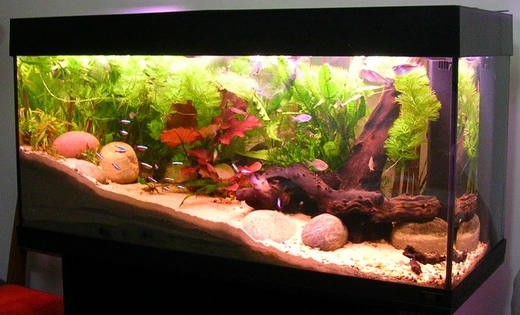
Danio margaritatus
A small danionin from Myanmar and Thailand, discovered in 2006.

Danio margaritatus, also called the celestial pearl danio, galaxy rasbora, or Microrasbora sp. 'Galaxy' in the aquarium hobby, is a small freshwater ray-finned fish from the family Danionidae. It comes from Myanmar and northern Thailand, specifically the Salween basin, and has only been found in a tiny area east of Inle Lake near Hopong, at an elevation above 1,000 meters (3,400 feet). Its habitat includes the Nam Lang and Nam Pawn Rivers. Discovered in 2006, the species quickly became a hit in the aquarium trade because of its small size and vivid colors.
Initially, scientists thought it belonged to the genus Microrasbora, due to its resemblance to "Microrasbora" erythromicron. Less than a year after its discovery, it was formally described and placed in the genus Celestichthys. In 2008, a more thorough study showed it is actually a member of the genus Danio, with Danio erythromicron and Danio choprae as its closest relatives.
This fish is small and plump, with a noticeably blunt snout. It measures 2 to 2.5 centimeters in standard length, though a few individuals can reach 3 centimeters. Its body is about three times as long as it is high, and in overall shape it most closely resembles Danio erythromicron. Males and females look different: males have a bright-blue background color (females are dull blue-green), and their fins are more brightly colored. The caudal peduncle (the tail end of the body) is also higher in males. The body is covered with small, pearly dots. The back is bronzy green, and the belly of females is yellowish-white. The gill covers are transparent, so the blood-red gills show through. Males display their unpaired fins prominently to other males. All fins except the pectoral fins have two parallel black lines with a bright red area between them; on the tail fin, this pattern appears twice (once on each lobe), and the outer black band is reduced. Females have a weaker version of this pattern on the tail and dorsal fins only, and sometimes on the anal fin. When courting, a male develops a red belly, and his flanks brighten and darken, making the pearly spots stand out even more, while the back looks paler than the flanks. A female ready to reproduce can be recognized by a black anal spot that separates the belly color from the uniformly reddish base of the anal fin.
- Discovery year
- 2006
- Standard length
- 2–2.5 cm (some up to 3 cm)
- Elevation
- over 1,000 m (3,400 ft)
- Water temperature january
- 22–24 °C
- Egg batch size
- around 30 eggs
- Incubation period
- 3–4 days at 24–25 °C
- Initial price
- $20 or more per fish
Lore & Background
The celestial pearl danio is native to Myanmar and Northern Thailand, found only in a small area near Hopong east of Inle Lake in the Salween basin, specifically the Nam Lang and Nam Pawn Rivers. Its habitat consists of small ponds created by seeping groundwater or overflow from small brooks or springs, heavily vegetated with Hydrocharitaceae. The water is slightly alkaline, and the fish shares its habitat with a few other species including the dwarf snakehead Channa harcourtbutleri, its only known significant predator. The species is also locally fished for food, dried and sold as a protein source.
Initially assumed to be a member of the genus Microrasbora, it was scientifically described less than a year after discovery and given the genus name Celestichthys. In 2008, a more comprehensive study placed it in the genus Danio, with Danio erythromicron and Danio choprae as its closest relatives. The fish shows sexual dimorphism: males have bright-blue background color and more brightly colored fins, while females are dull blue-green. Courting males develop a red belly, and females in reproductive age have a black anal spot.
Reader's Guide
The celestial pearl danio's significance in fishkeeping stems from its rapid rise in the aquarium trade after its 2006 discovery. Within six months, unfounded concerns about its rarity led British magazine Practical Fishkeeping to urge aquarists to breed rather than buy wild-caught fish. The government of Myanmar banned exports in February 2007, but an inquest found populations at five locations around Hopong. The species proved prolific, spawning almost every day and restocking ponds within months. It is now captive-bred worldwide commercially and by hobbyists, dropping the price from an initial high of $20 or more per fish to around $4 each. In the aquarium, it is undemanding, not a true shoaling fish, and does well in groups of six in well-planted tanks with water weed and spawning mops. It is peaceful but cannot be kept with large or bully fish. Maintaining the slightly alkaline pH found in the Inle basin is necessary for success.
Did You Know?
- The celestial pearl danio was discovered in 2006 and initially assumed to be a member of the genus Microrasbora.
- Males have a small black pad at the edges of the lower jaw, which is absent or reduced in females.
- The dwarf snakehead Channa harcourtbutleri is the only known significant predator of D. margaritatus.
- A can of some 500 D. margaritatus sold for food fetched about 25 kyat before the fish was discovered for the aquarium trade.
Discovery & Taxonomic Journey
The celestial pearl danio was first identified in 2006 in a tiny stretch of water near Hopong, east of Inle Lake in Myanmar, at elevations exceeding 1,000 meters. Its waters belong to the Salween basin, specifically the Nam Lang and Nam Pawn Rivers in northern Thailand and Myanmar. When it first surfaced, researchers assumed it was yet another Microrasbora, closely resembling M. erythromicron. However, within less than a year of its initial discovery, the species received a formal scientific description and was placed in its own genus, Celestichthys. That classification proved short-lived. By 2008, a broader phylogenetic analysis revealed that the fish actually belonged to the genus Danio, with Danio erythromicron and Danio choprae emerging as its nearest relatives. This rapid taxonomic reshuffling—spanning three different genus assignments in barely two years—highlights how little was initially known about the species' evolutionary placement and how quickly new data can overturn early assumptions in ichthyology.
Appearance & Sexual Dimorphism
At just 2 to 2.5 centimeters in standard length, with a few individuals stretching to 3 centimeters, the celestial pearl danio is a compact, plump fish with a notably blunt snout and a body roughly three times longer than it is tall. Males carry a vivid blue background, while females display a more subdued blue-green tone. Both sexes are dusted with tiny pearly dots, and the back takes on a bronzey green hue. The gill covers are translucent, revealing the deep red of the gills beneath. The most striking feature is the fin pattern: all fins except the pectorals bear two parallel black lines framing a bright red band, a design that appears twice on the tail fin, once per lobe. During courtship, males develop a red belly, their flanks shift in brightness to make the pearly spots pop, and they prominently display their unpaired fins. Females of breeding age show a small black anal spot. Immature fish initially display a striped pattern that gradually breaks apart into the characteristic dot arrangement seen in adults.
Habitat & Ecological Niche
The celestial pearl danio occupies a remarkably restricted range, found only in a small area near Hopong east of Inle Lake, at elevations above 1,000 meters. Its preferred water bodies are shallow ponds formed by seeping groundwater or overflow from small brooks and springs within the Nam Lang and Nam Pawn Rivers of the Salween basin. Water temperatures hover around 22 to 24 degrees Celsius in January, but the shallow depth means these pools warm rapidly during hot periods, suggesting the species tolerates temperatures above 26 degrees. The water tends to be slightly alkaline, and the ponds are densely colonized by Hydrocharitaceae plants resembling Elodea. The fish shares this habitat with very few other species: a Microrasbora resembling M. rubescens, a rosy loach in the genus Yunnanilus (possibly undescribed), and the dwarf snakehead Channa harcourtbutleri, which is likely the only significant predator of the danio. Locally, the fish has been harvested for food—dried and sold as a protein source to impoverished communities, with a can of roughly 500 individuals fetching about 25 kyat before the aquarium trade took hold.
Reproduction & Conservation Pressures
The celestial pearl danio appears adapted to somewhat ephemeral water bodies, and its reproductive strategy reflects this. Rather than a fixed spawning season, females produce small batches of approximately 30 eggs, hidden loosely within dense vegetation. Males actively seek out and defend patches of thick plant cover, displaying to passing females and testing their readiness with a brief chase before the pair moves into the substrate to deposit eggs. Rival males may follow the mating pair, attempting to fertilize the eggs with their own sperm or simply consume them. At 24 to 25 degrees Celsius, larvae hatch after three to four days, remaining dark and cryptic for about three days before becoming visible and feeding independently. Metamorphosis to adult form occurs around eight to ten weeks, with coloration emerging from week twelve. In the wild, recolonization of depleted pools appears possible within roughly a year if only part of a subpopulation is removed. However, within six months of entering the aquarium trade, unfounded reports of scarcity prompted Practical Fishkeeping to urge buyers to only purchase fish from breeders, aiming to reduce demand for wild-caught specimens.
Frequently Asked Questions
What is Danio margaritatus?
It is a tiny freshwater fish in the Danionidae family, widely known in the hobby as the celestial pearl danio or galaxy rasbora. Despite its minuscule size, it is celebrated for its striking, vivid coloration.
Where is Danio margaritatus native to?
The species is restricted to a small stretch of the Salween basin in Myanmar and northern Thailand, east of Inle Lake near Hopong. It inhabits streams such as the Nam Lang and Nam Pawn Rivers at elevations exceeding 1,000 meters.
How big does Danio margaritatus get?
Adults measure roughly 2 to 2.5 cm in standard length, with a few individuals reaching about 3 cm. This makes it one of the smallest danionins commonly kept in aquariums.
How does Danio margaritatus breed?
A single female will deposit around 30 eggs per batch, and those eggs typically hatch within 3 to 4 days when the water is held near 24–25 °C.
What temperature range suits Danio margaritatus in a tank?
Because January readings in its native streams sit between 22 and 24 °C, keeping the aquarium in the mid-20s Celsius is a solid target for healthy, active fish.
More in Fishkeeping, Part 2 1-24
Spotted an error? Know more?
Reader corrections go straight into our review queue. Suggest an edit · How this site is sourced