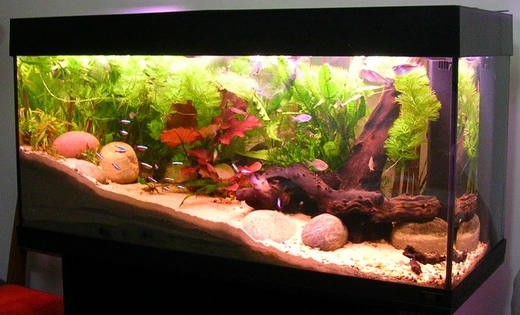
Community aquarium
A tank housing multiple compatible fish species from different regions.

A community aquarium is a tank designed to house more than one species of fish, typically bringing together species that do not normally occur together in nature, such as angelfish from Brazil, swordtails from Mexico, and gouramis from Southeast Asia. The aim is to select fish that are compatible in temperament and water requirements, using their different colors and behaviors to add interest and entertainment value. Most marine aquaria also fit this category, using fish from diverse regions like the Caribbean, Red Sea, and western Pacific Ocean.
- Ph range
- 6 to 8
- Water hardness
- soft to moderately hard
- Water change recommendation
- 25% of aquarium volume weekly
- Ammonia removal mechanism
- nitrogen cycle in the filter
- Algae control methods
- phosphate sponge, java moss
Lore & Background
Community aquaria are most commonly freshwater setups that combine species from various continents, such as angelfish from Brazil, swordtails from Mexico, and gouramis from Southeast Asia. Some aquarists prefer biotope communities that represent specific geographic locations, combining fish with endogenous rocks and plants; the most popular biotopes replicate the cichlid habitats of Lake Tanganyika and Lake Malawi in East Africa. Many freshwater species make successful community fish, including livebearers, barbs, tetras, rasboras, danios, rainbowfishes, angelfish, gouramis, and Corydoras catfishes, though some like tiger barbs and serpae tetras are fin nippers, and angelfish are predatory toward very small fish like neon tetras.
Reader's Guide
The significance of the community aquarium lies in its ability to bring together fish from different natural habitats into a single, harmonious tank. A key principle is that if a fish fits into the mouth of another fish, it is likely to be eaten, so pairing fish of similar size is recommended to maintain stability. Many fish are unsuitable for typical community tanks, including territorial or aggressive cichlids, red-tailed black sharks (which become territorial with their own species), predatory fish like snakeheads and leaffish, large active fish that outgrow the tank, fragile fish like discus, and slow eaters like pipefishes. Water chemistry is critical: most freshwater fish do well in soft to moderately hard water with a pH between 6 and 8. Ammonia from fish excretions is the most deadly chemical, removed through the nitrogen cycle in the filter, which takes a few weeks to establish. Weekly 25% water changes with vacuuming help control nitrate buildup. Algae growth is managed by controlling light, using phosphate sponges, or adding java moss, which competes with algae for nitrate.
Did You Know?
- Most marine aquaria are considered community tanks, using fish from the Caribbean, Red Sea, and western Pacific Ocean.
- The most popular biotope community tanks replicate the cichlid habitats of Lake Tanganyika and Lake Malawi.
- Tiger barbs and serpae tetras are noted as fin nippers in community tanks.
- Java moss, not java fern, competes with algae for nitrate and reduces algae growth.
Ancient Roots of Keeping Fish
The practice of holding fish in contained water stretches back roughly four and a half millennia. The earliest documented keepers were Sumerians around 2500 BCE, who held wild-caught specimens in ponds as a practical step before cooking them. Egyptian artists depicted the sacred fish of Oxyrhynchus living in rectangular temple pools, suggesting that captivity carried spiritual weight as well as utilitarian purpose. Across Asia, rice paddies were deliberately stocked with edible freshwater species such as catfish and cyprinids, and the selective breeding of carp into the ornamental koi of Japan and the fancy goldfish of China has been underway for more than two thousand years. By the Song dynasty, Chinese households had moved goldfish indoors into large ceramic vessels purely for visual pleasure. In medieval Europe, carp pools were a standard fixture on estates and in monasteries, offering a permissible protein source on days when religious observance forbade meat. The Romans, meanwhile, kept lampreys and other species in salt-water pools; one patron reportedly paid eight thousand sesterces for a single prized mullet, and the orator Hortensius was known to weep when a favored specimen perished. Cicero, less sentimental, dismissed such owners as Piscinarii, the fish-pond keepers.
From Survival to Science: The Evolution of Aquatic Keeping
For most of its long history, fishkeeping was driven by necessity rather than understanding. Early Sumerian and Egyptian keepers held fish in pools without grasping the environmental conditions those animals needed to survive. The turning point came as aquatic biology matured: keepers began designing specialized tanks tailored to individual species and integrating live aquatic plants to build more balanced, naturalistic habitats. This shift from mere containment to ecosystem management transformed the practice into what modern hobbyists call aquarism. A landmark figure in that transition was Pierre Carbonnier, who in 1850 opened one of the oldest public aquaria in Paris. In 1869 he successfully bred imported Macropods, commonly known as Paradise fish, in European waters for the first time, and went on to acclimatize additional exotic species. His work earned him the Gold Medal of the Imperial French Acclimatization Society in 1875. Today, fishkeeping serves dual roles: it remains a personal expression of fascination with marine and freshwater life, while also functioning as a branch of agriculture through the piscicultural industry, one of the most widespread methods of cultivating fish for commercial profit.
The Community Tank and the Aquascaping Movement
Freshwater keeping is the most accessible of the three major disciplines, and the community tank sits at its heart. Rather than housing a single species, a community aquarium brings together a carefully chosen mix of compatible fish—goldfish, guppies, angelfish, and others—into one shared environment. Breeding enthusiasts push further, raising livebearing species like mollies and guppies in dedicated tanks, while others focus on cichlids, catfish, characins, cyprinids, and killifish. Beyond the fish themselves, a powerful artistic current has grown around aquascaping. Dutch aquaria, named for the European keepers who first popularized them, mass contrasting stem plants into dense, layered compositions. In recent decades, Japanese aquarist and photographer Takashi Amano became one of the most influential advocates of the heavily planted tank. His striking images of complex, plant-dominant aquaria inspired a global audience, and in 1982 he founded Aqua Design Amano to sell aquarium products of high quality and design, sharing his vision with keepers worldwide. Garden ponds extend the same freshwater philosophy outdoors, where goldfish, koi, and orfe thrive in temperate climates.
Saltwater Complexity and Brackish Hybrid Systems
Marine fishkeeping demands a higher level of commitment. The livestock is generally more expensive, and the water parameters require tighter control, which is why this branch tends to attract more experienced aquarists. The reward is a visual spectacle: the vivid colors and intricate shapes of corals and reef fish create an aesthetic that freshwater tanks rarely match. Temperate-zone marine species pose an additional challenge because they do not thrive at room temperature; keepers must house them in a cool room or install a refrigeration unit called a chiller. Many marine aquarists build what are known as reef tanks, starting with large quantities of living rock—porous calcareous stones encrusted with coralline algae, sponges, worms, and other small organisms. Once the system has matured, larger corals, shrimps, crabs, echinoderms, mollusks, and a variety of small fish are introduced. Brackish water aquaria occupy a middle ground, maintaining a salinity that falls between pure freshwater and full seawater. The fish they house originate from transitional habitats like mangroves and estuaries, and they do not survive if kept permanently in freshwater, making brackish setups a distinct and less common discipline.
Frequently Asked Questions
What is a Community aquarium?
A community aquarium is a tank set up to keep multiple fish species from different parts of the world together, chosen for compatible temperaments and similar water needs. The goal is to create visual interest by combining different colors and behaviors in one display.
What water conditions does a Community aquarium need?
The ideal pH range sits between 6 and 8, and the water should be soft to moderately hard. These parameters accommodate the diverse species typically mixed in a community setup.
How often should I do water changes in a Community aquarium?
You should replace about 25% of the tank's volume each week to keep conditions stable for all the species living together.
How does a Community aquarium deal with ammonia?
Ammonia is broken down through the nitrogen cycle, which is carried out by beneficial bacteria colonies housed in the filter.
What's the best way to control algae in a Community aquarium?
Keeping phosphate levels in check with a phosphate sponge and adding java moss are two effective methods for managing algae growth.
More in Fishkeeping, Part 2 1-24
Spotted an error? Know more?
Reader corrections go straight into our review queue. Suggest an edit · How this site is sourced