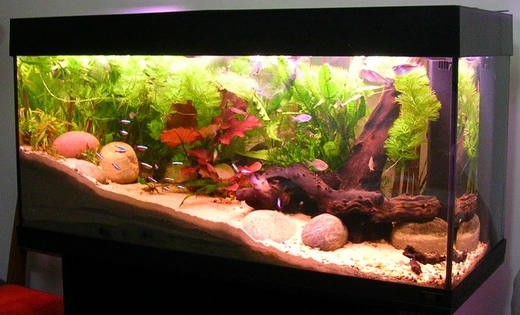
Danionin
Small, active freshwater fish popular in aquariums.

Danionins are small, slender, pelagic freshwater fish belonging to the family Danionidae within the suborder Cyprinoidei. Their natural range is mainly the shallow freshwater environments—such as ponds, streams, floodplains, marshes, and rice paddies—of South and Southeast Asia, though a smaller number of species occur in Africa. Many species are vividly colored and are commonly kept in aquariums around the world.
Based on phylogenetic research from 2009, the group includes species in the genera *Danio* and *Devario*, as well as the genera *Chela*, *Laubuka*, *Microdevario*, and *Microrasbora*. Fish in the *Danio* clade typically display horizontal stripes, rows of spots, or vertical bars, and often have long barbels. Those in the *Devario* clade tend to have vertical or horizontal bars and short, rudimentary barbels, if any at all.
All danionins are egg scatterers, timing their reproduction to the monsoon season in the wild. They are opportunistic feeders, consuming a variety of tiny insects, crustaceans, plankton, and other microorganisms and invertebrates.
The earliest known fossil record of the group comes from the Eocene of Sumatra, Indonesia, where two specimens tentatively assigned to *Rasbora*—*'Rasbora' antiqua* and *'Rasbora' mohri*—have been found.
Since 2004, many new danionin species have been discovered that lack formal scientific names, while others previously known only to scientists have entered the aquarium trade. This has led to considerable confusion in naming: some species are known by up to five different common names, and some common names refer to as many as four different species. Scientific names have also been unstable, with many species moved between genera repeatedly over recent decades, and some species synonymized and later unsynonymized.
The genera currently recognized within the group are organized into several subfamilies: Chedrinae (troutbarbs), Rasborinae (rasborines), Danioninae (danionines), and Esominae (flying barbs).
- Family
- Danionidae
- Suborder
- Cyprinoidei
- Native regions
- South and Southeast Asia, with fewer species in Africa
- Earliest fossil record
- Eocene of Sumatra, Indonesia
- Typical temperature range
- 20 to 22 °C (68 to 72 °F)
- Typical ph range
- 3 to 5
Lore & Background
Danionins are egg scatterers that time reproduction during the monsoon season in the wild. They are opportunistic feeders, living on tiny insects, crustaceans, plankton, and other microorganisms. In the aquarium, they are active swimmers occupying the top half of the tank, eat most aquarium foods but not plants or algae, and are generally good community fish though they may nip fins and eat small fish or eggs. They are easily stressed by flowing water and bright light, prefer stagnant water with low pH (3–5) and subtropical temperatures (20–22 °C), and are good jumpers requiring a tight-fitting lid.
The grouping has been subject to constant taxonomic research. Historically, nearly all species were placed in Danio, but George S. Myers split them into Danio, Brachydanio, and Daniops. Later, Fang Fang determined Danio was paraphyletic and restricted Danio to the 'D. dangila species group', moving most other species to Devario. The sister group to Devario includes Inlecypris and Chela, while Esomus was found to be sister to Danio. The relationships of Sundadanio, Danionella, and Microrasbora remain unresolved. The danionin notch was not supported as a danionin synapomorphy, but a 'danionin mandibular knob' may be diagnostic.
Reader's Guide
Danionins are significant in fishkeeping for their active behavior, bright colors, and ease of care, though they require specific water conditions (low pH, still water, subtropical temperatures). Their taxonomy has been historically confused, with many species moved between genera and common names overlapping—some species have up to five common names, and some common names apply to four different species. This confusion persists as new species are discovered and reclassified. The group's fossil record extends to the Eocene of Sumatra, making them an ancient lineage. In aquariums, they are valued as community fish but need tight lids due to jumping. Their reproductive strategy of egg scattering during monsoons influences captive breeding. The ongoing phylogenetic research, such as that by Fang et al. in 2009, continues to refine their classification, with genera like Celestichthys and Paedocypris showing complex relationships that challenge traditional groupings.
Did You Know?
- Two fossil danionins, tentatively assigned to Rasbora, are known from the Eocene of Sumatra, Indonesia.
- Some danionin species have up to five different common names in use.
- The danionin mandibular knob is better developed in males than females.
Discovery and the Taxonomic Rollercoaster
The celestial pearl danio first entered scientific awareness in 2006, when it was collected from a remarkably restricted stretch of water in Myanmar and northern Thailand. Its entire known range is confined to a small zone near Hopong, east of Inle Lake, at elevations exceeding 1,000 metres, within the Nam Lang and Nam Pawn Rivers of the Salween basin. For a time, aquarists encountered it under the trade name 'galaxy rasbora' or 'Microrasbora sp. Galaxy,' reflecting the early assumption that it belonged to the genus Microrasbora because of its resemblance to M. erythromicron. That classification, however, proved short-lived. Within a year of its discovery, the species received a formal scientific description under the new genus Celestichthys. Then, in 2008, a broader phylogenetic analysis upended the arrangement once more, placing the fish firmly within Danio alongside D. erythromicron and D. choprae as its nearest kin. This rapid succession of taxonomic revisions underscores how little was initially known about this tiny, brilliantly coloured species.
A Study in Vivid Colour and Sexual Display
At just two to two and a half centimetres in standard length, with a few individuals stretching to three centimetres, the celestial pearl danio is a compact, plump-bodied fish with a notably blunt snout. Its body is roughly three times longer than it is tall, and its overall silhouette most closely mirrors that of Danio erythromicron. The most striking feature is the colouration: a bronzy-green back, a body scattered with tiny pearly dots, and transparent gill covers through which the deep red of the gills glows. Sexual dimorphism is pronounced. Males carry a vivid blue background and more intensely hued fins, while females display a muted blue-green and a yellowish-white underside. Every fin except the pectorals bears two parallel black stripes framing a band of bright red; on the caudal fin this pattern repeats on each lobe, with the outer black stripe reduced to a vestige. During courtship, a male's belly flushes red, his flanks shift in brightness to make the pearly spots pop, and he prominently fans his unpaired fins at passing females. Immature fish show a faint striped pattern that gradually dissolves into the adult dot pattern.
Life in Shallow, Vegetated Pools
The celestial pearl danio inhabits a highly specific microhabitat: small, shallow ponds formed by groundwater seepage or overflow from tiny brooks and springs. In January, water temperatures sit around 22 to 24 degrees Celsius, but because these pools are so shallow they warm rapidly during hot spells, suggesting the species tolerates temperatures above 26 degrees. The water is slightly alkaline, consistent with other bodies in the Inle drainage, and the pools are densely colonised by Hydrocharitaceae plants resembling Elodea. The fish shares this confined ecosystem with only a handful of other species: a Microrasbora resembling M. rubescens, a rosy loach of the genus Yunnanilus (possibly an undescribed species), and the dwarf snakehead Channa harcourtbutleri, which is presumably the danio's only significant predator. Locally, D. margaritatus is harvested for food to a modest degree; the dried fish are purchased as an affordable protein source by poorer communities. Before the aquarium trade took notice, a can containing roughly 500 individuals sold for about 25 kyat, a sum equivalent to roughly three US dollars at the time.
The Aquarium Trade, Breeding, and Conservation Anxiety
Within six months of its 2006 discovery, the celestial pearl danio became an instant sensation in the aquarium trade, with nearly every specimen sold being wild-caught. Only a handful of aquarists had managed to breed the fish in captivity. This scarcity triggered alarm: collectors were obtaining a few dozen fish per day, and the British magazine Practical Fishkeeping urged readers to purchase only if prepared to breed, hoping to reduce demand on wild stocks. The concern was not baseless. The species appears adapted to small, potentially ephemeral pools, and if an entire local population is removed, recolonisation is uncertain. However, if only a portion of a subpopulation is taken, emptied pools appear to be recolonised within roughly a year. Breeding in captivity is complicated by the species' reproductive strategy: there is no fixed spawning season, and females release small batches of about 30 eggs hidden loosely in dense vegetation. Males defend vegetation patches and display to passing females, while rival males attempt to intercept the mating pair to steal fertilisations or consume eggs. Larvae hatch after three to four days at 24–25 degrees, remain cryptic for about three days, and do not develop their adult colour pattern until week twelve.
Frequently Asked Questions
What exactly are Danionins?
Danionins are a group of small, slender, open-water freshwater fish classified within the family Danionidae and the suborder Cyprinoidei. They are widely kept in community aquariums around the world for their lively behavior and vivid coloration.
Where do Danionins naturally live?
Most species are native to shallow freshwater habitats—ponds, streams, floodplains, marshes, and rice paddies—across South and Southeast Asia. A smaller number of species are also found in African waters.
What water parameters do Danionins prefer?
They typically thrive in slightly acidic conditions with a pH around 3 to 5 and a temperature range of roughly 20–22 °C (68–72 °F). Keeping water within these bounds helps replicate the shallow, soft-water environments they evolved in.
Which genera are included in the Danionin group?
Based on 2009 phylogenetic research, the group encompasses the genera Danio and Devario as well as Chela, Laubuka, Microdevario, and Microrasbora.
How far back does the Danionin fossil record go?
The earliest known fossil evidence for this group dates to the Eocene epoch and was recovered from deposits in Sumatra, Indonesia.
More in Fishkeeping, Part 2 1-24
Spotted an error? Know more?
Reader corrections go straight into our review queue. Suggest an edit · How this site is sourced