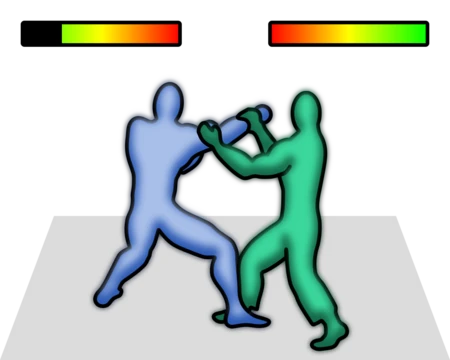
Barbarian: The Ultimate Warrior
Sword-fighting game that sparked controversy over its box art.

Barbarian: The Ultimate Warrior is a fighting game released in 1987 by Palace Software for the Amstrad CPC, Commodore 64, and ZX Spectrum. It was later ported to numerous other systems and licensed to Epyx, which released it in the United States under the title Death Sword. Players control sword-wielding barbarians in combat. A two-player mode lets them fight each other, while a single-player mode has the player's barbarian facing a series of challenges set by an evil wizard to rescue a princess.
Instead of painted artwork, Palace Software used photographs of hired models for the game's box and advertising. The photos featured Michael Van Wijk—later known as 'Wolf' on the TV series Gladiators—as the hero, and Maria Whittaker, a model associated with The Sun tabloid's Page 3 topless shoots, wearing a bikini. This marketing strategy sparked controversy in the United Kingdom, with protests focusing on the sexual imagery of the packaging rather than the game's decapitations and violence. The controversy boosted the game's profile and helped make it a commercial success. Critics praised its fast combat and humor. Barbarian became Palace Software's critical hit, leading the company to expand and begin publishing other developers' work. A sequel, Barbarian II: The Dungeon of Drax, followed in 1988.
In gameplay, one or two players control sword-wielding barbarians in arenas like a forest glade or a fighting pit. The head-to-head mode pits a player against another or the computer in timed matches. The single-player story mode consists of a series of plot-connected challenges. Using joysticks or keyboard, players move, jump to dodge low blows, and roll to dodge or trip opponents. Holding the fire button and moving the controller directs kicks, headbutts, or sword attacks. Each barbarian has 12 life points shown as six circles. A successful attack removes half a circle. Death occurs when life points reach zero, or instantly from a well-timed decapitation, after which a goblin kicks the head and drags the body away. If no commands are entered for a while, the barbarians turn to face the player, shrug, and say "C'mon." Points are awarded for attacks, with more complex moves scoring higher. A scoreboard shows the highest points.
Quick Facts
- Title
- Barbarian: The Ultimate Warrior
- Developer
- Palace Software
- Publisher
- EU · Palace Software · NA · Epyx
- Designer
- Steve Brown
- Programmer
- Stanley Schembri
- Composer
- Richard Joseph
- Released
- 1987
- Genre
- Fighting game
- Modes
- Single-player, multiplayer
- Platforms
- Acorn Electron, Amiga, Amstrad CPC, Apple II, Atari ST, BBC Micro, Commodore 64, MS-DOS, Java ME, ZX Spectrum
Facts from the source article.
Lore & Background
Barbarian: The Ultimate Warrior was developed by Palace Software after the success of Cauldron and Cauldron II. Designer Steve Brown, inspired by Frank Frazetta's fantasy paintings and Robert E. Howard's Conan stories, aimed to create a brutal sword-fighting game. He conceptualized 16 moves, practicing with wooden swords and filming sessions for animation reference. The team traced frames onto clear plastic sheets over a television screen and transferred them pixel by pixel to digital form. Brown refused to use small sprites, forcing coders to multiplex sprites with different look-up tables.
The game's packaging used photos of hired models instead of painted artwork. Michael Van Wijk (later known as 'Wolf' on Gladiators) posed as the hero, and Maria Whittaker, a Page 3 topless model from The Sun, appeared in a bikini. Palace Software also included a poster of Whittaker. The marketing provoked protests in the UK focused on sexual aspects rather than in-game violence. The controversy boosted the game's profile and commercial success. A sequel, Barbarian II: The Dungeon of Drax, was released in 1988.
Reader's Guide
Barbarian: The Ultimate Warrior is significant as a landmark fighting game that demonstrated how marketing controversy could drive sales. Its use of live models for box art was unusual for the time and sparked public debate, with critics and religious groups calling the imagery offensive while the Advertising Standards Authority found it not in bad taste. The game itself was praised for fast combat and humor, and its decapitation mechanic—where a goblin kicks the head and drags the body away—became iconic. Palace Software's success with Barbarian allowed the company to expand and publish other developers' work. The game's legacy includes multiple ports, a budget re-release without Whittaker on the cover, and an American version retitled Death Sword. Critics noted that UK public concern focused on the scantily-clad model rather than the game's violence, a dynamic that foreshadowed later debates about video game content.
Did You Know?
- The game's decapitation sound effect, an 'EEY-ECH!' yell, was taken from the 1985 film Red Sonja.
- Designer Steve Brown nearly injured himself practicing the 'Web of Death' move with a wooden sword, copying it from the film Conan the Destroyer.
- The Atari ST version features 10 barbarians in story mode instead of the usual 8, and uses digitized sound samples.
- Palace Software appended the subtitle 'The Ultimate Warrior' after discovering another company was releasing a game also titled Barbarian.
More in Fighting games 1-24
Spotted an error? Know more?
Reader corrections go straight into our review queue. Suggest an edit · How this site is sourced