Age of Elements
Cancelled PSP fighting game blending Tekken and Powerstone.

Unknown author · Public domain
Age of Elements was a fighting game for the PlayStation Portable, developed by the newly formed studio Steamroll and set to be published by Atari. The project was first revealed in June 2006, shown at E3 2006, and ultimately canceled in 2007.
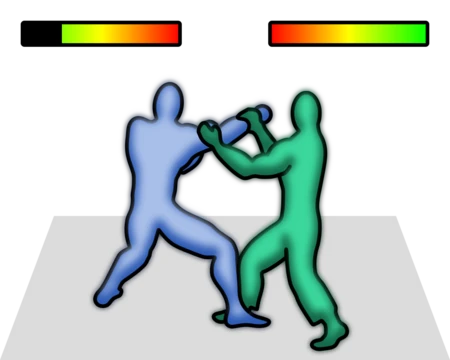
The gameplay was described by IGN as a blend of *Tekken* and *Powerstone*. Fights were one-on-one, with a camera that shifted based on distance: from far away, it offered a third-person, behind-the-back view for aiming and shooting, while close-quarters combat switched to a standard side-by-side fighting game perspective. Planned modes included training, versus, and story. Local multiplayer was intended, but online play was not.
At E3 2006, Atari stated the game was about 40% complete. The demo was playable at the event, and a release window of "Winter 2006" (late 2006 to early 2007) was announced, though the game was canceled the following year.
At E3 2006, IGN nominated it for "Best Fighting Game" on PSP, but it lost to *Tekken: Dark Resurrection*. IGN called the premise "promising and unique" but noted it was too early to judge given the incomplete state. The graphics engine was singled out as impressive, running at a high framerate with special effects and animations. IGN initially mistook the visuals for 2D polygons, and praised the expansive environments—featuring details like waterfalls, lit signs, and storefronts—comparing the look favorably to console 3D fighters.
Quick Facts
- Title
- Age of Elements
- Developer
- Steamroll
- Publisher
- Atari
- Released
- Cancelled
- Genre
- Fighting
- Modes
- Single-player, multiplayer
- Platforms
- PlayStation Portable
Facts from the source article.
Lore & Background
Age of Elements was first announced in June 2006 and debuted by publisher Atari at E3 2006, where it was described as about 40% complete. The game was developed by a newly created development team named Steamroll and was made playable at the event. It was planned for a 'Winter 2006' release (late 2006 to early 2007) on the PlayStation Portable, but the release was later cancelled in 2007.
Gameplay was described by IGN as a mix between Tekken and Powerstone, featuring one-on-one battles with a shifting camera-view. When combatants were far apart, the camera shifted to a third-person, behind-the-back view allowing the player to aim and shoot; when close, it shifted to a side-by-side view common in fighting games. Planned modes included training, versus, and story mode, with local multiplayer but no online multiplayer.
At E3 2006, Age of Elements was nominated for IGN's 'Best Fighting Game' for PSP but lost to Tekken: Dark Resurrection. IGN called the premise 'promising and unique' but noted it was too early to judge with the game less than half complete. The graphics engine was singled out as impressive, running at a high framerate with special effects and detailed environments, including waterfalls and rustic town settings.
Reader's Guide
Age of Elements is notable as a cancelled PSP fighting game that demonstrated technical ambition for the handheld platform. Its shifting camera system—alternating between third-person shooting and traditional side-view fighting—was an unusual hybrid mechanic that IGN compared to Tekken and Powerstone. The game's graphics engine was praised for its detail and performance, with IGN noting it could be mistaken for a 2D polygon-based fighter. Though cancelled before release, its nomination for IGN's Best Fighting Game at E3 2006 indicates it generated interest among critics. The game represents a brief moment when Atari and the new studio Steamroll attempted to innovate within the fighting genre on portable hardware. Its cancellation in 2007 left the concept unrealized, but the previews provide a snapshot of what might have been a distinctive entry in the PSP library.
Did You Know?
- Age of Elements was developed by a newly created studio named Steamroll.
- The game was nominated for IGN's 'Best Fighting Game' for PSP at E3 2006 but lost to Tekken: Dark Resurrection.
- The camera view shifted between third-person behind-the-back and side-by-side depending on character distance.
- The game was planned for a 'Winter 2006' release but was cancelled in 2007.
A Hybrid Fighting Vision Built for the Handheld
Age of Elements was conceived as a one-on-one fighting game that blended the competitive depth of a title like Tekken with the arena-based chaos of Powerstone, a description IGN offered when previewing the project. Its most distinctive mechanical feature was a dynamic camera system that responded to the distance between the two combatants. When fighters were separated by a wide gap, the perspective pulled back into a third-person, over-the-shoulder view, allowing the player to aim and fire projectiles at the opponent. As the characters closed in, the camera snapped to the classic side-by-side angle familiar to any fighting-game veteran. Beyond the core combat loop, the design team outlined a training mode for mastering techniques, a straightforward versus mode, and a narrative story mode for single-player progression. Local multiplayer was on the table, though online play was never part of the plan. All of this was intended to run on Sony's PlayStation Portable, making the ambitious scope all the more striking for a handheld device.
From New Studio to E3 Debut in a Matter of Months
The project first surfaced in June 2006, when publisher Atari took the stage at E3 to unveil Age of Elements to the public. At the time of that debut, Atari reported the game was roughly forty percent complete, and a playable build was available for attendees to try on the show floor. The development credit went to Steamroll, a studio that had been newly assembled specifically to build this title, meaning the team had essentially been created from the ground up to deliver the project. Atari had penciled in a "Winter 2006" release window, which in industry terms meant somewhere between late 2006 and early 2007, targeting Sony's PlayStation Portable handheld. That timeline, however, never materialized. By 2007 the game had been officially cancelled, leaving Steamroll's work unfinished and the title absent from the PSP's already modest fighting-game library. The entire arc from studio creation to cancellation spanned barely a year and a half.
A Graphics Engine That Stunned on a Handheld
Even at less than half completion, the technical presentation of Age of Elements drew immediate attention from reviewers. IGN specifically called out Steamroll's graphics engine as something the studio had already pushed well beyond what was typical for the PSP at that point. The preview build ran at what IGN described as an impressive framerate, layered with special effects and dedicated animation sequences that gave characters a sense of weight and life. The visual fidelity was so convincing that the reviewer initially mistook the game for a two-dimensional fighter rendered with polygons. Arena environments were expansive and richly detailed: fantasy outdoor settings featured both running and towering waterfalls, while a rustic town stage included illuminated signage and recognizable storefronts. Character models carried fine detail on faces and outfits. IGN concluded that, taken together, the arena scale, character detail, and smooth engine performance placed the game's visual quality in the same conversation as several console 3D fighting titles, all achieved exclusively on a handheld.
A Cancellation That Left a Permanent Gap
Age of Elements never reached a retail shelf. The title was cancelled in 2007, just over a year after its E3 debut, and it remains one of the PSP's notable what-ifs in the fighting-game genre. Its brief public life was marked by a single but meaningful recognition: a nomination for "Best Fighting Game" in IGN's "PSP Best of E3 2006" awards, where it ultimately lost to the already-released Tekken: Dark Resurrection. IGN's preview struck a careful tone, calling the premise "promising and unique" while acknowledging that a build under fifty percent complete was too early for a definitive verdict. What the cancellation erased was not just a single game but an entire experimental design philosophy—the hybrid of ranged aiming and close-quarters brawling, the adaptive camera, the story mode—none of which ever got the chance to be refined, balanced, or experienced by players. For the PSP, which never received a deep catalog of original 3D fighters, the loss of Age of Elements represents a small but permanent gap in the platform's history.
Gallery


Frequently Asked Questions
What is Age of Elements?
Age of Elements was a one-on-one fighting game built for the PlayStation Portable that merged close-range melee brawling with a ranged aiming system. It was created by the studio Steamroll and was slated for publication by Atari.
Who developed and published Age of Elements?
The title was produced by Steamroll, a brand-new development team at the time, with Atari serving as the publishing partner. The project first surfaced in June 2006 and was demonstrated at that year's E3 showcase.
What was Age of Elements's gameplay like?
IGN likened the combat to a cross between Tekken and Powerstone, using a camera that swapped from a behind-the-back aiming view at distance to a classic side-on fighting perspective up close. Fights were strictly one-on-one, and a training mode was listed among the planned game modes.
When was Age of Elements announced?
The game was first revealed to the public in June 2006 and shown on the E3 2006 floor, where its PSP-exclusive scope and hybrid fighting style were highlighted.
Why can't I play Age of Elements today?
The project was officially scrapped in 2007 before it ever reached retail shelves, so no finished copy was ever produced for the PSP. As a result, the game remains unplayable outside of any leaked or prototype builds that may have circulated among collectors.
More in Fighting games 1-24
Spotted an error? Know more?
Reader corrections go straight into our review queue. Suggest an edit · How this site is sourced