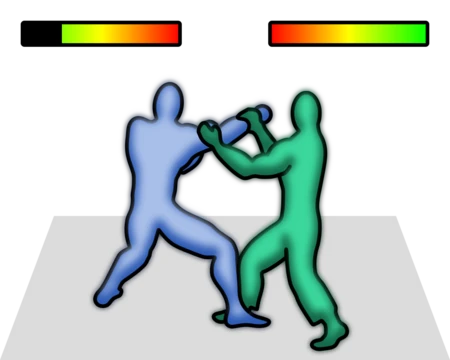
Fighting game
A genre of combat between characters using special moves and combos.

SecretName101 · CC BY 4.0
Fighting games are a type of action game where two or more on-screen characters fight each other, typically featuring special moves triggered by rapid sequences of button presses and joystick movements. The genre involves combat between characters, often one-on-one, with mechanics such as blocking, grappling, counter-attacking, and chaining attacks into combos. Battles are usually set in a fixed-size arena along a two-dimensional plane, though some games allow limited or full three-dimensional movement, referred to as '3D arena' fighting games.
- First game
- Heavyweight Champ (1976)
- Genre origin
- Karate Champ (1984)
- Key title
- Street Fighter II (1991)
- Related genre
- Beat 'em up
- Common view
- Side view, 2D or 3D graphics
Lore & Background
The first video game to feature fist fighting is Heavyweight Champ (1976), but Karate Champ (1984) is considered the first one-on-one fighting game rather than a sports game. Yie Ar Kung-Fu (1984) introduced various fighting styles, and Karate Champ (1984) does display a health meter. The Way of the Exploding Fist (1985) popularized the genre on home systems. In 1987, Capcom's Street Fighter introduced special attacks, and in 1991, Street Fighter II refined and popularized many genre conventions. However, combos were not an intentional design feature—they were discovered by players and later codified; the first game to intentionally include combos is generally considered to be Street Fighter II: The World Warrior (1991) in later revisions, or more commonly Street Fighter II: Champion Edition (1992) or Super Street Fighter II (1993). Fighting games became the preeminent genre in arcades during the early to mid-1990s, spawning franchises like Street Fighter, Mortal Kombat, Tekken, and Super Smash Bros.
Reader's Guide
Fighting games are distinctly related to beat 'em ups, which pit many computer-controlled enemies against one or more players. During the 1980s to 1990s, publications used the terms 'fighting game' and 'beat 'em up' interchangeably, though critics argue the two types gradually became dichotomous. Sports-based combat games like boxing, MMA, and wrestling are often considered separate genres due to their realistic models. Fighting games emphasize predicting opponents' moves and counter-attacking, with strategies such as zoning (defensive play to keep opponents away) and rushdown (aggressive strategies to overwhelm opponents). Spacing and footsies refer to positioning a character at a range where their attacks are effective. The genre's legacy includes the standardization of special attacks, combos, and health meters, influencing countless games across platforms.
From Arcade Pioneers to Genre Dominance
The fighting game genre traces its roots back to 1976 with Heavyweight Champ, the first video game to feature fist fighting. However, it was Karate Champ in 1984 that truly established the one-on-one fighting format in arcades, moving beyond the sports game classification. That same year, Yie Ar Kung-Fu expanded the formula by introducing multiple fighting styles and health meters. The genre continued its momentum with The Way of the Exploding Fist in 1985, which brought these mechanics to home consoles. Capcom's 1987 Street Fighter added special attacks to the mix, but it was the 1991 release of Street Fighter II that truly cemented the genre's conventions, refining combos and establishing the template that would define the category for decades. This period of the early to mid-1990s saw fighting games become the dominant force in arcades, spawning a wave of iconic franchises including Mortal Kombat, Tekken, and Super Smash Bros.
Combat Mechanics and the Art of the Exchange
At the heart of every fighting game lies a carefully constrained combat system. Players are confined to offensive and defensive maneuvers within a fixed-size arena, typically navigating a two-dimensional plane by walking, dashing, and jumping. The side-view presentation persists even as graphics have evolved into full three-dimensional rendering, preserving the genre's fundamental spatial logic. Defense is layered: basic blocking counters standard attacks, while more sophisticated systems introduce parrying, as seen in Street Fighter III, where a successful parry skips the temporary stun of a block and opens an immediate counter-attack window. SNK's Garou: Mark of the Wolves uses similar terminology with its just defended state. Offense is elevated through special attacks triggered by rapid sequences of directional inputs and button presses. Some characters even possess taunts, originated by SNK in Art of Fighting in 1992, that add personality and can affect gameplay by boosting the strength of subsequent attacks. Combos, which chain multiple attacks together, represent the genre's most celebrated mechanical depth.
Drawing Lines: Fighting Games vs. Beat 'Em Ups vs. Sports
The fighting game genre has long existed in a state of taxonomic ambiguity. During the 1980s and 1990s, publications frequently used fighting game and beat 'em up interchangeably, alongside labels like martial arts simulation and punch-kick games. Video game magazines continued calling fighting games beat 'em ups well into the late 1990s. The distinction, as critics have since clarified, is that beat 'em ups pit one or more player characters against waves of computer-controlled enemies without dividing combat into discrete rounds, whereas fighting games center on structured one-on-one or small-group bouts. Sports-based combat titles, including boxing, mixed martial arts, and wrestling games, occupy yet another category. These aim for realistic modeling of athletic techniques, while fighting games lean toward highly exaggerated or outright fantastical interpretations of martial arts. This fundamental difference in realism versus spectacle has led to boxing and wrestling games being classified under the sports genre rather than action, keeping them distinct from the fighting game family despite superficial similarities in health bars and combat presentation.
The 3D Revolution and the Arena Fighter
The transition from two-dimensional to three-dimensional graphics transformed fighting games, though the degree of spatial freedom varied enormously. Titles like Tekken, Soul Edge, and Dead or Alive introduced limited 3D movement while still largely constraining play to a two-dimensional plane of motion. At the other extreme, a subset of games abandoned the 2D plane entirely, creating fully three-dimensional environments where characters roam freely without directional restrictions. These 3D arena fighting games include Dragon Ball Z: Budokai Tenkaichi, Jump Force, Kill la Kill: If, My Hero: One's Justice, Naruto: Ultimate Ninja Storm, One Piece: Burning Blood, and Power Stone. Even within the more traditional 3D-rendered fighting games, developers gained the ability to add a greater number of animations, enriching character expression while preserving the left-right-and-jump movement paradigm. Some titles, like Fatal Fury: King of Fighters, even allowed players to shift between parallel planes of movement, offering a middle ground between strict 2D and full 3D freedom.
Gallery




Frequently Asked Questions
What is a fighting game?
A fighting game is a combat-focused action genre in which two or more characters duel each other inside a fixed arena, usually rendered on a two-dimensional side-view plane. Players execute special moves and combos through rapid button presses and joystick directions, with options for blocking, grappling, and counter-attacks.
What was the first fighting game ever made?
Heavyweight Champ, released in 1976, is generally cited as the earliest example of the genre. It presented a boxing-style one-on-one duel, predating the structured special-move systems that would later become standard.
Which title is considered the most influential in fighting game history?
Street Fighter II (1991) is the game most often credited with cementing the modern template for the genre. It popularized large multi-character rosters, dedicated special-move inputs, and the side-view arena layout that became the category's default presentation.
How do fighting games differ from beat 'em ups?
Although both are combat genres, fighting games center on one-on-one duels in a confined, fixed-size arena, while beat 'em ups typically pit a player against waves of enemies across a scrolling stage. The tight, turn-based structure of fighting games contrasts with the more open, multi-enemy encounters of beat 'em ups.
What core mechanics define gameplay in a fighting game?
Standard tools include blocking, grappling, counter-attacking, and chaining attacks into combos. Players trigger special moves with rapid sequences of button presses and directional joystick inputs, and battles are usually confined to a two-dimensional plane, though some titles allow limited or full three-dimensional movement.
More in Fighting games 1-24
Spotted an error? Know more?
Reader corrections go straight into our review queue. Suggest an edit · How this site is sourced