Aggressors of Dark Kombat
A 1994 Neo Geo fighter with planar movement and weapon play.

Aggressors of Dark Kombat is a fighting game for the Neo Geo, released in 1994 in Japan and 1995 internationally, made by ADK and put out by SNK. Its main gimmick lets fighters step toward or away from the screen in an otherwise 2D setup—a bit like the "Oversway" system in SNK's later Fatal Fury 3. Some reviewers liked this, but most felt the game brought nothing new to the table and came off as generic and shallow. It did okay commercially, but never got as big as the top SNK fighters.
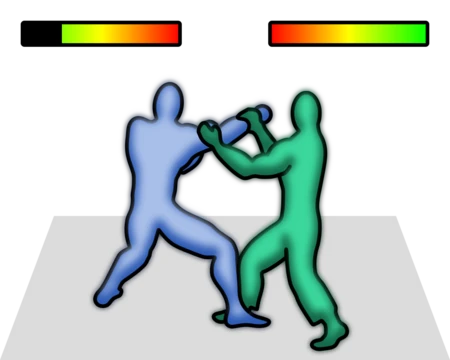
In gameplay, the screen-depth movement works like older arcade brawlers such as Violence Fight, Street Smart, and Pit-Fighter. Jumping requires a dedicated button instead of a diagonal press. There are only two attack buttons—punch and kick—and no "D" button. Grappling is central: you can grab opponents, and they can counter and break free. Weapons, tossed in by background spectators, can be picked up, thrown, or used in normal and special attacks, similar to beat 'em ups like Renegade and The Combatribes. The health bar has multiple colored layers. A "Crazy Meter" (called "Gan Gan Attack" in Japan) fills as you attack, letting you unleash a one-hit knockout special—known as "Crazy Attack" internationally. Before each fight, characters exchange irreverent or funny banter, which changes depending on the opponent, and the match starts with two small eye images clashing on screen. The Japanese and international versions differ in more than just the title and blood removal: the Japanese version also has different character names and some gameplay differences.
There are eight selectable fighters, whose names are displayed on the character select screen and in the attract mode. Seven are new, while Kotaro Fūma returns from World Heroes. Joe Kusanagi, the "Red Panther of Honmoku," is the top brawler in the Kantō region and heads west seeking stronger foes; he later cameos in a Kisarah attack in Neo Geo Battle Coliseum. Goh Kidokoro, the "Strong Spirit from Naniwa," leads a gang in Kansai and wants to fight Joe to conquer the nation. Sheen Genus, the "Rising Tiger," is a Canadian amateur wrestler looking to start his own pro league; he rivals Leonhalt and appears as an action card in SNK vs. Capcom: Card Fighters DS.
Quick Facts
- Title
- Aggressors of Dark Kombat
- Developer
- ADKAdditional work by SNK
- Platforms
- Arcade, Neo Geo AES, Neo Geo CD
- Released
- ArcadeJP · 26 July 1994 · NA · 1994 Neo Geo AESNA/JP · 26 August 1994 Neo Geo CDJP · 13 January 1995 · NA · October 1996
- Genre
- Fighting
- Modes
- Single-player, multiplayer
- Arcade System
- Neo Geo MVS
Facts from the source article.
Lore & Background
The game's major innovation is the ability of fighters to move virtually continuously towards or away from the screen as well as left and right, similar to some 1980s arcade fighting games like Taito's Violence Fight, SNK's Street Smart, and Atari's Pit-Fighter. Jumping is done with an action button, and only two action buttons are used for attacking: one for punches and one for kicks. Grappling and grabbing the opponent is the focus of the gameplay, and the opponent can counter being grabbed and break free. Weapon play is also featured, with weapons thrown into the ring by spectators in the background. The health bar has several layers of colors, and a 'Crazy Meter' at the bottom of the screen builds up as a character attacks, granting a special attack that defeats the opponent outright. In Japan, this meter is called 'Gan Gan Attack', while the special move itself is known internationally as 'Crazy Attack'.
Reader's Guide
Aggressors of Dark Kombat is significant as an attempt by ADK to innovate within the 2D fighting genre by introducing planar movement and weapon mechanics borrowed from beat 'em ups. While some reviews praised the mechanic, critics generally remarked that it offers no meaningful innovation and that the game is generic and lacking in depth. The game features eight selectable characters, seven of which are new, with Kotaro Fūma returning from World Heroes. Characters are not named during gameplay, which is unusual for the genre. The game was met with generally underwhelming reviews, with critics noting that the large sprites and planar movement do not make it intrinsically different from or as deep as preceding fighting games. However, it had its share of defenders, with some praising the fun factor, humorous Crazy moves, and high-quality sound effects. The game was included in the ADK Damashii Game Collection for PlayStation 2 in Japan in 2008 and on the NeoGeo Mini in 2018. Its legacy is modest, with several characters later appearing in other SNK titles such as Neo Geo Battle Coliseum and SNK vs. Capcom: Card Fighters DS.
Did You Know?
- The game's defining feature allows characters to move towards or away from the screen, similar to the 'Oversway' system from the later SNK title Fatal Fury 3: Road to the Final Victory.
- Weapons are thrown into the ring by spectators in the background and can be picked up and thrown or used in attacks.
- The characters are not named anywhere during gameplay, which is unusual for the genre.
Combat Design & Mechanical Identity
Aggressors of Dark Kombat sets itself apart in the 2D fighting space by letting fighters drift continuously toward or away from the screen alongside lateral movement. That depth axis recalls 1980s arcade titles such as Taito's Violence Fight and Atari's Pit-Fighter, and would later reappear in SNK's Fatal Fury 3 as the Oversway system. Because the movement plane is broader, jumping is assigned to a dedicated action button rather than a directional input. The control scheme is pared to just two attack buttons—punches and kicks—with no auxiliary "D" button, a rarity in the SNK catalogue. Grappling is the tactical core: players can grab, be grabbed, and counter-grab, keeping throws and breaks in constant play. A weapon layer, echoing beat 'em ups like Renegade, lets fighters pick up implements hurled into the ring by background spectators and use them in standard or special attacks. A multi-colored health bar tracks damage, and a "Crazy Meter" (the Gan Gan Attack in Japan) builds with each landed hit until it unleashes a single match-ending blow. Pre-fight banter is irreverent and unique to each matchup, and the bout is announced by a brief clash of the two fighters' eyes at screen center. Japanese and international builds are nearly identical, differing only in title and the removal of blood on critical hits.
The Roster & Character Backstories
The game offers eight selectable fighters, seven original to the title and one—Kotaro Fūma—returning from SNK's World Heroes. Unusually for the genre, none of the characters are displayed by name during actual gameplay. Joe Kusanagi, the "Red Panther of Honmoku," is the top brawler of the Kantō region who travels west seeking worthy opponents. Goh Kidokoro, the "Strong Spirit from Naniwa," leads a Kansai gang and aims for nationwide dominance after hearing of Joe's arrival. Sheen Genus, a Canadian amateur wrestler dubbed the "Rising Tiger," hunts strong recruits for his own league and serves as Leonhalt's rival. Kisarah Westfield, the "Naive Tomboy," is an English schoolgirl who chases Joe out of infatuation and is the roster's sole female fighter. Bobby Nelson, the "Brown Bullet," is a basketball player and the fastest, smallest character, always carrying his ball as a weapon. Fūma, the "Angry Hurricane," stumbled out of a time-travel mishap into 1994 Japan and fights without supernatural powers, relying on combo-heavy moves. Lee Hae Gwon, the "White Fang," is a Korean taekwondo practitioner in Japan seeking revenge on Leonhalt. Leonhalt Domador, the "Black Bull," is a Spanish refugee and the tallest, slowest, most powerful fighter on the card.
Critical Reception & Industry Standing
Despite its ambitious depth-movement system and weapon mechanics, Aggressors of Dark Kombat received generally underwhelming critical response. Reviewers acknowledged the large character sprites and the ability to shift between planes, but most felt these features did not make the game intrinsically deeper or more innovative than the fighting titles that preceded it. The consensus leaned toward calling the experience generic and lacking in strategic depth, with several critics noting the depth mechanic offered no meaningful new dimension to 2D combat. Ultimate Future Games, reviewing the Neo Geo CD port, captured the prevailing sentiment by observing that the game presented nothing players had not already encountered in earlier titles. A minority of reviewers did defend the game's charm and accessibility, and it achieved a modest commercial success on the Neo Geo platform. However, it never approached the cultural footprint or player base of SNK's flagship fighters. The title ultimately occupies a niche position: a well-crafted but unremarkable entry in a catalog dominated by far more influential games, remembered today more for its roster's later crossover appearances than for its own gameplay.
Release History & Post-Launch Appearances
Developed by ADK and published by SNK, Aggressors of Dark Kombat launched in 1994 for the Neo Geo arcade system and was subsequently ported to the Neo Geo AES and Neo Geo CD home consoles. Its post-launch life has been defined by periodic re-releases on Japanese platforms. In 2008, ADK bundled the title with several other Neo Geo games on the ADK Damashii Game Collection, a PlayStation 2 compilation available exclusively in Japan. The game returned to hardware in 2018 when it was included on the Japanese Neo Geo Mini, and it also appeared on the limited-edition Christmas, Samurai Shodown, and Samurai Spirits variants of that console. Beyond re-releases, the roster has found a second life in crossover titles: Kisarah Westfield and Kotaro Fūma are both playable in Neo Geo Battle Coliseum, while Sheen Genus and Bobby Nelson appear as action cards in SNK vs. Capcom: Card Fighters DS. Joe Kusanagi even makes a brief cameo in one of Kisarah's attacks in Neo Geo Battle Coliseum. These appearances have kept the characters visible to new generations of players, even as the original game itself remains a modest footnote in SNK's otherwise storied fighting-game legacy.
Frequently Asked Questions
What is Aggressors of Dark Kombat?
It is a 2D fighting game that hit Neo Geo arcades in Japan in 1994 and rolled out internationally in 1995. ADK developed the title while SNK handled publishing. Its defining trait is a screen-depth mechanic that lets fighters step toward or away from the camera inside an otherwise flat plane.
How does the depth-movement system in Aggressors of Dark Kombat work?
Characters can shift forward and backward relative to the viewer, adding a pseudo-3D layer to standard side-on combat. The feel is often compared to older brawlers like Violence Fight or Street Smart, and later to SNK's own 'Oversway' system in Fatal Fury 3.
Who made Aggressors of Dark Kombat?
A.D.K. Corporation (ADK) built the game, and SNK served as the publisher for both the arcade cabinet and the Neo Geo home consoles. It launched in Japanese arcades in 1994 before arriving in Western markets in 1995.
How was Aggressors of Dark Kombat received by critics and the fan community?
A handful of reviewers praised the planar-movement idea, but the prevailing opinion was that the roster was shallow and the overall package felt generic. It sold adequately on Neo Geo hardware yet never achieved the lasting cultural presence of SNK's bigger fighting franchises.
What platforms can I play Aggressors of Dark Kombat on today?
The game was released for the Neo Geo arcade system as well as the Neo Geo AES and CDZ home units. No official modern port or re-release has appeared, so the original hardware or emulation remain the main ways to experience it.
More in Fighting games 1-24
Spotted an error? Know more?
Reader corrections go straight into our review queue. Suggest an edit · How this site is sourced