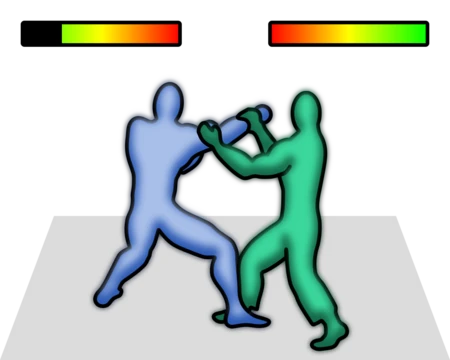
Aaargh!
A monster action game about destruction and growth on a lost island.

Andrew Bone from Weymouth, England · CC BY 2.0
Aaargh! is a single-player action video game released in 1988 for home computers such as the Amiga, Atari ST, Commodore 64, and ZX Spectrum, and was never released as an arcade cabinet. The player controls a giant ogre-like monster destroying buildings and eating food to grow, with no egg-collecting mechanic. The Amiga version was published by Mastertronic.
Quick Facts
- Title
- Aaargh!
- Developer
- Binary Design / Sculptured Software
- Publisher
- Arcadia Systems / Melbourne House
- Designer
- Steve Coleman / Joe Hitchens
- Artist
- Joe Hitchens
- Platforms
- Arcade, Amiga, Amstrad CPC, Apple IIgs, Atari ST, Commodore 64, MS-DOS, MSX, ZX Spectrum
- Released
- 1987, 1988, 1989
- Genre
- Action game
- Modes
- Single-player
Facts from the source article.
Lore & Background
In Aaargh!, the player controls a single giant ogre-like monster, while the rival is a dragon-like creature—there is no choice between two characters. The goal is to destroy buildings in ten cities—including a Primitive village, a Wild West Fort, and an Aztec city—and eat food to grow. There are no Roc eggs or golden dragon's egg; the final battle against the rival takes place on a volcano. The game is single-player only on all platforms.
Reader's Guide
Aaargh! received mixed reviews across its ported platforms, with scores ranging from approximately 2/10 to 9/10. Reviewers praised the graphics and sound, especially on the Amiga version, but criticized the gameplay. ACE magazine noted good graphics and sound but found the game lacking challenge. ZX Spectrum reviewers disliked the need to load levels individually, with Your Sinclair magazine highlighting the frustration of reloading after death. In 1989, Dragon magazine's reviewers gave the game an 'X' rating instead of stars, calling it 'boring, violent without purpose, and lacks a solid plot.' The game is often compared to earlier monster-destruction titles like Rampage (1986) and Crush, Crumble and Chomp! (1981).
Did You Know?
- The game's final level is set on the island's giant volcano.
- The player can eat natives or giant food items like pizza, hamburgers, and tacos for health.
- The game was single-player only on all platforms, with no arcade version.
- Dragon magazine rated the game with an 'X' instead of stars due to strong dislike.
Gameplay & World Design
The player assumes the role of either a Dinosaur or an Ogre, while the unchosen character becomes the rival vying for the same prize. The objective is to traverse ten distinct cities on a Lost Island—spanning a Primitive village, a Pueblo settlement, a Wild West Fort, a Chinese Pagoda village, an ancient Egyptian city, a Colonial harbour town, a Medieval village, an Aztec city, an Ancient Greece city, and an Indian Temple city—smashing buildings to uncover Roc eggs. Each egg discovery triggers a one-on-one battle against the rival monster. After collecting five eggs, the final showdown takes place atop the island's giant Volcano, where the golden dragon's egg is at stake. Every city is rendered as a single static arena using a 2.5D projection technique to simulate depth. Hidden within the buildings are health-restoring items such as giant pizza slices, hamburgers, hot dogs, and tacos, plus lightning bolts that grant powerups. The monsters contend with both native weaponry—catapults, cannons, and wagons—and the island's fauna, including giant mosquitoes, bees, hornets, Rocs, flying lizards, and dragons.
Platform History & Distribution
Aaargh! was originally designed for Mastertronic's Arcadia Systems, an arcade cabinet built around custom hardware derived from the Amiga platform. The title hit arcades in 1987, and in that version, one or two players could compete simultaneously. Following its arcade debut, the game was ported to a range of home platforms over the course of 1988 and 1989, though these releases restricted play to a single player at a time. Electronic Arts took on the distribution role specifically for the Amiga port. The shift from arcade to home systems meant a notable reduction in the social, competitive element the original cabinet supported, as the multi-player simultaneous play available in the arcade version was stripped away in the home releases. The Amiga hardware connection was significant, since the arcade machine's custom hardware was directly based on Amiga technology, giving the Amiga port a particular pedigree in graphical and audio fidelity that reviewers would later single out for praise.
Critical Reception & Controversy
Reviews of Aaargh! across its various platform ports were notably divided, with scores spanning from roughly 2 out of 10 up to nearly 9 out of 10. The Amiga version's graphics and sound drew particular praise from critics, who felt the presentation was a standout. Gameplay, however, was a consistent point of criticism. ACE magazine acknowledged the game's "good graphics, atmospheric sound and good gameplay" but ultimately felt the challenge was insufficient, warning that players would tire quickly of a title they could beat without effort. On the ZX Spectrum, the requirement to load each level individually frustrated reviewers; Your Sinclair magazine quipped that the experience was a "multi-level, multi-load, beat 'em, blowtorch 'em up which'll have you screaming its title each time you die and have to reload." Perhaps most scathing was the 1989 review in Dragon magazine issue 141, where Patricia Hartley and Kirk Lesser, writing in their "The Role of Computers" column, bypassed their usual 1-to-5-star scale entirely and awarded the game an "X," calling it "boring, violent without purpose, and lacks a solid plot."
Legacy & Lineage
Aaargh! sits within a well-established lineage of giant-monster destruction games that had been a staple of arcade and home gaming since the early 1980s. Its closest predecessors include Crush, Crumble and Chomp! from 1981, Rampage from 1986, and The Movie Monster Game, also from 1986. What distinguishes Aaargh! within this family is its specific structural design: rather than a continuous run through a single environment, the game is broken into ten discrete city stages, each representing a different cultural or historical setting, culminating in a volcanic finale. The dual-monster rivalry mechanic—where the player's unchosen character becomes the antagonist—adds a narrative layer not always present in its predecessors. The 2.5D static-arena presentation and the inclusion of both native human threats and oversized insect and reptile enemies further set it apart. Though it received mixed critical response, the game occupied a recognizable niche in the monster-destruction genre during the late 1980s, bridging the arcade era's competitive spirit with the home-computer market's growing appetite for action titles.
Gallery




Frequently Asked Questions
What is Aaargh!?
Aaargh! is a 1988 single-player action game in which you play as a massive ogre-like creature rampaging across a lost island. Developed by Mastertronic, it is a pure destruction-and-growth experience with no competitive or fighting elements.
What platforms was Aaargh! available on?
The title shipped for home computers including the Amiga and Atari ST, with the Amiga edition distributed by Electronic Arts. It was never released as an arcade cabinet.
What do you actually do in Aaargh!?
You pilot a giant monster that tears apart buildings and devours food items to grow larger as you progress. There is no egg-collecting or item-gathering loop—just straightforward demolition and feeding.
Who developed and published Aaargh!?
Mastertronic created the game, while Electronic Arts handled distribution of the Amiga version. The title launched in 1988 exclusively for personal computers.
How many levels are in Aaargh! and what is the final one?
The campaign spans ten distinct city levels you must bulldoze through in sequence. The run concludes at a Volcano stage, serving as the ultimate destination on the lost island.
More in Fighting games 1-24
Spotted an error? Know more?
Reader corrections go straight into our review queue. Suggest an edit · How this site is sourced