Astra Superstars
Airborne fighting game with conversation-based difficulty and Star Specials.

Astra Superstars (アストラスーパースターズ) is a 1998 arcade fighting game developed by Sunsoft and published by Tecmo, released only in Japan. It is Sunsoft's fourth fighting game, following Sugoi Hebereke (1994), Galaxy Fight: Universal Warriors (1995), and Waku Waku 7 (1996). Powered by the Sega Saturn-based ST-V (Sega Titan Video) arcade system, the game is notable for its airborne-based combat and unique conversation system that affects opponent difficulty.
Quick Facts
- Title
- Astra Superstars
- Developer
- Sunsoft
- Publisher
- Tecmo / Sunsoft (Saturn)
- Director
- Kiharu Yoshida / Mitsuharu Kitajima
- Producer
- Akito Takeuchi
- Designer
- Michio Okasaka / Mayson Dassy
- Programmer
- Michio Okasaka
- Artist
- Michio Okasaka / Mayson Dassy / Shigeyuki Asa / Maki Saitō / Ayako Mochizuki
- Composer
- Kazuo Nii / Atsushi Takada / Satoshi Asano
- Released
- 1998
- Platforms
- Arcade, Sega Saturn
- Genre
- Fighting
Facts from the source article.
Lore & Background
The game features eleven characters, eight of whom are playable: Lettuce, Maron, Stella, Sakamoto, Rouge, Coco, Cupe, and Fooly. The three non-playable bosses are Satanvolte, Test-kun, and My Angel/My Devil (a single boss with two forms). In Story Mode, players select one of three sentences before each battle, influencing whether the opponent becomes harder (Heat Up), easier (Cool Down), or stays neutral. Correct judgments may lead to fighting the Angel, while any wrong choice summons the Devil.
Reader's Guide
Astra Superstars uses an 8-way joystick and six buttons, but its moves differ from typical six-button layouts. Heavy attacks send opponents flying across the screen, with possible pinball-like bouncing. Players can move briefly above or below the screen to dodge or chase. The Star Rank bars fill to enable one of two desperation moves per character called Star Specials. Unlike most fighting games, it has only small basic moves and large Star Specials, with no medium-sized specials. Guard breaks occur if the player constantly attacks a guarding opponent. Winning a round awards a letter: V (basic KO), S (Star Special KO), D (aggressive dizzy KO), or J (judge decision). The game was developed first for Sega Saturn and then ported to arcade, with the Saturn version including six exclusive modes and an updated soundtrack.
Did You Know?
- Astra Superstars was released first for arcade hardware, with a Sega Saturn port planned but never released.
- The game's illustrator, Santaclaus, released a freeware software called Rouge Kitz Room that lets users dress the character Rouge in different clothes.
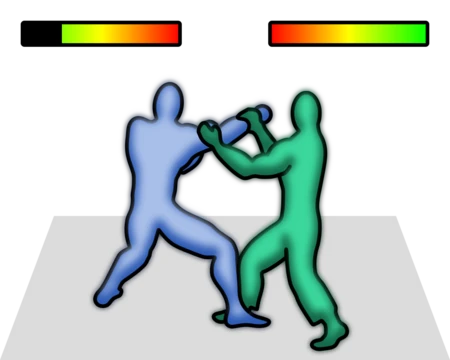
- The final boss, Test-kun, is a simple blue stick figure originally used as a template for the fighters.
- No official soundtrack album for Astra Superstars was ever released; the claim of a Pony Canyon release on February 18, 1998, is incorrect.
More in Fighting games 1-24
Spotted an error? Know more?
Reader corrections go straight into our review queue. Suggest an edit · How this site is sourced