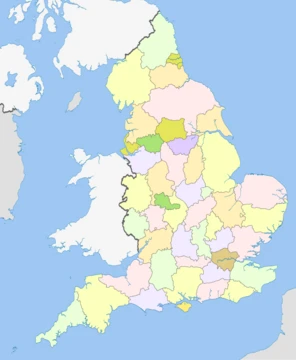
Northumberland
The northernmost county in England, rich in border history and natural beauty.
Northumberland is a ceremonial county in North East England, on the border with Scotland. It is bordered by the North Sea to the east, Tyne and Wear and County Durham to the south, Cumbria to the west, and the Scottish Borders council area to the north. The town of Blyth is the largest settlement. Northumberland is the northernmost county in England.
- area
- 5,013 km² (1,936 sq mi)
- population_2024_estimate
- 331,420
- largest_settlement
- Blyth
- administrative_centre
- Morpeth
- highest_point
- The Cheviot (815 m / 2,674 ft)
- notable_features
- Northumberland National Park, Northumberland Coast, part of North Pennines
Lore & Background
During the Roman occupation of Britain, most of the present county lay north of Hadrian's Wall. It was controlled by Rome only for the brief period of its extension of power north to the Antonine Wall. The Roman road Dere Street crosses the county from Corbridge over high moorland west of the Cheviot Hills to Melrose, Scottish Borders. Northumberland has more castles than any other county in England, including prominent ones at Alnwick, Bamburgh, Dunstanburgh, Newcastle, and Warkworth. Nearly 2,000-year-old Roman boxing gloves were uncovered at Vindolanda in 2017. Present-day Northumberland formed the core of the Anglian kingdom of Bernicia from about 547. It was united with Deira to form the kingdom of Northumbria in the 7th century. Northumberland is often called the 'cradle of Christianity' in England because Christianity flourished on Lindisfarne after King Oswald of Northumbria invited monks from Iona to come to convert the English. The Kingdom of Northumbria fragmented after the Viking invasion. After the battle of Nechtansmere, Northumbrian influence north of the Tweed began to decline. In 1018, its northern part between the Tweed and the Forth was ceded to the Kingdom of Scotland. The Earldom of Northumberland was briefly held by the Scottish royal family by marriage between 1139–1157 and 1215–1217. Scotland relinquished all claims to the region as part of the Treaty of York (1237). Northumberland has a history of revolt and rebellion, as seen in the Rising of the North (1569–1570) against Elizabeth I. After the Restoration in 1660, the county was a centre for Roman Catholicism in England, as well as a focus of Jacobite support. Northumberland played a key role in the Industrial Revolution from the 18th century on. The historic county town was Alnwick; assizes were mainly held in Newcastle, with the county gaol in Morpeth. From the county council's formation in 1889 until 1981 Newcastle was the county town.
Reader's Guide
The county has an area of 5013 km2 and had an estimated population in , making it the least-densely populated county in England. The south-east contains the largest towns: Blyth, Cramlington, Ashington, Bedlington, and Morpeth, the last of which is the administrative centre. The remainder of the county is rural, the largest towns being Berwick-upon-Tweed in the far north and Hexham in the south-west. For local government purposes Northumberland is a unitary authority area. The county historically included the parts of Tyne and Wear north of the River Tyne. The west of Northumberland contains part of the Cheviot Hills and North Pennines, while to the east the land becomes flatter before reaching the coast. The Cheviot (815 m) is the county's highest point. The county contains the source of the River North Tyne and much of the South Tyne; near Hexham they combine to form the Tyne. The other major rivers are, from south to north, the Blyth, Wansbeck, Coquet, Aln and Tweed, the last of which forms part of the Scottish border. The county contains Northumberland National Park and two national landscapes: the Northumberland Coast and part of the North Pennines.
Did You Know?
- Northumberland is the least densely populated county in England.
- The county has more castles than any other county in England.
- Nearly 2,000-year-old Roman boxing gloves were uncovered at Vindolanda in 2017.
- Northumberland is often called the 'cradle of Christianity' in England due to Lindisfarne.
More in English Counties 1-24
Spotted an error? Know more?
This is a living reference — every entry is fact-audited, and reader corrections feed straight into our audit queue. Suggest an edit · See this site's audit record