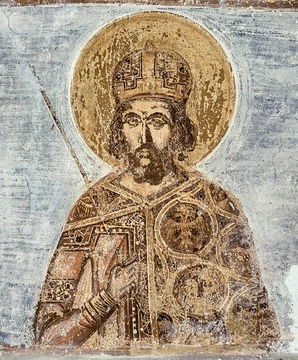
Constantine V
Byzantine emperor who strengthened borders and enforced iconoclast policies.
Last updated

Kostisl · CC BY-SA 4.0
He was crowned co-emperor at age two in Easter 720 by Patriarch Germanus I.[1] He targeted monasteries, expropriating their property and persecuting iconodule monks.[2][3] He invaded Syria in 746, captured Germanikeia and Cyprus, and resettled Christians in Thrace.[4] Constantine led nine successful campaigns against the Bulgarians, causing instability that led to six Bulgarian monarchs losing their crowns.[5][6]
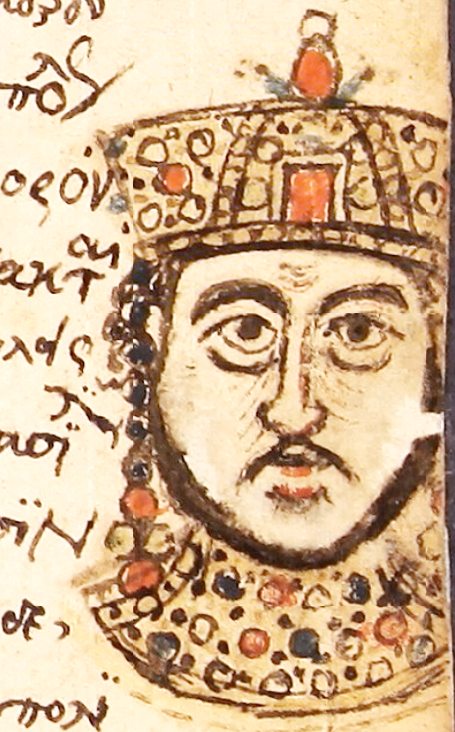
Artabasdos rebelled right after Constantine's accession, but Constantine defeated him and entered the capital in early November; Artabasdos and his sons were then publicly blinded.[7][8][9] Constantine supported iconoclasm, which rejected the veneration of religious images, and in February 754 he convened a council at Hieria that endorsed his policy.[10][11][12]
What the cited sources add
The Prosopography of the Byzantine Empire records that Constantine V was also known as Constantinus, was Christian and Iconoclast, and was buried at the Church of the Holy Apostles.[13] That source confirms his coronation at Easter 720 and gives his floruit as E/M VIII with dates 718 to 775.[13]
References
- Wikipedia, "Constantine V" (CC BY-SA 4.0), which cites: PBE (2001) Konstantinos 7 (#3703) (we also read that source) en.wikipedia.org
- Wikipedia, "Constantine V" (CC BY-SA 4.0), which cites: Brubaker and Haldon, pp. 156, 241 (original not read by us) en.wikipedia.org
- Wikipedia, "Constantine V" (CC BY-SA 4.0), which cites: Brubaker and Haldon, p. 241 (original not read by us) en.wikipedia.org
- Wikipedia, "Constantine V" (CC BY-SA 4.0), which cites: Treadgold (1997), pp. 359–360 (original not read by us) en.wikipedia.org
- Wikipedia, "Constantine V" (CC BY-SA 4.0), which cites: Bury, p. 11; Jenkins, pp. 71–72 (original not read by us) en.wikipedia.org
- Wikipedia, "Constantine V" (CC BY-SA 4.0), which cites: Bury, p. 11; Treadgold (1997), p. 363; Curta, pp. 85–88 (original not read by us) en.wikipedia.org
- Wikipedia, "Constantine V" (CC BY-SA 4.0), which cites: Treadgold (1997), p. 356 (n. 12, p. 939) (original not read by us) en.wikipedia.org
- Wikipedia, "Constantine V" (CC BY-SA 4.0), which cites: Brubaker and Haldon, p. 159 (original not read by us) en.wikipedia.org
- Wikipedia, "Constantine V" (CC BY-SA 4.0), which cites: Garland, p. 9 (original not read by us) en.wikipedia.org
- Wikipedia, "Constantine V" (CC BY-SA 4.0), which cites: Bury, p. 9 (original not read by us) en.wikipedia.org
- Wikipedia, "Constantine V" (CC BY-SA 4.0), which cites: Barnard, p. 13; Ostrogorsky, p. 171; Brubaker and Haldon, p. 182 (original not read by us) en.wikipedia.org
- Wikipedia, "Constantine V" (CC BY-SA 4.0), which cites: Ostrogorsky, pp. 171–173; Pelikan, pp. 111–112; Loos, p. 32 (original not read by us) en.wikipedia.org
- PBE (2001) Konstantinos 7 (#3703). facts only, no text reused. pbe.kcl.ac.uk
Each numbered sentence above was checked against the source it cites before publication. Sentences citing Wikipedia adapt text from the English Wikipedia article Constantine V (contributors), used under CC BY-SA 4.0; this entry is available under the same licence. Other sources were used for facts only; no text or images are copied from them.
More in Emperors Of The Byzantine And Roman World
Sources
Compiled from Wikipedia and the sources listed below. Text from Wikipedia is available under CC BY-SA 4.0; this entry is adapted from it.
- Wikipedia: Constantine V (CC BY-SA 4.0).
Spotted an error? Know more?
Reader corrections go straight into our review queue. Suggest an edit · How this site is sourced