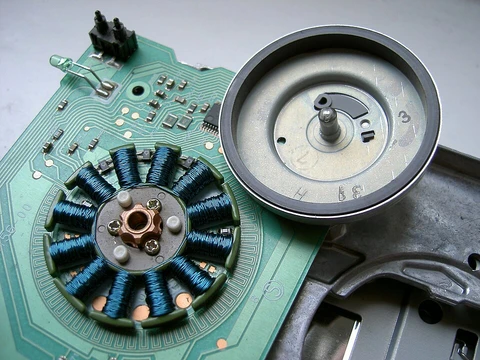
Stator (electric machines)
Stationary part providing magnetic field or converting rotating field.

The stator is the non-moving part of an electric machine, working with the rotor, which spins. In a motor, the stator creates a magnetic field that moves the armature; in a generator, it turns the spinning magnetic field into electricity.
Motor stators can be built from iron or steel, or from a printed circuit board (PCB). Originally used only for low-power devices, PCB stators are lighter, smaller, and quieter. A PCB stator has thin copper traces embedded in it that act as windings, separated by epoxy-glass layers to insulate each coil. Instead of a traditional iron core, it uses an air core, which saves space and weight and allows a smaller air gap. Another construction method uses hairpin windings, where each wire has a larger cross-section than in conventional windings.
Depending on the machine’s design, the stator may act as the field magnet, interacting with the armature to produce motion, or as the armature, influenced by moving field coils on the rotor. Early DC generators (dynamos) and DC motors placed the field coils on the stator and the power coils on the rotor. This requires a commutator—a moving switch that keeps the field aligned as the rotor spins—which must grow larger and stronger as current increases. The stator in these devices can be a permanent magnet or an electromagnet. An AC alternator, by contrast, generates power using multiple high-current coils connected in parallel, which eliminates the need for a commutator.
- Materials
- iron/steel or printed circuit board (PCB)
- Applications
- low-power applications (for PCB stators)
- Winding types
- thin copper traces in PCB stators; hairpin windings with larger cross-section wires
Lore & Background
Motor stators are traditionally made from iron or steel, but PCB stators have been applied to low-power applications, offering lighter weight, smaller size, and reduced noise. One design embeds thin copper traces in the PCB stator as windings, interleaved with epoxy-glass laminates for insulation, and replaces the traditional iron core with an air core, saving space and weight and allowing a smaller air gap. Hairpin windings may also be used, employing wires with individually larger cross sections than conventional windings.
Depending on the configuration, the stator may act as the field magnet, interacting with the armature to create motion, or as the armature receiving influence from moving field coils on the rotor. Early DC generators (dynamos) and DC motors placed field coils on the stator and power generation or motive coils on the rotor, requiring a commutator to keep the field aligned across the spinning rotor. The stator of these devices may be either a permanent magnet or an electromagnet. An AC alternator produces power across multiple high-current power generation coils connected in parallel, eliminating the commutator.
Reader's Guide
The stator is fundamental to electric machines, serving as either the field magnet or the armature depending on the device configuration. In early DC dynamos and motors, the stator housed the field coils, necessitating a commutator that must grow larger and more robust with increasing current. The introduction of PCB stators, with thin copper traces and an air core, enabled lighter, smaller, and less noisy designs for low-power applications. Hairpin windings offer an alternative construction with larger cross-section wires. The stator's material and design—whether iron/steel or PCB, permanent magnet or electromagnet—directly influence the machine's performance, weight, and noise. The AC alternator's use of multiple parallel high-current coils on the stator eliminated the commutator, marking a significant design shift. The stator's role remains central to both motors and generators, as it either provides the driving magnetic field or converts the rotating field into electric current.
Did You Know?
- PCB stators can be lighter, smaller, and less noisy than traditional iron/steel stators.
- Early DC generators and motors required a commutator that must become larger and more robust as current increases.
- An AC alternator eliminates the commutator by using multiple high-current power generation coils connected in parallel.
More in Electric Motors, Part 2 1-24
Spotted an error? Know more?
Reader corrections go straight into our review queue. Suggest an edit · How this site is sourced