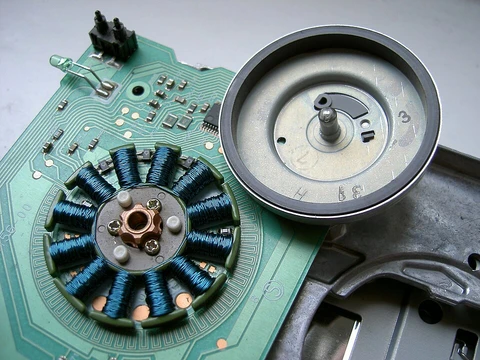
Induction motor
An AC motor that creates torque solely by electromagnetic induction.

An induction motor, also called an asynchronous motor, is a type of AC electric motor. Torque is produced by an electric current in the rotor, and that current is generated through electromagnetic induction from the stator winding’s magnetic field. Because of this, the rotor requires no direct electrical connections. The rotor can be either a wound type or a squirrel-cage type.
Three-phase squirrel-cage induction motors are common in industrial drives because they start on their own, are reliable, and are cost-effective. Single-phase induction motors are widely used for smaller loads, such as garbage disposals and stationary power tools. While these motors were traditionally used only for constant-speed operation, both single- and three-phase versions are now increasingly found in variable-speed applications, thanks to variable-frequency drives (VFDs). VFDs provide energy savings for induction motors in applications like fans, pumps, and compressors that have varying loads.
**History**
The concept of rotating magnetic fields—called Arago's rotations—was first described by French physicist François Arago in 1824. In 1879, Walter Baily demonstrated this by manually turning switches on and off, creating the first primitive induction motor. The first commutator-free single-phase AC induction motor was invented by Hungarian engineer Ottó Bláthy, who used it to power his electricity meter.
The first commutator-free polyphase AC induction motors were invented independently by Galileo Ferraris and Nikola Tesla. Ferraris demonstrated a working model in 1885, and Tesla in 1887. Tesla applied for US patents in October and November 1887, receiving some in May 1888. In April 1888, Ferraris published his research on the AC polyphase motor, detailing its operating principles. In May 1888, Tesla presented a technical paper to the American Institute of Electrical Engineers (AIEE) describing three types of four-stator-pole motors: a non-self-starting reluctance motor with a four-pole rotor, a self-starting induction motor with a wound rotor, and a true synchronous motor with a separately excited DC supply to the rotor winding.
George Westinghouse, who was building an alternating current power system, licensed Tesla’s patents in 1888 and bought a US patent option on Ferraris’ induction motor concept. Tesla worked as a consultant for one year. Westinghouse employee C. F.
- Inventors
- Galileo Ferraris and Nikola Tesla (independently)
- First polyphase motor demonstration
- 1885 (Ferraris), 1887 (Tesla)
- Cage rotor inventor
- Mikhail Dolivo-Dobrovolsky
- Cage rotor invention year
- 1889
- Typical slip range
- 0.5% to 5.0%
- Magnetizing current range
- 20–35%
Lore & Background
In 1824, French physicist François Arago formulated the existence of rotating magnetic fields, termed Arago's rotations. Walter Baily demonstrated this in 1879 by manually turning switches on and off, effectively the first primitive induction motor. The first commutator-free single-phase AC induction motor was invented by Hungarian engineer Ottó Bláthy, who used it to propel his invention, the electricity meter. The first AC commutator-free polyphase induction motors were independently invented by Galileo Ferraris and Nikola Tesla, with working models demonstrated in 1885 and 1887 respectively. Tesla applied for US patents in October and November 1887, granted in May 1888. In April 1888, the Royal Academy of Science of Turin published Ferraris's research detailing the foundations of motor operation. In May 1888, Tesla presented a technical paper describing three four-stator-pole motor types: a non-self-starting reluctance motor, a self-starting induction motor with a wound rotor, and a true synchronous motor with separately excited DC supply to the rotor winding. George Westinghouse licensed Tesla's patents in 1888 and purchased a US patent option on Ferraris' induction motor concept. Westinghouse employee C. F. Scott assisted Tesla and later took over development. Mikhail Dolivo-Dobrovolsky invented the cage-rotor induction motor in 1889 and the three-limb transformer in 1890, claiming Tesla's motor was not practical due to two-phase pulsations. Westinghouse achieved its first practical induction motor in 1892 and developed a line of polyphase 60 hertz induction motors in 1893, though these were two-phase with wound rotors until B. G. Lamme developed a rotating bar winding rotor. General Electric began developing three-phase induction motors in 1891, and by 1896 GE and Westinghouse signed a cross-licensing agreement for the bar-winding-rotor design, later called the squirrel-cage rotor. Arthur E. Kennelly first brought out the full significance of complex numbers in AC analysis, and Charles Proteus Steinmetz improved the application and developed the Steinmetz equivalent circuit. Improvements were such that a 100-horsepower induction motor built in the 1970s had the same mounting dimensions as a 7.5-horsepower motor in 1897.
Reader's Guide
The induction motor's essential character is that torque is created solely by induction, unlike synchronous or DC machines with separately excited rotors or permanent magnet motors. Its rotor can be either wound type or squirrel-cage type. Three-phase squirrel-cage induction motors are widely used as industrial drives because they are self-starting, reliable, and economical. Single-phase induction motors are used extensively for smaller loads, such as garbage disposals and stationary power tools. Although traditionally used for constant-speed service, both types are increasingly being installed in variable-speed applications using variable-frequency drives (VFD), which offer energy savings opportunities for applications like fans, pumps, and compressors that have a variable load. An induction motor can also be used as an induction generator, though this mode is complicated by the need to excite the rotor, which begins with only residual magnetization. In some cases, residual magnetization is enough to self-excite under load; otherwise, it is necessary to snap the motor and connect it momentarily to a live grid or add capacitors charged initially by residual magnetism. A feature in generator mode parallel to the grid is that rotor speed is higher than in driving mode, and active energy is given to the grid. A disadvantage is that it consumes a significant magnetizing current of 20–35%.
The Induction Principle at Work
The defining trait of an induction motor is that its rotor never receives electrical power through a physical connection. Alternating current fed into the stator windings generates a magnetic field that rotates in step with the AC oscillation. Because the rotor conductors lag slightly behind this spinning field, the field is always moving relative to them, and by the same electromagnetic principle that drives a transformer's secondary, currents are induced in the rotor. Those induced currents produce their own magnetic field, which, in accordance with Lenz's Law, opposes the change that created it. The net effect is that the rotor is dragged along in the direction of the stator field, accelerating until the torque it generates matches the external load. If the rotor were to reach synchronous speed, the relative motion would vanish, no current would be induced, and torque would collapse. Thus every induction motor runs a small fraction below synchronous speed; engineers call this gap "slip," and for standard Design B machines it typically falls between roughly half a percent and five percent. This reliance on pure induction—rather than separate excitation, commutators, or permanent magnets—sets the induction motor apart from other AC machine types.
A Pioneering Century of Invention
The road to the modern induction motor stretched across more than six decades and involved inventors on both sides of the Atlantic. In 1824, French physicist François Arago described the phenomenon of rotating magnetic fields, a concept Walter Baily later demonstrated in 1879 by manually toggling switches—a crude but genuine first induction motor. Hungarian engineer Ottó Bláthy then built the first commutator-free single-phase AC induction motor, which he used to drive his electricity meter. The polyphase breakthrough came almost simultaneously: Galileo Ferraris demonstrated a working AC polyphase motor in 1885, and Nikola Tesla followed with his own model in 1887, filing US patents that October and November and receiving several by May 1888. Tesla's landmark AIEE paper that May outlined three distinct four-pole stator motor types, including a self-starting wound-rotor induction machine. Meanwhile, Mikhail Dolivo-Dobrovolsky, convinced that two-phase designs suffered from pulsation problems, pushed three-phase development forward, inventing the cage-rotor induction motor in 1889.
From Workshop to Factory Floor
The commercialization of the induction motor was as competitive as its invention. George Westinghouse, building an alternating-current power system, licensed Tesla's patents in 1888 and also secured a US patent option on Ferraris's concept, employing Tesla briefly as a consultant. Westinghouse employee C. F. Scott assisted Tesla and eventually took over motor development at the company. Westinghouse produced its first practical induction motor in 1892 and a line of polyphase 60-hertz machines by 1893, though these early units were two-phase with wound rotors until B. G. Lamme devised a rotating bar-winding rotor. General Electric began its own three-phase induction motor program in 1891, and by 1896 the two giants signed a cross-licensing agreement covering the bar-winding design that would become known as the squirrel-cage rotor. Arthur E. Kennelly at GE was the first to fully exploit complex-number notation—using j for the square root of minus one—as a 90-degree rotation operator in AC analysis, while Charles Proteus Steinmetz built on that foundation to develop the analytical model now called the induction motor Steinmetz equivalent circuit.
Ubiquity and the Variable-Speed Future
Today the induction motor is arguably the single most widespread electric motor on Earth, and its dominance rests on a simple combination of self-starting capability, mechanical reliability, and low cost. Three-phase squirrel-cage machines are the default choice for industrial drives, while single-phase variants power smaller household and workshop loads such as garbage disposals and stationary power tools. For decades these motors were associated almost exclusively with constant-speed service, but the rise of variable-frequency drives has opened a new chapter. A VFD lets an operator adjust the electrical frequency fed to the stator, thereby varying motor speed to match the actual load. In applications where the load fluctuates—fans, pumps, and compressors being the classic examples—this speed-matching delivers meaningful energy savings compared with running a fixed-speed motor and throttling the output. The result is that induction motors, once locked to a single rotational speed, are increasingly deployed in variable-speed roles across industry, extending the reach of a technology whose core principle was established in the 1880s.
Frequently Asked Questions
Who is the Induction Motor?
The Induction Motor, also called the asynchronous motor, is an AC electric motor that generates rotational torque purely through electromagnetic induction, so the rotor never needs a direct electrical connection. It was independently conceived by Galileo Ferraris (demonstrated 1885) and Nikola Tesla (demonstrated 1887).
What are the Induction Motor's core powers?
Its signature ability is producing torque without brushes or slip rings, because the stator's rotating magnetic field induces current in the rotor on its own. It runs with a small speed difference called slip, typically between 0.5% and 5.0% of synchronous speed.
What are the Induction Motor's two main forms?
The rotor can be built as a wound type with discrete windings, or as a squirrel-cage type where conductive bars are short-circuited by end rings. Mikhail Dolivo-Dobrovolsky introduced the cage-rotor design in 1889, and it went on to become the dominant industrial configuration.
Why is the Induction Motor so important in the real world?
Three-phase squirrel-cage induction motors dominate industrial drives because they self-start, are mechanically robust, and keep manufacturing costs low. Single-phase variants handle smaller household and light-commercial loads, making the family ubiquitous across every sector.
More in Electric Motors, Part 2 1-24
Spotted an error? Know more?
Reader corrections go straight into our review queue. Suggest an edit · How this site is sourced