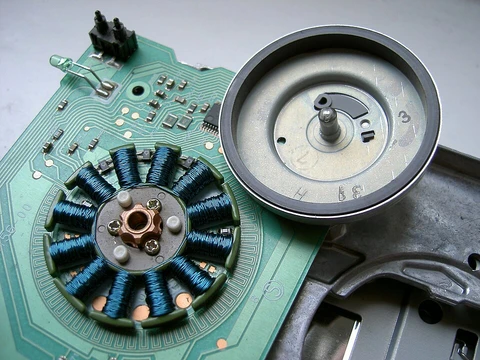
Linear motor
An unrolled electric motor producing linear force, used in industry and transport.

A linear motor is an electric motor that has had its stator and rotor 'unrolled', producing a linear force along its length rather than a rotational force. Unlike conventional motors arranged as a continuous loop, a linear motor's active section has ends. Linear motors are notable for their use in high-accuracy CNC machining, industrial robots, and maglev transportation, with a market valued at 1.8 billion USD in 2024.
- Market value 2024
- 1.8 billion USD
- Typical operation
- Lorentz-type actuator (F = I L × B)
- Major categories
- low-acceleration and high-acceleration
- Low acceleration example
- maglev trains
- High acceleration example
- coilgun
- Common designs
- LIM (linear induction motor) and LSM (linear synchronous motor)
Lore & Background
The history of linear electric motors can be traced back at least as far as the 1840s, to the work of Charles Wheatstone at King's College London, but his model was too inefficient to be practical. A feasible linear induction motor is described in U.S. patent 782,312 (1905 - inventor Alfred Zehden of Frankfurt-am-Main), for driving trains or lifts. The German engineer Hermann Kemper built a working model in 1935. In the late 1940s, Dr. Eric Laithwaite of Manchester University, later Professor of Heavy Electrical Engineering at Imperial College in London, developed the first full-size working model. In a single sided version the magnetic repulsion forces the conductor away from the stator, levitating it, and carrying it along in the direction of the moving magnetic field. He called the later versions of it magnetic river. The technologies would later be applied, in the 1984, Air-Rail Link shuttle, between Birmingham's airport and an adjacent train station.
Many designs have been put forward for linear motors, falling into two major categories: low-acceleration and high-acceleration. Low-acceleration linear motors are suitable for maglev trains and other ground-based transportation applications. High-acceleration linear motors are normally rather short, and are designed to accelerate an object to a very high speed; for example, see the coilgun. High-acceleration linear motors are used in studies of hypervelocity collisions, as weapons, or as mass drivers for spacecraft propulsion. They are usually of the AC linear induction motor (LIM) design with an active three-phase winding on one side of the air-gap and a passive conductor plate on the other side. However, the direct current homopolar linear motor railgun is another high acceleration linear motor design. The low-acceleration, high speed and high power motors are usually of the linear synchronous motor (LSM) design, with an active winding on one side of the air-gap and an array of alternate-pole magnets on the other side. These magnets can be permanent magnets or electromagnets. The motor for the Shanghai maglev train, for instance, is an LSM.
Types include brushless, brush, synchronous, induction, homopolar, tubular, and piezoelectric. Brushless linear motors are members of the Synchronous motor family, invented in the late 1980s by Anwar Chitayat at Anorad Corporation, now Rockwell Automation. Brushed linear motors were used prior to brushless ones and operate on a single phase. Synchronous designs control the rate of movement of the magnetic field to track the rotor; examples include coilguns and some maglev systems. Induction designs produce force by a moving linear magnetic field acting on conductors. Homopolar designs pass a large current through a metal sabot across sliding contacts fed by two rails. Tubular and piezoelectric designs are also noted.
Reader's Guide
Linear motors have significant legacy and impact across multiple fields. In industrial automation, they are widely used to actuate high-performance equipment, with brushless linear motors improving throughput and quality of manufacturing processes since their invention in the late 1980s. In transportation, linear motors are often used in maglev propulsion, as in the Japanese Linimo magnetic levitation train line near Nagoya, and independently of magnetic levitation in systems like the Bombardier Innovia Metro and Tokyo's Toei Ōedo Line. Similar technology is used in some roller coasters, though it remains impractical on street running trams. Vertical linear motors have been proposed for lifting mechanisms in deep mines, and they are often used on sliding doors of low floor trams such as the Alstom Citadis and Socimi Eurotram. Dual axis linear motors provide direct X-Y motion for precision laser cutting, automated drafting, and cable forming. Most linear motors in use are LIM or LSM, with LIM preferred for long runs and LSM for short runs. High-acceleration linear motors have been considered for weapons, amusement park launched roller coasters, and spacecraft propulsion as mass drivers. The United States Navy uses linear induction motors in the Electromagnetic Aircraft Launch System to replace steam catapults on future aircraft carriers. High-acceleration designs require large amounts of energy in very short periods, with one rocket launcher design calling for 300 GJ per launch in less than a second; short-term electrical energy storage methods such as capacitors or homopolar generators are used. Two basic designs exist: railguns and coilguns.
Did You Know?
- Linear motors are used by the millions in high accuracy CNC machining and industrial robots.
- The motor for the Shanghai maglev train is a linear synchronous motor (LSM).
The Unrolled Motor: Principle and Two Acceleration Families
A linear motor takes the familiar architecture of a rotary electric motor and essentially flattens it. Instead of a stator and rotor arranged in a circular loop, the components are stretched out along a straight axis, producing a translational force rather than torque. This geometric shift introduces a defining characteristic: the active section has physical endpoints, unlike conventional motors where the magnetic circuit wraps seamlessly around itself. The dominant operating principle is the Lorentz force, where the generated push is directly proportional to the current flowing through a conductor and the strength of the surrounding magnetic field. Despite the name, these machines are not confined to straight geometries. Designers split them into two broad families based on their acceleration profile. Low-acceleration variants are built for sustained, moderate-speed transport such as maglev rail systems, while high-acceleration types are typically compact and engineered to hurl a projectile or payload to extreme velocities in a very short distance.
Industrial Workhorses and a Multi-Billion-Dollar Market
By 2024, the global linear motor market had reached a valuation of 1.8 billion USD, a figure driven largely by their ubiquity in high-precision CNC machining centers and industrial robotic cells. In these settings, the motor is frequently configured with a stationary magnet stator and a moving coil, with a Hall-effect sensor on the rotor tracking the stator's magnetic flux while a stationary servo drive feeds current through a moving cable housed in a cable carrier. The brushless variant, a member of the synchronous motor family, was invented in the late 1980s by Anwar Chitayat at Anorad Corporation, now part of Rockwell Automation, and has since become the standard for high-performance positioning stages. Before that innovation, brushed linear motors dominated industrial automation, operating on single-phase current and offering lower upfront cost because they eliminated the need for three-phase servo drives and moving cables. The trade-off was persistent brush wear, which demanded regular maintenance. The shift to brushless designs measurably improved both throughput and part quality across manufacturing lines.
From Maglev Trains to Hypervelocity Mass Drivers
Linear motors power some of the most ambitious transportation and propulsion projects on Earth. The Shanghai maglev train relies on a linear synchronous motor design, pairing an active winding on one side of the air gap with an array of alternating-pole magnets—either permanent or electromagnet—on the other. Japan's Linimo line near Nagoya uses similar magnetic-levitation propulsion, while Bombardier's Innovia Metro systems and Tokyo's Toei Ōedo Line demonstrate that linear motors can drive conventional rail without levitation. The technology also appears in modified roller-coaster launches. At the opposite end of the acceleration spectrum, high-acceleration linear motors serve as coilguns, railguns, mass drivers for spacecraft, and tools for hypervelocity collision research. The AC linear induction motor, with a three-phase winding facing a passive conductor plate, is the most common architecture here, though the DC homopolar railgun represents an alternative. In the homopolar design, a large current passes through a metal sabot across sliding contacts fed by two rails, and the resulting magnetic field projects the sabot along those rails.
Two Centuries of Iteration: From Wheatstone to the Brushless Revolution
The intellectual roots of the linear motor stretch back to the 1840s, when Charles Wheatstone at King's College London demonstrated an early model. His device, however, was far too inefficient for practical use. A workable linear induction motor design appeared in U.S. Patent 782,312, filed in 1905 by Alfred Zehden of Frankfurt-am-Main, with the explicit intent of driving trains or lifts. German engineer Hermann Kemper followed with a functioning prototype in 1935. The breakthrough to full-scale operation came in the late 1940s through Dr. Eric Laithwaite, who held the Heavy Electrical Engineering chair at Imperial College London. His single-sided version used magnetic repulsion to both levitate and propel a conductor along the direction of the traveling field—a concept he poetically termed the "magnetic river." That lineage eventually fed into the 1984 Air-Rail Link shuttle connecting Birmingham's airport to its adjacent rail station. In the industrial realm, the late-1980s invention of the brushless linear motor by Chitayat marked another pivotal leap, replacing maintenance-heavy brushed designs and reshaping how precision manufacturing stages are built and operated.
Frequently Asked Questions
Who is Linear motor?
A linear motor is essentially a conventional electric motor whose stator and rotor have been flattened into a straight configuration, so it pushes or pulls along a single axis instead of spinning in a circle. Because of this unrolled geometry, its active section has defined endpoints rather than forming a continuous loop.
What are Linear motor's powers/role?
In practice, linear motors serve as the driving force behind high-precision CNC machining centers, industrial robotic arms, and maglev train systems. Their operation relies on the Lorentz-force principle, where current flowing through a conductor within a magnetic field generates a straight-line push or pull.
Why is Linear motor important?
Linear motors split into two broad families—low-acceleration types such as those powering maglev trains and high-acceleration types like coilguns—covering an enormous range of performance needs. This versatility makes them indispensable wherever smooth, contactless, high-precision linear motion is required.
What are Linear motor's main forms/designs?
The two most common architectural variants are the linear induction motor (LIM) and the linear synchronous motor (LSM), each suited to different speed and control requirements. Choosing between them depends on whether the application prioritizes robustness at lower speeds or tight synchronization at higher precision.
More in Electric Motors, Part 2 1-24
Spotted an error? Know more?
Reader corrections go straight into our review queue. Suggest an edit · How this site is sourced