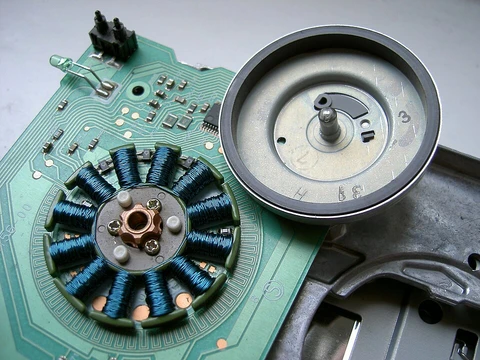
Slip ring
Electromechanical device for transmitting power and signals across rotating interfaces.

A slip ring, also called a collector ring or rotary electrical interface, is an electromechanical device that transmits power and electrical signals from a stationary to a rotating structure. It is notable for enabling continuous rotation in electromechanical systems while eliminating damage-prone wires dangling from movable joints, thereby improving mechanical performance and simplifying system operation.
- Alternative names
- rotary electrical interfaces, rotating electrical connectors, collectors, swivels, electrical rotary joints
- Common applications
- slip ring motors, AC generators, alternators, packaging machinery, cable reels, wind turbines, aerodrome beacons, rotating tanks, power shovels, radio telescopes, telemetry systems, heliostats, ferris
- Typical construction
- stationary graphite or metal brush rubbing on a rotating metal ring
- Mercury slip ring limitation
- mercury solidifies at approximately -40 °C
- Pancake slip ring characteristics
- greater weight and volume, greater capacitance and crosstalk, greater brush wear, collects wear debris on vertical axis, reduced axial length
Lore & Background
The basic principle of slip rings can be traced back to the late 19th century, when they were initially used in early electrical experiments and the development of electrical generators and motors. With the advent of the Industrial Revolution and increasing demand for electrical power, slip ring technology evolved, becoming essential in large-scale machinery such as turbines and generators that required continuous rotation.
A slip ring typically consists of a stationary graphite or metal brush that rubs on the outside diameter of a rotating metal ring. Additional ring/brush assemblies can be stacked along the rotating axis if more than one electrical circuit is needed. Either the brushes or the rings are stationary and the other component rotates. This simple design has been used for decades as a rudimentary method of passing current into a rotating device.
Variants include mercury-wetted slip rings, which use a pool of liquid metal for low resistance and stable connection but pose safety concerns due to mercury toxicity and are limited by temperature (mercury solidifies at approximately -40 °C). Pancake slip rings arrange conductors on a flat disc as concentric rings, offering reduced axial length but greater weight, capacitance, crosstalk, and brush wear. Wireless slip rings transfer power and data via magnetic fields, avoiding friction-based contact, but transmit less power than traditional contact-type slip rings.
Reader's Guide
The slip ring is a foundational component in electromechanical systems requiring continuous rotation while transmitting power or signals. Its significance lies in its ability to replace dangling wires that would otherwise bind or break, enabling reliable operation in applications ranging from wind turbines and cable reels to radio telescopes and ferris wheels. The article notes that slip rings are also called rotary electrical interfaces, collectors, swivels, or electrical rotary joints, and are commonly found in slip ring motors, AC generators, alternators, and packaging machinery. The design is simple—a stationary brush rubbing on a rotating metal ring—and has been used for decades. Variants address specific needs: mercury-wetted rings offer low resistance but pose toxicity and temperature constraints; pancake rings save axial length at the cost of other performance factors; wireless rings reduce maintenance but limit power transmission. The article emphasizes that slip rings are distinct from commutators, which are segmented and used in DC motors. They can be integrated with rotary unions to handle both electrical and fluid media. Overall, the slip ring's legacy is as a durable, adaptable solution for unlimited rotation in electrical machinery, with trade-offs among contact type, power capacity, and environmental resilience.
Did You Know?
- A slip ring allows unlimited rotations of the connected object, whereas a slack cable can only be twisted a few times before binding.
- Mercury-wetted slip rings use a pool of liquid metal but are limited by temperature, as mercury solidifies at approximately -40 °C.
- Wireless slip rings transfer power and data via magnetic fields, but traditional contact-type slip rings can transmit orders of magnitude more power in the same volume.
- The terms 'slip ring' and 'commutator' are not interchangeable; commutators are segmented and specialized for DC motors and generators.
More in Electric Motors, Part 2 1-24
Spotted an error? Know more?
Reader corrections go straight into our review queue. Suggest an edit · How this site is sourced