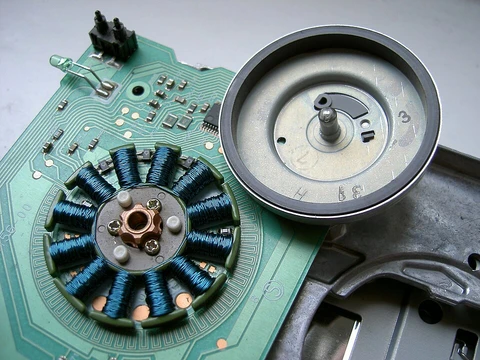
Shaft voltage
Shaft voltage causes bearing damage; mitigated by grounding or insulation.

Shaft voltage is an electrical potential that appears on the rotor shaft of electric motors and generators, arising from leakage, induction, or capacitive coupling with the motor windings. It is notable because the resulting currents can cause deterioration of motor bearings, leading to premature failure, particularly in systems powered by variable-frequency drives (VFDs) used in heating, ventilation, air conditioning, and refrigeration.
- Causes
- leakage, induction, capacitive coupling, non-symmetrical magnetic fields, external coupled machines, electrostatic charging from rubber belts
- Affected systems
- motors powered by variable-frequency drives, DC machines
- Counter measures
- insulation, alternate discharge paths, Faraday shield, insulated bearings, ceramic bearings, grounding brush, shaft grounding ring, shielded cable
- Typical line frequency
- 50–60 Hz
- Vfd switching components
- insulated gate bipolar transistors (IGBTs)
Lore & Background
Shaft voltage can be induced by non-symmetrical magnetic fields within the motor or generator itself, as well as by external sources such as other coupled machines or electrostatic charging from rubber belts rubbing on drive pulleys. Every rotor has some degree of capacitive coupling to the motor's electrical windings, but the effective inline capacitor acts as a high-pass filter, making coupling weak at typical 50–60 Hz line frequencies. However, many variable-frequency drives induce significant shaft voltage due to the kilohertz switching of insulated gate bipolar transistors (IGBTs) used in pulse-width modulation, which can cause high-frequency ground currents leading to sparks, arcing, electrical shocks, and bearing damage.
Reader's Guide
The significance of shaft voltage lies in its potential to cause accelerated bearing wear, particularly through a phenomenon called fluting induced by pulse-width modulated inverters. Counter-measures are well-documented: an electrostatic shielded induction motor (ESIM) reduces voltage below dielectric breakdown, stopping bearing degradation. Grounding brushes installed on the shaft provide a low-impedance path to the motor case, channeling current away from bearings. Shaft grounding rings, containing microfilaments or carbon brushes, similarly create a low-impedance pathway. Insulated bearings eliminate the ground path through the bearing but do not eliminate shaft voltage, which may then find another path through the driven load. Shielded cable with extremely low impedance between the VFD and motor improves high-frequency grounding. These techniques collectively address the problem without resolving the underlying voltage, instead managing its discharge paths to protect bearings and equipment.
Did You Know?
- Shaft voltage can be caused by electrostatic charging from rubber belts rubbing on drive pulleys.
- Insulated bearings do not eliminate shaft voltage; it will still find the lowest impedance path to ground.
- A shaft grounding ring may contain microfilaments that make direct contact with the shaft.
More in Electric Motors, Part 2 1-24
Spotted an error? Know more?
Reader corrections go straight into our review queue. Suggest an edit · How this site is sourced