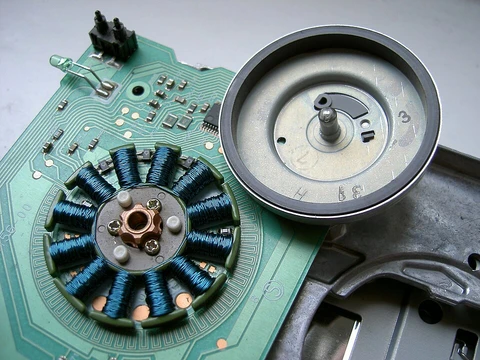
Servomotor
A closed-loop actuator for precise position, velocity, and acceleration control.

A servomotor is a type of rotary or linear actuator designed for precise control over position, speed, and acceleration within a mechanical system. It is a key component of a servomechanism, combining a motor with a position feedback sensor and a controller, which is often a specialized module. While the term "servomotor" does not refer to a specific motor class, it typically describes a motor suited for closed-loop control systems. These actuators are commonly found in robotics, CNC machinery, and automated manufacturing.
The core mechanism relies on closed-loop feedback. The controller receives a signal—either analog or digital—indicating the desired output shaft position. A position encoder on the motor provides real-time feedback on the actual position. The controller compares the desired and actual positions, generating an error signal that drives the motor to rotate until the error reaches zero, at which point the motor stops.
A basic servomotor uses a potentiometer for position sensing and bang-bang control, meaning the motor either runs at full speed or stops. This simple design is rarely used in industrial settings but is the foundation for inexpensive servos in radio-controlled models. More advanced servomotors employ an absolute rotary encoder to determine shaft position and infer speed. A variable-speed drive adjusts motor speed, and a PID control algorithm typically coordinates these elements to achieve faster, more precise positioning with minimal overshoot.
Compared to stepper motors, servomotors offer higher performance. Stepper motors have inherent position control through discrete steps, allowing open-loop operation without feedback, but they require initialization on startup—moving to a known position, like triggering an end limit switch (as seen in an inkjet printer). In contrast, a servomotor with an absolute encoder can immediately move to any commanded angle from any starting position. The lack of feedback in stepper motors limits their load capacity; missed steps under load cause positioning errors, often requiring recalibration. Servomotors add cost for their encoder and controller, but they optimize speed, power, and accuracy relative to the motor's capacity, making them advantageous in larger systems where the motor cost is significant.
- Mounting standards
- NEMA ICS 16 defines several flange mounting patterns and corresponding bolt circles in millimeters or inches
- Encoder types
- synchros, resistive potentiometers, rotary encoders (absolute or incremental), linear encoders
- Motor types
- brushed permanent magnet DC motors, electronically commutated brushless motors, AC induction motors, brushless AC motors with permanent magnet fields
- Control methods
- bang-bang control, PID control algorithm, digital servo drives with feedback loops
- Communication fieldbuses
- EtherCAT, CANopen, POWERLINK
Lore & Background
The first servomotors were developed with synchros as their encoders, with much work done in the development of radar and anti-aircraft artillery during World War II. Simple servomotors may use resistive potentiometers as position encoders, but these suffer from wear and electrical noise. Modern servomotors use rotary encoders, either absolute or incremental; absolute encoders can determine position at power-on but are more complicated and expensive, while incremental encoders are simpler, cheaper, and work at faster speeds.
A servomotor is a closed-loop servomechanism that uses position feedback to control its motion and final position. The input is a signal representing the desired position. The motor is paired with a position encoder; the controller compares measured position with desired position to generate an error signal, which causes the motor to rotate toward the desired position. Simple servomotors use position-only sensing via a potentiometer and bang-bang control, forming the basis of cheap servos in radio-controlled models. More sophisticated servomotors use an absolute encoder and a variable-speed drive, often with a PID control algorithm, for quicker and more precise positioning with less overshooting.
Servomotors are generally used as a high-performance alternative to stepper motors. Stepper motors have inherent output steps allowing open-loop position control, but require knowing position on power-up. A servomotor with an absolute encoder can immediately turn to any commanded angle regardless of initial position. The encoder and controller of a servomotor are an additional cost but optimize system performance. There has been increasing popularity in closed-loop stepper motors in recent years, which act like servomotors but have differences in software control.
Reader's Guide
Servomotors are notable as a high-performance alternative to stepper motors, offering precise closed-loop control of position, velocity, and acceleration. The article describes them as not a specific class of motor, but rather a motor suitable for use in a closed-loop control system, with various motor types employed depending on application: brushed permanent magnet DC motors for simplicity and low cost, electronically commutated brushless motors for small industrial servomotors, AC induction motors with variable frequency drives for large industrial servomotors, and brushless AC motors with permanent magnet fields for ultimate performance in a compact package. The encoder and controller add cost but optimize speed, power, and accuracy relative to the basic motor's capacity. Modern industrial servomotor systems employ digital servo drives that communicate over industrial fieldbuses such as EtherCAT, CANopen, and POWERLINK, allowing coordinated motion among multiple axes. Manufacturers including ADVANCED Motion Controls, Bosch Rexroth, and Yaskawa have developed such servo-drive families used in robotics, CNC machinery, and automated production equipment. Integrated servomotors combine the motor, driver, encoder, and associated electronics into a single package. The legacy of servomotors includes their development from synchro-based systems in World War II radar and anti-aircraft artillery to modern digital systems, and their continued role as a key component in precision motion control.
Did You Know?
- The first servomotors were developed with synchros as their encoders, with much work done during World War II for radar and anti-aircraft artillery.
- Simple servomotors using potentiometers and bang-bang control form the basis of cheap servos in radio-controlled models.
- Modern industrial servomotor systems communicate over fieldbuses such as EtherCAT, CANopen, and POWERLINK for coordinated multi-axis motion.
More in Electric Motors, Part 2 1-24
Spotted an error? Know more?
Reader corrections go straight into our review queue. Suggest an edit · How this site is sourced