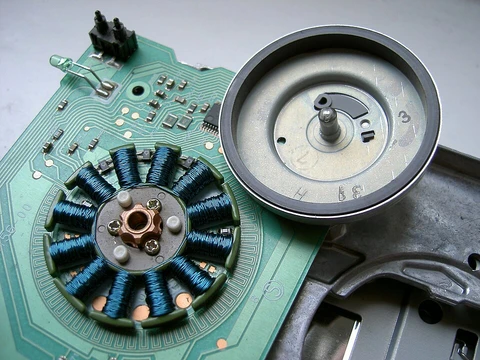
Series wound motor
Series wound motors offer high starting torque and compact design.

A series wound motor is a type of electric motor in which the stator's field coils are wired in series with the rotor windings via a commutator. When modified to run on alternating current, it is known as a universal motor, capable of operating on either AC or DC power. This works because the current in both the field coils and the armature reverses polarity in sync with the AC supply, so the resulting mechanical force consistently drives rotation in one direction, determined by the commutator and field coil polarity.
These motors offer high starting torque, high speed, and a lightweight, compact design. They are common in portable power tools, household appliances, and other equipment. Control is relatively simple, using electronic or electromechanical methods like tapped coils. However, the commutator’s brushes wear over time, making them less suitable for continuous use, and the commutator also causes significant acoustic and electromagnetic noise.
Not all series wound motors work well on AC. An ordinary DC series motor would run poorly on AC. The universal motor is modified with a compensating winding, laminated pole pieces (instead of solid ones), and an armature with more coils and plates but fewer windings per coil, which reduces inductance.
Efficiency is generally low: around 30% for small motors and up to 70–75% for larger ones. Despite this, they can run at speeds well above the AC mains frequency—often 4,000 to 16,000 RPM, and over 20,000 RPM—unlike AC synchronous or induction motors, which are limited by line frequency (e.g., 3,600 RPM on 60 Hz).
Under increased load, the motor slows down, and current rises. Because the same current flows through both armature and field windings, torque increases with the square of the current. If stalled, current is limited only by winding resistance, producing very high torque but risking overheating. At startup, counter-electromotive force (EMF) is zero, so armature resistance alone limits current, which can be very large. Additional series resistance may be needed initially, then gradually cut out as speed builds. The speed-torque curve is nearly a straight line between stall torque and no-load speed, suiting large inertial loads.
As speed increases, rotor inductance shifts the ideal commutating point.
- Efficiency range
- 30% for smaller motors, up to 70–75% for larger ones
- Typical speed range
- 4000–16000 RPM, can exceed 20,000 RPM
- Power range common
- less than 1000 watts in domestic appliances
- Stall torque characteristic
- torque rises in proportion to the square of the current
Lore & Background
The series wound motor is the basis for the universal motor, which can operate on either AC or DC power. When an ordinary series-wound DC motor is connected to an AC supply, it runs very poorly; the universal motor is modified with a compensating winding, laminated pole pieces, and an armature with more coils and plates to reduce inductance. These modifications allow the motor to operate well on AC because the current in both field coils and armature alternates synchronously with the supply, producing a consistent direction of rotation.
Series wound motors respond to increased load by slowing down, with current and torque rising proportionally to the square of the current. At stall, current is limited only by winding resistance, and torque can be very high, risking overheating. The speed-torque characteristic is an almost perfectly straight line between stall torque and no-load speed, suiting large inertial loads. As speed increases, counter-EMF reduces voltage across the field windings, causing field weakening and allowing the motor to have no theoretical maximum speed for a given voltage.
Universal motors are commonly used in portable power tools and household appliances such as blenders, vacuum cleaners, and hair dryers. They are lightweight and compact, but relatively inefficient and noisy due to the commutator and brushes. The commutator requires maintenance and produces electromagnetic interference, making these motors best suited for intermittent use.
Reader's Guide
The series wound motor's significance lies in its ability to provide high starting torque and high speed in a compact package, characteristics that are valuable for portable power tools and household appliances. The article notes that universal motors, which are series wound, can run at speeds well above mains frequency, unlike AC synchronous or induction motors limited to 3600 RPM on 60 Hz supply. This allows them to be lightweight and powerful, though they are relatively inefficient, with efficiency ranging from 30% for smaller motors to 70–75% for larger ones. The series wound design also enables easy speed control via thyristor circuits or tapped field coils. However, the commutator and brushes lead to short life, noise, and electromagnetic interference, limiting these motors to intermittent-duty applications. The article also mentions that shunt winding was experimented with in the late 19th century but was impractical due to commutation problems, and that repulsion-start wound-rotor motors were used historically for high starting torque but added complexity. Overall, the series wound motor's legacy is its dominance in applications requiring high speed and torque in a small, lightweight form factor, despite its drawbacks in efficiency and maintenance.
Did You Know?
- Universal motors can run at speeds over 20,000 RPM, far exceeding the 3600 RPM limit of AC induction motors on 60 Hz supply.
- The efficiency of universal motors ranges from about 30% for smaller motors to 70–75% for larger ones.
- If a universal motor is operated with no significant mechanical load, it may over-speed and suffer damage.
More in Electric Motors, Part 2 1-24
Spotted an error? Know more?
Reader corrections go straight into our review queue. Suggest an edit · How this site is sourced