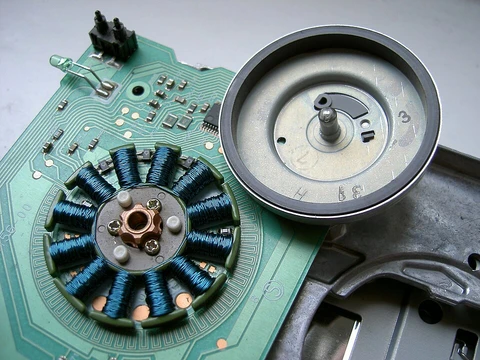
Sawyer motor
Multi-coordinate drive for independent planar movements.

A Sawyer motor, also called a planar motor or area drive, is a type of multi-coordinate drive that allows for several independent movements within a single plane. Its key feature is that it can move goods along any path to any destination. In industrial settings, this motor often takes the place of cross tables in machine tools. The motor is named after its inventor, Bruce Sawyer, who created it in 1968.
The motor’s history begins with Bruce Sawyer, an American engineer who filed a patent for a "Magnetic Positioning Device" in 1966, which was granted in 1968. Later, in 2012, Xiaodong Lu and Irfan-Ur-Rab Usman at the University of British Columbia developed and patented a long-stroke magnetically levitated planar motor design. The first commercial product using this technology was launched by Planar Motor Inc. in 2017.
- Inventor
- Bruce Sawyer
- Patent year
- 1968
- Patent application year
- 1966
- Patent title
- Magnetic Positioning Device
- Alternative names
- planar motor, area drive
Lore & Background
The Sawyer motor traces back to Bruce Sawyer, a U.S. engineer who applied for a patent for a 'Magnetic Positioning Device' in 1966, confirmed in 1968. The forcer (mover) contains two sets of windings oriented 90° to each other, which interact with a magnetically permeable toothed platen below to produce X and Y thrust via a stepping or servo principle, levitated a few micrometers above the platen surface by a pressurized air bearing.
Sawyer motors are commonly used in semiconductor and electronics processing and inspection machinery. Since there is no mechanical connection between the stator and the mover, they are characterized by minimal maintenance and cleaning requirements. The cover of the base surface can be made of stainless steel, glass, or plastic to protect it from leakage of liquids or cleaning processes.
Reader's Guide
The Sawyer motor's significance lies in its ability to replace cross tables in machine tools, offering multi-coordinate movement in a single plane without mechanical contact. This design reduces maintenance and cleaning needs, as there is no mechanical connection between stator and mover. Its application in semiconductor and electronics processing and inspection machinery highlights its precision and reliability. The motor's operating principle—using two sets of windings oriented 90° to each other interacting with a toothed platen—enables stepping or servo control, with levitation provided by a pressurized air bearing. The legacy of the Sawyer motor includes its naming after Bruce Sawyer, who patented the concept in 1968. Later developments, such as the magnetically levitated planar motor architecture by Xiaodong Lu and Irfan-Ur-Rab Usman at UBC in 2012, built upon this foundation, with Planar Motor Inc. commercially launching a product in 2017. The motor's ability to transport goods along any path to any location, combined with minimal maintenance, makes it a key component in automated handling systems.
Did You Know?
- The Sawyer motor is named for Bruce Sawyer, who invented it in 1968.
- The mover is levitated a few micrometers above the platen by a pressurized air bearing.
More in Electric Motors, Part 2 1-24
Spotted an error? Know more?
Reader corrections go straight into our review queue. Suggest an edit · How this site is sourced