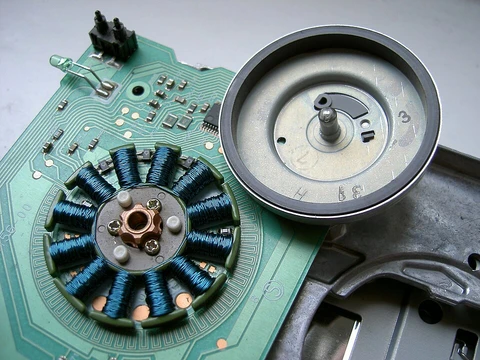
Repulsion motor
Single-phase AC motor using brush-shifting for speed and torque control.

A repulsion motor is a type of single-phase AC electric motor that operates on the principle of repulsion between two magnetic fields. It was formerly used as a traction motor for electric trains, such as the SR Class CP and SR Class SL electric multiple units, but has since been superseded by other motor types. The motor features a stator connected directly to the AC supply and a rotor connected to a commutator and brush assembly similar to that of a DC motor, with no electrical connection between stator and rotor; rotor current is generated by induction.
- Voltage limit
- Most commutator motors are limited to about 1,500 volts; repulsion motors can be used at higher voltages because the rotor circuit is not electrically connected to the supply.
- Maximum torque brush shift
- 45 degrees
- Starting torque atkinson
- about 2.5 times full-load torque with twice full-load current
- Speed range atkinson
- from 75% below synchronous speed to 10% above
Lore & Background
The repulsion motor was developed as a single-phase AC motor that could provide high starting torque and variable speed without complex electronics. Its construction includes a stator and rotor with no direct electrical connection; rotor current is induced, and the rotor winding connects to a commutator with a short-circuited pair of movable brushes. By changing the angular position of the brushes, the motor can be started, stopped, reversed, and its speed varied. The principle relies on repulsion between magnetic fields: when the brush axis is displaced at an angle to the magnetic axis, a net voltage induces current in the armature, creating rotor poles that are repelled by the stator poles, causing rotation. The direction of rotation depends on whether the brushes are shifted clockwise or counter-clockwise from the main magnetic axis. Starting torque is determined by the brush shift angle, with maximum torque at 45 degrees. Several types were developed to match torque/speed characteristics to specific services: the Elihu Thomson (original), Deri (two pairs of brushes for fine speed control), Latour-Winter-Eichberg (compensated, with torque/speed like a series-wound motor), Atkinson (two stator coils, speed control from 75% below to 10% above synchronous speed), and repulsion-start induction-run (started as repulsion motor, then brushes lifted and commutator bars short-circuited to act as a squirrel-cage induction motor).
Reader's Guide
The repulsion motor's significance lies in its ability to provide variable speed and high starting torque from a single-phase AC supply, using only brush-shifting for control—no complex electronics. It was notably used as a traction motor for electric trains (e.g., SR Class CP and SL multiple units) and in applications such as high-speed lifts, electrical locomotives, fans, pumps, printing presses, textile machines, and film winding machines, where smooth manual speed and direction adjustment was achieved without complicated circuitry. Its legacy includes being superseded by other motor types, but it represents an early solution for AC motor control. The motor's ability to operate at higher voltages than typical commutator motors (due to no electrical connection between rotor and supply) was a key advantage. The development of variants like the Deri, Latour-Winter-Eichberg, Atkinson, and repulsion-start induction-run motors shows an effort to tailor torque/speed characteristics to specific needs. The repulsion-start induction-run type, in particular, combined high starting torque with the simplicity of an induction motor at running speed.
Did You Know?
- The rotor circuit is not electrically connected to the supply, allowing repulsion motors to be used at higher voltages than most commutator motors.
- Maximum torque is obtained from a brush shift of 45 degrees.
- The Atkinson motor can achieve speed control from 75% below synchronous speed to 10% above.
More in Electric Motors, Part 2 1-24
Spotted an error? Know more?
Reader corrections go straight into our review queue. Suggest an edit · How this site is sourced