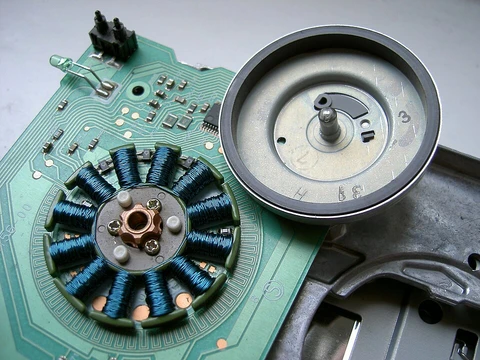
Radial flux motor
Radial flux motors generate flux perpendicular to the rotation axis.

A radial flux motor produces magnetic flux that moves perpendicular to its rotational axis, unlike an axial flux motor where the flux runs parallel. In its design, components are arranged along the sides, with copper windings fitted into slots. A conventional radial flux brushless DC motor uses a rotor with permanent magnets inside a stator. The stator includes a yoke that supports teeth, each individually wrapped with electromagnetic coils; these teeth act as alternating magnetic poles. Torque is generated when the rotor's magnetic poles interact with the teeth's alternating flux. Using grain-oriented steel in these motors is difficult because the magnetic flux path has a curved shape. For permanent magnet versions, radial flux motors generally require less magnet material, but this results in lower torque density. The relationship between torque, speed, and mechanical power is given by the formula P = T × ω, where power is in watts, torque in newton-metres, and speed in radians per second. Regarding thermal management, radial flux permanent magnet motors produce more heat than induction motors while offering higher power, so this heat must be removed through conduction, air cooling, or water cooling, depending on the application.
- Flux direction
- perpendicular to the axis of rotation
- Rotor position
- inside the stator
- Rotor type
- permanent magnets
- Stator components
- yoke with teeth individually wrapped with electromagnetic coils
- Torque density
- lower than axial flux motors
- Magnet material usage
- less than axial flux motors
Lore & Background
A traditional radial flux BLDC motor places a rotor made of permanent magnets inside the stator. The stator contains a support known as a yoke, which is outfitted with 'teeth', individually wrapped with electromagnetic coils. The teeth function as alternating magnetic poles, and the rotor’s magnetic poles interact with the alternating magnetic flux of the teeth to produce torque.
The use of grain-oriented steel in radial flux motors is challenging due to the curving geometry of the magnetic flux path. Radial flux motors typically use less permanent magnet material, at the cost of lower torque density.
While permanent magnet radial flux motors offer considerably higher power than induction motors, they produce more heat, which must be removed via conduction or air/water cooling, depending on application requirements.
Reader's Guide
The radial flux motor is significant as a foundational design in electric motor technology, characterized by its flux direction perpendicular to the axis of rotation. Its traditional construction places a permanent magnet rotor inside a stator with a yoke and individually wrapped teeth that act as alternating magnetic poles. This design uses less permanent magnet material than axial flux motors, resulting in lower torque density. The curved magnetic flux path makes the use of grain-oriented steel challenging. In terms of performance, radial flux permanent magnet motors produce higher power than induction motors but generate more heat, necessitating thermal management through conduction or air/water cooling. The relationship between torque, speed, and power is given by P = T * ω, where P is mechanical power, T is torque in Newton-metres, and ω is speed in radians/second. The legacy of the radial flux motor lies in its widespread application and the trade-off between material efficiency and torque density.
Did You Know?
- Radial flux motors generate flux perpendicular to the axis of rotation.
- The stator's teeth are individually wrapped with electromagnetic coils and function as alternating magnetic poles.
More in Electric Motors, Part 2 1-24
Spotted an error? Know more?
Reader corrections go straight into our review queue. Suggest an edit · How this site is sourced