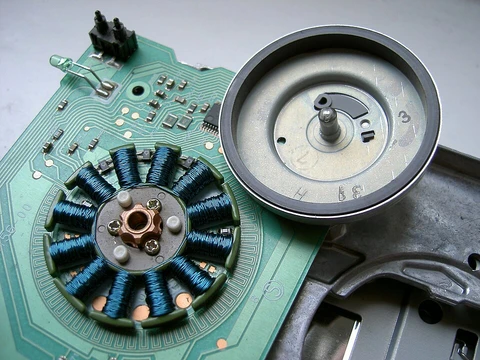
Piezoelectric motor
Piezoelectric motors use crystal distortion for precise motion.

A piezoelectric motor, also known as a piezo motor, is an electric motor that operates through the shape change of a piezoelectric material when an electric field is applied, a phenomenon called the converse piezoelectric effect. An electrical circuit generates acoustic or ultrasonic vibrations in the material—commonly lead zirconate titanate, and sometimes lithium niobate or other single-crystal materials—which can produce either linear or rotary motion depending on the motor's design. These motors typically rely on a cyclic stepping motion, allowing the crystal oscillations to create movement of any size, unlike most other piezoelectric actuators, which are limited by the static strain that can be induced in the material.
The industry for growing and shaping piezoelectric crystals is well-established, producing very uniform and consistent distortions for a given voltage. This consistency, combined with the tiny scale of those distortions, enables the motor to make extremely fine steps, with manufacturers claiming precision down to the nanometer. The crystals also respond and distort very quickly, allowing steps to occur at frequencies up to 5 MHz, which yields a maximum linear speed of about 800 mm per second, or nearly 2.9 km/h.
A distinctive feature of piezoelectric motors is their ability to function in strong magnetic fields, making them useful in applications where traditional electromagnetic motors cannot be used, such as inside nuclear magnetic resonance antennas. Their maximum operating temperature is limited by the Curie temperature of the piezoelectric ceramic, which can exceed +250 °C. Key advantages include high positioning precision, stable position when unpowered, and the ability to be made very small or in unusual shapes, like thin rings. Common uses include focusing systems in camera lenses and precision motion control in specialized fields like microscopy.
**Resonant motor types**
**Ultrasonic motor** Ultrasonic motors differ from other piezoelectric motors primarily in their use of resonance to amplify the vibration of the stator that contacts the rotor. Two main methods control friction at the stator-rotor interface: traveling-wave vibration and standing-wave vibration. Early practical motors from the 1970s, such as those by Sashida, used standing-wave vibration with angled fins to create unidirectional rotation.
- Maximum linear speed
- approximately 800 mm per second, or nearly 2.9 km/h
- Step frequency
- upwards of 5 MHz
- Precision
- nanometer scale
- Maximum operating temperature
- can exceed +250 °C
- Common materials
- lead zirconate titanate, occasionally lithium niobate or other single-crystal materials
Lore & Background
The growth and forming of piezoelectric crystals is a well-developed industry, yielding very uniform and consistent distortion for a given applied potential difference. This, combined with the minute scale of the distortions, gives the piezoelectric motor the ability to make very fine steps. Manufacturers claim precision to the nanometer scale. High response rate and fast distortion of the crystals also let the steps happen at very high frequencies—upwards of 5 MHz. This provides a maximum linear speed of approximately 800 mm per second, or nearly 2.9 km/h.
A unique capability of piezoelectric motors is their ability to operate in strong magnetic fields. This extends their usefulness to applications that cannot use traditional electromagnetic motors—such as inside nuclear magnetic resonance antennas. The maximum operating temperature is limited by the Curie temperature of the used piezoelectric ceramic and can exceed +250 °C.
The main benefits of piezoelectric motors are the high positioning precision, stability of position while unpowered, and the ability to be fabricated at very small sizes or in unusual shapes such as thin rings. Common applications of piezoelectric motors include focusing systems in camera lenses as well as precision motion control in specialised applications such as microscopy.
Reader's Guide
Piezoelectric motors are notable for their ability to achieve nanometer-scale positioning precision and operate at very high frequencies, enabling fine motion control in specialized applications. Their capacity to function in strong magnetic fields makes them indispensable in environments where traditional electromagnetic motors cannot be used, such as inside nuclear magnetic resonance antennas. The motors also offer stability of position while unpowered and can be fabricated in very small sizes or unusual shapes like thin rings, expanding their utility in compact devices. Common applications include focusing systems in camera lenses and precision motion control in microscopy. The article describes several types of piezoelectric motors, including inchworm motors, stepper and slip-stick motors, and ultrasonic motors (further categorized into standing wave and travelling wave motors). Ultrasonic motors differ by using resonance to amplify vibration, and early practical versions in the 1970s by Sashida used standing-wave vibration, while later designs by Sashida and researchers at Matsushita, ALPS, Xeryon and Canon used traveling-wave vibration for bi-directional motion with better efficiency and less wear. The first U.S. patent disclosing a vibrationally-driven motor may be U.S. Pat. No. 3,184,842 (Maropis, 1965), and the first practical piezomotors were designed and produced by V. Lavrinenko in Piezoelectronic Laboratory, starting 1964, Kyiv Polytechnic Institute, USSR.
Did You Know?
- Piezoelectric motors can achieve precision to the nanometer scale.
- They can operate in strong magnetic fields, such as inside nuclear magnetic resonance antennas.
- The maximum operating temperature can exceed +250 °C, limited by the Curie temperature of the ceramic.
- The first practical piezomotors were designed and produced by V. Lavrinenko starting 1964 at Kyiv Polytechnic Institute, USSR.
More in Electric Motors, Part 2 1-24
Spotted an error? Know more?
Reader corrections go straight into our review queue. Suggest an edit · How this site is sourced